Translate this page from English into :

Thursday, July 31, 2008

Deutsche Bank Profit Falls 64%, Less Than Analyst Estimates, on Writedowns

From Bloomberg, today, July 31, 2008:
    Deutsche Bank AG, Germany's largest bank, said second-quarter profit fell 64 percent as 2.3 billion euros ($3.6 billion) in writedowns led to a second straight loss at its securities unit.
    Net income dropped to 649 million euros, or 1.27 euros a share, from 1.78 billion euros, or 3.60 euros, a year ago, the Frankfurt-based bank said on its Web site today. Earnings beat the 491 million-euro median estimate of 19 analysts surveyed by Bloomberg after a year-earlier tax charge wasn't repeated.
    Chief Executive Officer Josef Ackermann said he ``remains cautious'' after the investment bank posted a 311 million-euro pretax loss following markdowns on mortgage securities, loans and debt backed by bond insurers. Deutsche Bank sidestepped the worst of the subprime contagion, which led to record losses and capital raisings at UBS AG and Merrill Lynch & Co.
Write Reuters wrote:
    Deutsche Bank's writedowns swell beyond $11 bln. Deutsche Bank made a further $3.6 billion of writedowns in the second quarter of the year, taking its bill from the global financial crisis beyond $11 billion.
    Germany's flagship financier had originally been seen as one of the winners in the chaos but as the problems on global markets continue, Deutsche Bank is being sucked ever deeper into trouble.
    The group's pretax profit fell in the second quarter to 642 million euros ($1 billion), it said on Thursday -- a fraction of the 2.7 billion euros it made a year earlier as writedowns ate into profits.
    Deutsche Bank said it had made 1 billion euros of writedowns in residential mortgage-backed securities and a further 500 million linked to monoline insurers. Commercial real estate investments had cost it 300 million euros.

Related Posts :
  1. Writedowns of Largest Banks Reach $274bn
  2. Bridgewater warns Bank losses from credit crisis may run to $1,600bn
Please Note!
This is generally never true. Before buying or selling any stock you should do your own research and reach your own conclusion. See my Disclaimer on the bottom for more information.

You are welcome to republish this article, or any portion thereof.
Please, cite the actual/original source. I would be grateful if you could link back.


Stumble Upon Toolbar Add to Technorati Favorites Bookmark and Share

Wednesday, July 30, 2008

Stock Picks today, July 30, 2008

Long to these oversold stocks :
  1. Giant Interactive Group Inc. (GA)
  2. Silver Wheaton Corp. (SLW)
  3. Solitario Exploration & royalty Corp. (XPL)

Short to these overbought stocks :
  1. Home Bancshares, Inc. (HOMB)
  2. Plum Creek Timber Co. (PLC)
  3. Waste Services Inc. (WSII)
  4. Arbour Realty Trust, Inc. (ABR)
  5. Alexion Pharmaceuticals, Inc. (ALXN)
  6. Concur Technologies, Inc. (CNQR)

Related Posts :

Please Note!
This is generally never true. Before buying or selling any stock you should do your own research and reach your own conclusion. See my Disclaimer on the bottom for more information.

You are welcome to republish this article, or any portion thereof.
Please, cite the actual/original source. I would be grateful if you could link back.


Stumble Upon Toolbar Add to Technorati Favorites Bookmark and Share

Writedowns of Largest Banks Reach $274bn

By Julia Kollewe
http://www.guardian.co.uk
Tuesday, July 29, 2008

Merrill Lynch shocked the market last night when it moved to raise fresh funds to shore up its battered balance sheet, sold $11.1bn (£5.6bn) of toxic mortgage securities and took a fresh $5.7bn mortgage-related writedown — just 10 days after it slipped into the red and unveiled writedowns of $9.4bn.

As the first anniversary of the credit crunch approaches, total writedowns announced by the world's largest banks have ballooned to $274bn. Some estimates suggest that the total losses, related to US sub-prime mortgages and leveraged loans, could hit $1 trillion.

Citigroup(C) $47bn

Merrill Lynch(MER) $46bn

UBS $37bn

HSBC(HBC) $25bn

Lehman Brothers(LEH) $17bn

Morgan Stanley(MS) $12bn

Royal Bank of Scotland(RBS) $11.8bn

Deutsche Bank(DB) $11bn

Credit Agricole(ACA) $7bn

Bank of America(BAC) $7bn

Wachovia Bank(WB) $6bn

Societe Generale(GLE) $6bn

Credit Suisse(CS) $6bn

JP Morgan(JPM) $4.9bn

Natixis(KN) $4.3bn

Goldman Sachs(GS) $3.8bn

Barclays(BCS) $3.8bn

Bear Stearns(BSC) $3.2bn

BayernLB $3bn

IKB $2.6bn

Lloyds TSB(LYB) $2.2bn

Heritage Financial Group(HBOS) $2bn

Washington Mutual(WM) $1.6bn

UniCredit(BIT:UCG) $1.6bn

WestLB AG $1.5bn

Commerzbank AG(ADR) (OTC:CRZBY) $1.1bn

Related Posts :
  1. Wachovia Bank(WB) Needs to Raise $15 Billion in Capital
  2. Merril Lynch(MER) Takes A New $5.7 bn Pre-tax Write-Down in the Third Quarter
  3. Bank Collapse Update: $400 Billion of Writeoffs So Far, $600 Billion to Go (WM, WB, JPM, FNM, FRE)
  4. Bridgewater warns Bank losses from credit crisis may run to $1,600bn
Please Note!
This is generally never true. Before buying or selling any stock you should do your own research and reach your own conclusion. See my Disclaimer on the bottom for more information.

You are welcome to republish this article, or any portion thereof.
Please, cite the actual/original source. I would be grateful if you could link back.


Stumble Upon Toolbar Add to Technorati Favorites Bookmark and Share

Tuesday, July 29, 2008

Forget Oil, the New Bubble Burst is Agriculture


Today, July 29, agriculture futures traded mostly lower as a warm, dry weather pattern settled into the Midwest, boosting crops heading into the important fall harvest. But as shown on the table below, corn futures rose 12.25 cents to settle at $6.135 a bushel on the CBOT.


A rush to cash in on ethanol has slowed as soaring corn prices squeeze profit margins for producers of the alternative fuel. At a recent high of $7 per bushel, the corn used to make ethanol has tripled in price since many plants were built two years ago, and some facilities have been shut down or put on hold.

Chris Hurt, a professor of agricultural economics in the heart of the Corn Belt at Indiana's Purdue University, on July 15, said, “Corn is now more expensive than it was when many of the ethanol plants were built. Two years ago, when many of the plants were being built, corn was $2 per bushel, making ethanol production so profitable, that in some cases a plant could be paid off in just 6 months”.

Since mid-2007, U.S. corn prices have increased as domestic feedgrain supply prospects have caught up with demand. As a result, ethanol production gross profit margins were reduced in the later part of 2007 to the degree that almost no new ethanol plants were announced or planned in the U.S. Actually, ethanol plants on the drawing boards were cancelled before construction could begin, and work was halted on a few plants that were already under construction.

Now, operating ethanol plants are feeling the pain of declining profitability if not outright losses. The charts below shows corn ethanol profit margin.

Source: Daniel O’Brien and Mike Woolverton, Extension Agricultural Economist, K-State Research and Extension

The Washington Times reported on July 17, that high corn prices are threatening the U.S. ethanol industry’s ability to reduce the country’s foreign oil independence. Analysts are predicting that corn prices will stay high through next year even though the number of crops planted has drastically increased.

Beside due to Midwest flood, raising corn prices is also driven by higher fertilizer prices. According to State Agriculture Secretary Roger L on http://www.cattlenetwork.com, he said the cost of growing an acre of corn had increased by about 30 percent this year, due primarily to higher diesel fuel, land rental and fertilizer prices. A ton of potash fertilizer that cost about $600 last year rose to about $1,000 this year.

When all costs are included, it cost about $500 to plant an acre of corn this year, up from about $280 last year. Things don't always turn out the way farmers expect, state farmers changing their minds since March and planting less corn. Their decision can be influenced by weather. In March, Maryland farmers announced plans to plant 490,000 acres of corn this year. That would have been a decline of 9.26 percent from the 2007 planting, the largest in 15 years.

Even Brazilian sugarcane based ethanol is not excluded from squeezing profit margin. According to Forbes on July 7, Brazilian sugar and ethanol producers' profitability has been hit not only by a surge in production costs such as the price of fertilizer which has doubled in the past year but also a strong appreciation of the local currency against the dollar.


Costs to produce anhydrous ethanol, which in Brazil is made from sugar cane, rose 20 percent in reais from February 2007 through April 2008, according to Datagro analysts, who forecasts a new increase until July. "The real problem is not the price, but costs and the currency exchange," said Luiz Guilherme Zancaner, president of Unialco sugar and ethanol group. He said fertilizer prices rose 64 percent from a year ago. Rising fertilizer and diesel prices, and growing labor costs hit mills' results hard in the past year or so, Antonio de Padua Rodrigues, technical director at the Sugar Cane Industry Association, said.

According to BusinessWire on June 2006, A Comprehensive research report on the American corn ethanol industry written by Russell Hasan on 2006, entitled “A Research Report on Ethanol Investment: Golden Opportunity or Fool's Gold?”, cautions investors about the danger of the ethanol bubble bursting in the short term, but reaches the conclusion that there are long-term opportunities for intelligent ethanol investors.

The report reaches the following conclusions:
  1. The ethanol boom has been engineered by mandatory usage requirements, high tax incentives and prohibitive import tariffs. The domestic corn ethanol industry will have trouble in a free market economy.
  2. Domestic corn ethanol production capacity will surpass mandated consumption levels soon, bringing about pressure on price.
  3. Like the first ethanol boom and bust of the Carter era, this boom is also vulnerable to fickle political will. This is dangerous because profit margins will shrink if government incentives are removed.
  4. Ethanol is more expensive and gets less mileage than gasoline. Consumer acceptance of E85 is suspect.
  5. Brazilian sugarcane ethanol is considerably cheaper and more efficient than corn ethanol. Reprocessed Brazilian sugarcane ethanol can enter America from Caribbean and CAFTA countries without paying the tariff.
  6. There is simply not enough corn to make large-scale corn ethanol viable, a claim that former Fed Chairman Alan Greenspan agreed with recently. Tight corn supply will put pressure on producers.
  7. Corn ethanol is likely to be replaced by cellulosic ethanol, which will be cheaper and cleaner than corn ethanol.
  8. Ethanol stocks follow oil prices. At the first sign of the softening of crude oil prices, institutional investors will bail out, leaving individual investors to take losses.
  9. Ethanol has reached tabloid stardom because of celebrity endorsements from Bill Gates, Ted Turner and Richard Branson. Celebrities have been offered advantageous investment terms that the average investor will not receive.
  10. The ethanol craze contains a lot of fool's gold, but there are still golden opportunities for investors who understand the industry.
An excerpt from the report follows:
    "It is our firmly held belief that the next great fortunes are going to be made in the alternative energy industry. Unfortunately, corn ethanol is not a simple opportunity of this kind, for the reasons described above. Although this industry may be profitable for the next five years, it is highly probable that the American corn ethanol industry, except possibly for small co-ops, will face strong pressure from corn supply concerns, sugarcane ethanol imports from Brazil, and new cellulosic ethanol technology in five to ten years. Competition from gasoline will be brutal if oil prices fall, and profit margins will suffer fatal blows if government incentives like the tariff are removed. Companies overwhelmed by these factors will probably cause the ethanol bubble to burst by the end of the decade. Hopefully, the major American ethanol producers will find ways to weather this storm, particularly by exploiting new cellulosic technologies or securing cheap corn supplies, in order to achieve long-term profitability."

Related Posts :
  1. Dennis Gartman Predicts Corn Ethanol Producers Bankruptcy
  2. Agrium(AGU) is Temporary Oversold
  3. World Food Shortage and the Ethanol Bubble
Please Note!
This is generally never true. Before buying or selling any stock you should do your own research and reach your own conclusion. See my Disclaimer on the bottom for more information.

You are welcome to republish this article, or any portion thereof.
Please, cite the actual/original source. I would be grateful if you could link back.



Stumble Upon Toolbar Add to Technorati Favorites Bookmark and Share

Short Ideas Today, July 29, 2008

Tractor Supply Corp.(TSCO) is currently overbought and ready to be shorted for a short term trading. I expect it will be down to around 35.


The another is Energy South, Inc. (ENSI).


Related Posts :

Please Note!
This is generally never true. Before buying or selling any stock you should do your own research and reach your own conclusion. See my Disclaimer on the bottom for more information.

You are welcome to republish this article, or any portion thereof.
Please, cite the actual/original source. I would be grateful if you could link back.


Stumble Upon Toolbar Add to Technorati Favorites Bookmark and Share

Wachovia Bank(WB) Needs to Raise $15 Billion in Capital


According to ClusterStock.com on July 28, Wachovia Bank(WB) may offload WB's securities division, which consists of A.G. Edwards and Evergreen Mutual funds. Other supposed targets for the axe are the bank's Northeast and Texas retail branches. Wachovia's capital management unit could fetch $10 billion to $15 billion, CreditSights Inc. analyst David Hendler said in a July 22 report, based on annualized earnings of about $1 billion.

While Steven Syre, A The Boston Globe's Columnist, on July 29, wrote:
    Banks in trouble need to raise money to get out of the jam. First they try to sell more shares of the company. If that fails, they unload assets or business units. Banks that really get desperate will sell anything that isn't nailed to the floor.

    A number of banks facing serious problems are said to be considering sales of their money management arms. But most, like Fifth Third Bancorp., KeyCorp, and National City Corp., own relatively small and undistinguished investment arms.

    Not so at Wachovia Corp. The troubled banking giant owns Evergreen Investments, the well-known Boston firm that manages $246 billion in mutual funds and other accounts. Wachovia also owns a big retail brokerage operation. Could they be on the block?

    This became a serious question last week, when Wachovia reported the worst loss in company history. New chief Bob Steel told analysts he would sell noncore assets to plug the hole. Steel never did say what he considered a core asset, but promised a review would be finished in months.

    Wachovia needs to raise some serious money. Even the company estimates it won't be able to collect on about $9 billion worth of adjustable rate mortgages it owns. The brokerage and Evergreen combined might fetch $10 billion to $15 billion, by one estimate.

    A Wachovia official told Bloomberg News that the brokerage was off the table. So what about Evergreen?

    An Evergreen official declined to comment, but pointed me to Steel's words during his conference call with analysts last week. Sure, he was prepared to chop off and sell noncore assets. But Steel also said: "We're strong and well positioned in so many parts of asset management, it just seems like a great business for us to continue to drive and grow."

    I'd call that inconclusive. But the answer will be clear within a few months.
The bank has reported a surprisingly large second-quarter loss as much as $8.86 billion, on July 22, was slashing its dividend and eliminating 10,750 positions after losses tied to mortgages soared.

Related Posts :
  1. Merril Lynch(MER) Takes A New $5.7 bn Pre-tax Write-Down in the Third Quarter
  2. Bank Collapse Update: $400 Billion of Writeoffs So Far, $600 Billion to Go (WM, WB, JPM, FNM, FRE)
  3. Bridgewater warns Bank losses from credit crisis may run to $1,600bn
Please Note!
This is generally never true. Before buying or selling any stock you should do your own research and reach your own conclusion. See my Disclaimer on the bottom for more information.

You are welcome to republish this article, or any portion thereof.
Please, cite the actual/original source. I would be grateful if you could link back.


Stumble Upon Toolbar Add to Technorati Favorites Bookmark and Share

Merril Lynch(MER) Takes A New $5.7 bn Pre-tax Write-Down in the Third Quarter

Bloomberg wrote today:
    Merrill Lynch & Co., the third- biggest U.S. securities firm, will sell $8.5 billion of stock and liquidate $30.6 billion of bonds at a fifth of their face value to shore up credit ratings imperiled by mortgage losses.

    Losses on CDOs and the associated hedging contracts have accounted for about $27 billion of the total $41 billion of total writedowns taken by Merrill over the past year. The firm was one of the largest underwriters of CDOs before the credit crisis hit last year, and Merrill was stuck with more than $50 billion of them on its books when buyers fled the market.

    The remaining CDOs may be less worrisome to investors. About $7.2 billion of the $8.8 billion left are hedged with "highly rated counterparties", the firm said in the statement.
According to RTTNews, Merrill said it has agreed to sell $30.6 billion of U.S. super senior ABS CDOs to an affiliate of Lone Star Funds for $6.7 billion. At the end of the second quarter, the CDOs were carried at $11.1 billion. Merrill Lynch also said it plans to offer new stock to raise $8.5 billion. The underwriters will be granted option to buy an additional $1.3 billion of common stock to cover over-allotments. Common stock offerings are typically unpopular because they dilute current shareholders.

When Merrill earlier this month sold its 20 percent share of Bloomberg LP, the parent of Bloomberg News, for $4.43 billion, an 11 percent discount to the $5 billion market value. Kathy Lien, A DailyFX.com's Analyst, suspected that Merrill will not sell a such this valuable asset if it doesn't need a new cash. Now, we know that Merrill have not disclosed another $5.7 bn writedown when it reported its earning on July 17 -- it's just twelve days ago. Suddenly, Merrill needs to raise another $8.5 cash by selling shares, now.

Regarding to Merrill's new writedown, Barry Ritholtz, from the Big Picture, was raising some questions:
  1. Why did Merrill fail to disclose this write-down to shareholders when they reported on July 17th? The stock was $30.73 then; everyone who bought since then just got totally sandbagged.
  2. The Financials traded today as if many people knew this was coming. How much non-public information leaked in advance of this announcement?
  3. Who really thinks the worst of the write-downs, share issuance, and dilution is behind us? Anyone? Bueller?
  4. Anyone think Financials are cheap? Think they might get cheaper?
  5. Who really thinks the Financials have put in a bottom?

Related Posts :
  1. Lehman and Merrill Lynch Default Risk Charts
  2. Bridgewater warns Bank losses from credit crisis may run to $1,600bn
  3. Lehman Lying, Its Crush, and David Einhorn’s Winning
Please Note!
This is generally never true. Before buying or selling any stock you should do your own research and reach your own conclusion. See my Disclaimer on the bottom for more information.

You are welcome to republish this article, or any portion thereof.
Please, cite the actual/original source. I would be grateful if you could link back.


Stumble Upon Toolbar Add to Technorati Favorites Bookmark and Share

Monday, July 28, 2008

Active Hurricane Season Could Spike Energy Prices

PRNewswire, today, wrote:
    Serious flooding interrupted rail traffic in the Midwest last month disrupting agricultural, crude oil, ethanol, and coal shipments according to a recent analysis published by Morningstar Five-Star fund manager Joseph R. Dancy, Adjunct Professor of Law at Southern Methodist University and manager of the LSGI Venture Fund L.P.

    "The impact of the Midwest floods on the global agricultural and energy markets will be much larger than expected," according to Joseph Dancy. "We think the extent of these impacts will become quite evident and will be reflected in the markets -- especially in profitable public companies in the small cap sector."

    In addition to the floods in the Midwest, Dancy notes the Atlantic hurricane season started in earnest on July 1st. "It should be an active hurricane season; 2008 marked the first time in history we had three tropical storms active on the same day in the Atlantic -- Bertha, Cristobal, and Dolly. July 2008 already ranks fifth all time for the number of named July storms, and Bertha is the longest-lived July hurricane on record. So numerous records are already falling in the first inning of the 2008 hurricane season," added Dancy.

    Dancy notes the tropical storm activity is significant because roughly 25% of the crude oil and 18% of natural gas produced in the U.S. comes from Gulf of Mexico waters and roughly one-third of the nation's refining capacity is also located on the Gulf coast. "Any interruption of Gulf of Mexico energy supplies would have a serious impact on the markets."

    "We find profitable small firms in the energy and agricultural sector attractive in this market environment including Natural Gas Services Group NGS, Art's Way Manufacturing ARTW, and Crimson Exploration Inc.," noted Dancy.

Sidoti & Co. upgraded Natural Gas Services (NGS) from Neutral to Buy on July 8. As shown by the Technical Charts below, NGS price is currently supported by SMA 100 on Daily chart. While the Weekly chart shows NGS Price is currently supported by SMA 50. The Momentum Indicators also show oversold condition.


Related Posts :

Please Note!
This is generally never true. Before buying or selling any stock you should do your own research and reach your own conclusion. See my Disclaimer on the bottom for more information.

You are welcome to republish this article, or any portion thereof.
Please, cite the actual/original source. I would be grateful if you could link back.


Stumble Upon Toolbar Add to Technorati Favorites Bookmark and Share

Paul Tudor Jones Commented on Oil Bubble

Paul Tudor Jones is one of many hedge fund legends who recently did a number of short interviews on July 16, in Alpha Magazine; his comments on the energy markets were noteworthy:
    Is the price of oil high for fundamental reasons, or are hedge fund managers and Wall Street driving it up?

    It’s a very bullish supply-and-demand situation, and the peak oil theory is probably correct. But the run-up in prices is now bringing in an enormous amount of speculative, nontraditional capital such as pension funds and university endowments — principally through index products.

    Commodities have been the worst-performing asset class behind stocks, bonds and real estate for the past 200 years, but Wall Street doesn’t highlight that long history when selling commodity index instruments today. Instead, it shows a chart of the bull market of the past 12 years to rationalize why some pensioner should be long cattle futures in the derivatives markets as part of a basket.

    I am sure they were using similar logic about tulips three centuries ago. Oil is a huge mania, and it’s going to end badly. We’ve seen it play out hundreds of times over the centuries, and this is no different. It’s just the nature of a rip-roaring bull market. Fundamentals might be good for the first third or first 50 or 60 percent of a move, but the last third of a great bull market is typically a blow-off, whereas the mania runs wild and prices go parabolic.
While the rest of Wall Street counted its losses on Black Monday, 1987 market crash, Mr. Jones, at age 32, had predicted market will crash and returned 200 percent for his investors that year and drew a payday of an estimated $100 million for the year, an almost unheard-of sum at the time.

Bloomberg on June 3, wrote that Billionaire investor George Soros said the record oil prices weighing on the economy are the result of a "bubble" caused by speculation from index funds and a tight balance between supply and demand.


"The bubble is superimposed on an upward trend in oil prices that has a strong foundation in reality,'' Soros said in testimony before the Senate Committee on Commerce, Science and Transportation. "The rise in oil prices aggravates the prospects for a recession."

According to Forbes on July 16, Soros finally shorted oil at $137 a barrel and put on a long position in gold; he expects to see gold hold its ground even if oil continues to decline. In fact, the gold bug clique believes in a consistent 10-to-1 ratio for gold and oil. It holds that either gold will rise to 10 times a barrel of oil ($1,350 an ounce) or oil will fall to $96 a barrel–one-tenth the present market price of gold. Croesus was told Tuesday that statistics spanning many decades support, on average, this 10-to-1 ratio.


Related Posts :
  1. Other Short Ideas are Petrochina(PTR) and Whirlpool Corporation(WHR)
  2. Hedge Your Funds in Gold Stocks
Please Note!
This is generally never true. Before buying or selling any stock you should do your own research and reach your own conclusion. See my Disclaimer on the bottom for more information.

You are welcome to republish this article, or any portion thereof.
Please, cite the actual/original source. I would be grateful if you could link back.


Stumble Upon Toolbar Add to Technorati Favorites Bookmark and Share

Saturday, July 26, 2008

Gold’s Tight Supply, Soaring Demand Could Keep ETFs Looking Sharp

July 23, 2008 at 10:00 am by Tom Lydon

Source: http://www.etftrends.com

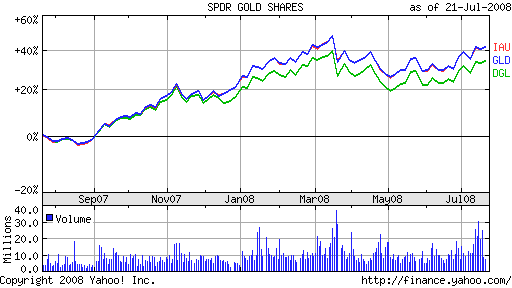
Gold bullion holdings in the world’s largest gold exchange traded fund (ETF), SPDR Gold Shares (GLD), reported a net inflow of five tons for the second quarter, making for a total of 948 tons.

The price of gold averaged $896.29 an ounce in the quarter, reports Frank Tang for Reuters, $30 below its average price in the first quarter. As the dollar strengthens, gold loses its luster and it’s seen as less of a safe haven than it is in more turbulent times.

Spot gold hit a record $1,030.80 an ounce on March 17. Yesterday, the price was $964.60.

BGF World Mining Fund Manager Evy Hambro reports for Telegraph that as uncertainty in the markets remains, gold will retain its characteristics as a hedge. The long-term outlook remains favorable, while both jewelry and investment demand should remain strong while gold mine production falls or keeps the status quo.

Hambro says that estimates are that global gold mining production will fall by 10%-15% over the next five years, in part because of a lack of success in exploration. Gold’s attractiveness as a hedge coupled with geopolitical tensions should keep the supply and demand fundamentals favorable.

  • iShares COMEX Gold Trust (IAU), up 15.5% year-to-date
  • SPDR Gold Shares (GLD), up 15.5% year-to-date
  • PowerShares DB Gold (DGL), up 13.6% year-to-date


Related Posts :
  1. Hedge Your Funds in Gold Stocks
  2. Gold May Rise to $5,000 on Inflation, Schroder Says
Please Note!
This is generally never true. Before buying or selling any stock you should do your own research and reach your own conclusion. See my Disclaimer on the bottom for more information.

You are welcome to republish this article, or any portion thereof.
Please, cite the actual/original source. I would be grateful if you could link back.


Stumble Upon Toolbar Add to Technorati Favorites Bookmark and Share

Dennis Gartman Predicts Corn Ethanol Producers Bankruptcy

FN Arena News on July 23, wrote:
    US based market trader Dennis Gartman highlighted this week a report from US FoodIndustryNews.com. It noted that VeraSun Energy, one of the country's largest ethanol producers, had delayed the opening of three new ethanol plants because of "volatility in the market". Citigroup has recently predicted that up to three-quarters of US ethanol plants would have to shut down as profits were turning to losses on the price of corn.

    Gartman also notes that a dozen or more ethanol and other bio-diesel plants have declared bankruptcy in recent months not just because of input prices, but because they can't find financing. The ramifications of the credit crunch have seeped beyond the financial sector into all corners of industry, and have not left the alternative fuel market unscathed. Moreover, the cost of building a new bio-fuel plant has skyrocketed along with everything else. Mr Jerry Taylor of the Cato Institute noted:

    "I think the ethanol industry as a whole will have to re-examine its entire financial model and determine how it can make money. Many of these [ethanol] plants never met the objectives that they were designed and built to achieve."

    It is actually a lot cheaper to make ethanol from sugar cane. Sugar, unlike corn, has not been on a one-way price trajectory. However the sugar market in the US is tightly controlled, and the government puts a US54c per gallon tariff on imported ethanol. Brazil is the world's major sugar source, and its ethanol industry has also been booming. And as corn ethanol has become ridiculously expensive, it has actually become a cheaper alternative for US oil refiners to pay the tariff and use Brazilian sugar ethanol instead.
While Darin Newsom, analyst with DTN in Omaha, on July 24, noted that the seemingly relentless drive in commodities - crude oil and corn have doubled in the past year - was built largely on robust demand for raw materials, especially in fast-growing economies in China and the Middle East.

A weakening U.S. greenback fed that demand by making dollar-denominated commodities cheaper to overseas buyers.

But with record energy prices and soaring costs for other commodities, "a lot of that demand has died out," Newsom said.

Rick Schwarck, CEO of Absolute Energy LLC, on January 8, said that the price of corn and soybeans is closely linked with the price of crude oil. “If oil goes down to $100 a barrel, ethanol goes down and plants shutter. More corn is released back into the market place and prices go down,” Schwarck says. “If it goes to $200 a barrel, plants that have gone off line would come back, demand [for corn] would go up, and the price of corn would go up.”

The Organization for Competitive Markets (OCM) on July 22, said that Monsanto's market power is driving up seed prices and devastating farmers and their communities. "Monsanto's market power has been quietly accruing over several years and has now begun materially impacting price," said Keith Mudd, OCM's board president. "The lack of competition and innovation in the marketplace has reduced farmers' choices and enabled Monsanto to raise prices unencumbered."

Even the list price on seed corn will topple the $300 per bag barrier starting this fall, up about $95 to $100 per bag, or 35 percent on average, according to Monsanto(MON) officials who met with DTN and Progressive Farmer editors this week. For 2009, 76 percent of the company's corn sales will be triple stack, 'so we think we can get the pricing right to show farmers the benefits,' John Jansen, Monsanto's corn traits lead. 'We can pass the red-faced test from the Panhandle of Texas to McLean County, Ill.'

"If and when the ethanol boom subsides, Monsanto will not lower its prices, farmers will be forced into bankruptcy, and the lack of an effective remedy for antitrust in crop seed will be a substantial cause," Said Fred Stokes, executive director, OCM.

Related Posts :

World Food Shortage and the Ethanol Bubble

Please Note!
This is generally never true. Before buying or selling any stock you should do your own research and reach your own conclusion. See my Disclaimer on the bottom for more information.

You are welcome to republish this article, or any portion thereof.
Please, cite the actual/original source. I would be grateful if you could link back.


Stumble Upon Toolbar Add to Technorati Favorites Bookmark and Share

Friday, July 25, 2008

Bank Collapse Update: $400 Billion of Writeoffs So Far, $600 Billion to Go (WM, WB, JPM, FNM, FRE)

Henry Blodget|Jul 25, 08 12:51 PM

ClusterStock.com

Picture 59.png

America's financial institutions insist they have enough capital. More and more analysts violently disagree.

For example, NYU professor Nouriel Roubini (who predicted this whole debacle), PIMCO bond guru Bill Gross, and Invesco strategist Diane Garnick all think that banks will have to write off $1 trillion of losses before the credit crash is through (and Diane and Nouriel think this is a floor).

What happens if these analysts are right and bank managers are wrong? The banks will have to take about another $600 billion of writeoffs on top of the $350+ billion they've already booked. What happens if that happens? Most of the banks will need to raise more capital, not all of them will be able to do so, and many will go bust. Even the ones that are able to raise capital, meanwhile, will dilute the hell out of current shareholders.

No wonder, then, that the stocks of Fannie Mae (FNM), Freddie Mac (FRE), Wachovia (WB), Wamu (WM), et al, have once again started marching toward zero.

Below, Nouriel Roubini and Diane Garnick discuss their apocalyptic views with me and Aaron Task on Yahoo TechTicker--views that are rapidly becoming consensus.


Related Posts :
  1. Lehman (LEH) May Sell Neuberger In Emergency Cash Raising Move
  2. WaMu Has $3.3 Billion Quarterly Loss on Rising Delinquencies
  3. Regional Banks Collapse Snow Ball Seems to Continue Rolling Downhill
  4. IndyMac Bancorp (IMB) Filling for Chapter 11 Bankruptcy
Please Note!
This is generally never true. Before buying or selling any stock you should do your own research and reach your own conclusion. See my Disclaimer on the bottom for more information.

You are welcome to republish this article, or any portion thereof.
Please, cite the actual/original source. I would be grateful if you could link back.


Stumble Upon Toolbar Add to Technorati Favorites Bookmark and Share

Lehman (LEH) May Sell Neuberger In Emergency Cash Raising Move


Bloomberg today, wrote:
    Lehman Brothers Holdings Inc(LEH). may sell at least part of its Neuberger Berman asset management unit to raise as much as $8 billion, CNBC reported, citing people it didn't name. A sale of the unit may make it difficult for Lehman, the smallest of the major Wall Street investment banks, to compete as an independent company, CNBC said. Last month, Lehman reported a $2.8 billion second-quarter loss, its first since the company went public in 1994.

Lehman Brothers Holdings Inc. acquired Neuberger Herman Inc, on July 28 2003, for about $2.63 billion. Under the terms of the agreement, Lehman Brothers will pay about $41.48 per share, consisting of $9.49 in cash and 0.496 shares of Lehman common stock.

Heidi N. Moore from Blog The Wallstreet Journal, on July 9, wrote:
    In fact, the asset-management business is Lehman’s biggest safety mechanism against the brutal markets. Consider that the asset-management business is valued at about two and a half times as much as Lehman’s investment banking business, according to one analyst’s estimates. Lehman Brothers asset management alone is worth $8 billion if it is valued the same as its peers using a multiple of 20.1 times the share price to trailing-earnings since 2000, wrote David Trone of Fox-Pitt Kelton Cochran Caronia Walker on June 13. That $8 billion is pretty considerable when you consider that all of Lehman had a market value of about $13 billion when the report was written ($11.5 billion as of Tuesday). It means the core Lehman businesses–investment banking, fixed-income and equity–was valued at only about $3 billion. Combined. (The remaining $2 billion in Trone’s valuation of Lehman comes from the high-net-worth brokerage business–the guys who sell Neuberger Berman’s funds, among others.)

    Without its asset-management business, Lehman could be scooped up for the price of a larger bank’s pocket change. So by selling Neuberger, Lehman would be signaling it wants to give up its independence and take a bargain-basement price for the rest of the firm.

    Other reasons that Lehman should keep its asset-management business? Take a look at the reasons it paid $2.6 billion for Neuberger Berman in the first place, back in 2003. At the time Lehman was looking for more stability in its earnings, which were highly dependent on the capital markets. Lehman also wanted to give its small group of high-net-worth brokers–400 at the time–a way to sell in-house funds, instead of just mutual funds founded and managed by other firms. If Lehman’s high-net-worth clients bought Lehman funds, Lehman could capture more fees.

    By many measures, Lehman’s acquisition of Neuberger fulfilled those expectations and more. Lehman, which had barely any assets under management before Neuberger, added $67 billion of assets under management through the 2003 deal. Now the Neuberger portion of Lehman Brothers Asset Management can claim about double that. Lehman Brothers Asset Management remains focused on high-net-worth individuals, which represent one of the few growing areas in the world of running money. Lehman has been adding to Neuberger through acquisitions: it acquired leveraged-loan manager Lightpoint in 2007 and is in the process of acquiring $2 billion New York money manager David J. Greene. There still is room for growth, as the brokerage house has long had its eye on overseas expansion in asset management. And, as recently as two years ago, Lehman bankers drove clients to Neuberger Berman to the tune of another $3.5 billion of assets under management, executives said at the time.
According to ClusterStock.com, Credit analysts suggest that because the unit is so profitable and is such a reliable source of income that offloading it might negatively affect Lehman's credit ratings.

Yesterday, July 24, Reuters wrote:
    Lehman, the smallest of the major Wall Street investment banks, has raised about $12 billion of capital this year to strengthen its balance sheet, sold off assets, and shaken up top management.

    The analyst said Lehman's current illiquid asset inventory of $83 billion includes residential mortgages of $24.9 billion, commercial mortgages of $29.4 billion, real-estate held for sale of $10.4 billion, non-investment grade acquisition finance facilities of $11.5 billion, and non-mortgage asset-backed securities of $6.5 billion.

    However, Lehman is able to borrow at the U.S. Federal Reserve's so-called discount window. This had not been the case in March when smaller Wall Street banking rival Bear Stearns Cos collapsed, eventually agreeing to a takeover by JPMorgan Chase & Co (JPM.N: Quote, Profile, Research).

    "Aggressive Fed moves and adequate capital cushion should help the firm weather near-term headwinds stemming from balance sheet overhang," Pinschmidt said.

Finally, I copy a part of The Financial Ninja Blog's Opinion, it may be also his conclusion:
    This is the same Lehman Brothers (LEH) that absolutely swore that they didn’t need to raise any additional capital as recently as a couple of weeks ago…

    Anyways… Selling Neuberger Berman means the following:

    1. Lehman really does need to raise capital, and lots of it.
    2. Lehman actually tried to quietly raise capital, and failed.
    3. Lehman is now left with no other option but to sell assets.
    4. Lehman will have to sell the ‘good stuff’ and keep the ‘bad stuff’.
    5. The end result will be a smaller, weaker Lehman.
    6. Therefore Lehman can’t survive as an independent entity.

    This should help put an end to the carefully orchestrated short covering rally in financials in general… Time to Go Ultra-Short, Again.

Related Posts :
  1. Lehman and Merrill Lynch Default Risk Charts
  2. Lehman Lying, Its Crush, and David Einhorn’s Winning
  3. Lehman: Death Spiral?
  4. Total Write-offs Stemming from the Credit Crisis may Total $1.3 Trillion
  5. Banks and Brokers at Greatest Risk of Default
  6. Why John Paulson Is Still Bearish On Financials [Housing Tracker]
Please Note!
This is generally never true. Before buying or selling any stock you should do your own research and reach your own conclusion. See my Disclaimer on the bottom for more information.

You are welcome to republish this article, or any portion thereof.
Please, cite the actual/original source. I would be grateful if you could link back.


Stumble Upon Toolbar Add to Technorati Favorites Bookmark and Share

Thursday, July 24, 2008

Agrium(AGU) is Temporary Oversold

Today market was panic because of negative news from the housing report and Ford Earning Release. Ford Earning Release is very important for investors as one of indicator whether US Economy is already in recession or not. Because it reflects current US industrial performance. When investors panic, they will dump everything assets they hold to save their money. As consequently, shares that have a good fundamental such as Agrium will also be sold off, it's like what occurred to many shares today, including Agrium.

Let's look at the chart below, Agu is currently oversold and I expect it will rebound in one or two days ahead. Beside Agu is currently supported by long upward trend as figured by the green line, Agu is also in a descending channel as figured by the double brown lines. I expected Agu will touch around $90 and further the rest depends on current market sentiment. It seems market will continue going lower as analysts said and Agu will follow the descending channel trend after rebound to around $90-$95.

If you are a long trader, maybe it's too late to buy Agu at this time. As Dennis Gartman said, "In Bull Markets One Can Only Be Long or Neutral, and in bear markets, one can only be short or neutral" (Dennis Gartman's Not-so-simple Rules of Trading).


While Agu's short Interest Ratio value was increasing sharply. It can be a measure of investors pessimism.

Source: Schaeffer's Investment Research, Inc.

Related Posts :
  1. The Rest of the World is Weakening Rapidly
  2. Buy Agrium (AGU) on The Dip


Please Note!

This is generally never true. Before buying or selling any asset you should do your own research and reach your own conclusion. See my Disclaimer on the bottom for more information.

You are welcome to republish this article, or any portion thereof.
Please, cite the actual/original source. I would be grateful if you could link back.


Stumble Upon Toolbar Add to Technorati Favorites Bookmark and Share

The Rest of the World is Weakening Rapidly

The Dow dropped triple digits in early trading this morning was due to The following headlines from around the world, including earning report from US companies and economic reports today. Here are:

  1. The Big Automaker, Ford(F), posts $8.7 billion loss on asset write-downs. Ford reported another terrific losses. According to ClusterStock.com News, The company posted a record $8.7 billion loss (down from a $750 million profit a year ago) after consumers continued to shun its oversize product lineup. The company's European and Asian businesses are doing well, but Ford has made a hash of its core US business after making the same mistake it made in the 1970s. Ford's CEO, Alan Mulally, said, "we continue to take decisive action in response to the rapidly changing business environment and remain absolutely committed to the four elements of our business transformation plan. Our European and South American operations are robust and profitable. We have momentum in Asia. And we are uniquely positioned to leverage our global assets and the global strength of the Ford brand to quickly bring more small, fuel-efficient vehicles to North America".

    In this Sept. 11, 2007 file photo, Ford CEO John Fleming presents the European Ford Focus during the first press day at the International Auto Show (IAA) in Frankfurt, Germany. Ford announced it will build the car in North America and is set to go on sale in the U.S. in 2010. Ford Motor Co. said Thursday, July 24, 2008, it lost $8.67 billion in the second quarter largely because of a reduction in the value of assets. (AP Photo/Bernd Kammerer)


  2. Existing home sales dropped to 4.86 million in June, down from 4.99 million in May and below the 4.95 million consensus estimate. Year-over-year, the figure is down from 5.75 million, or roughly 15%. Inventories up. The National Association of Realtors reported that sales dropped by 2.6 percent last month to a seasonally adjusted annual rate of 4.86 million units, a 10-year low.

    That was more than double the decline that had been expected and left sales 15.5 percent below where they were a year ago. The downward slide in sales depressed prices, too. The median price for a home sold in June dropped to $215,100, down by 6.1 percent from a year ago. That was the fifth largest year-over-year price drop on record. The drop in sales pushed inventories of unsold single-family homes and condominiums to 4.49 million units, up by 0.2 percent. That represented a 11.1 month supply at the June sales pace, the second highest level in the past 24 years.


  3. the Department of Labor released its report on initial jobless claims in the week ended July 19th, showing that jobless claims for the week increased by much more than economists had been anticipating.

    The report showed that jobless claims jumped to 406,000 from the previous week's revised figure of 372,000. Economists had been expecting jobless claims to increase to 380,000 from the 366,000 originally reported for the previous week.

    With the bigger than expected increase, weekly jobless claims rose to their highest level since a matching 406,000 in the week ended March 29th. Weekly jobless claims have not been higher since September of 2005.

    The Labor Department also said that the less volatile four-week moving average rose to 382,500 from the previous week's revised average of 378,000.

    At the same time, the report showed that continuing claims in the week ended July 12th edged down to 3.107 million from the preceding week's revised level of 3.116 million.

    Nonetheless, the bigger than expected increase in initial jobless claims is likely to add to recent concerns about the strength of the labor market.

    The Labor Department also said that the unemployment rate held steady at a nearly four-year high of 5.5 percent. Economists had been expecting the unemployment rate to edge down to 5.4 percent after surging up 0.5 percentage points in May.

    The 0.5 percentage point increase in the unemployment rate in May marked the biggest one-month increase since February of 1986 and lifted the unemployment rate to its highest level since October of 2004. (RTTNews)

  4. The Eurozone composite output index in July eased at the fastest pace since November 2001, signaling a contraction in private sector output, a survey carried out by the Royal Bank of Scotland and Markit Economics showed. The RBS/Markit Flash Eurozone Composite Output Index stood at 47.8 in July, down from 49.3 reported in June. Economists had expected a level of 49 for the month of June. The indicator suggested a contraction in private sector output for the second consecutive month in July. A reading below 50 indicates contraction in the private sector.

    The Purchasing Managers' Index for manufacturing as well as service sectors reached the lowest level since June 2003. The manufacturing PMI in July declined to 47.5 from 49.2 in June, while services PMI stood at 48.3, smaller than the 49.1 in June. Economists were expecting PMI readings of 48.7 for manufacturing and 48.8 for services.

    The Markit Flash Germany Composite Output Index, reached a six month low of 52.2 in July. The manufacturing PMI dropped to 50.9 from June's 52.6 and the services PMI eased to 53.3.

    According to Markit/CDAF report, the Flash French composite output index slid to 47 in July, 80-month low. The services PMI reached the series low of 47, while manufacturing PMI fell to 47.3, a 5-year low. (RTTNews)

  5. French business confidence fell to the lowest in more than three years in July as record oil prices and a stronger euro dimmed the outlook for economic growth. An index of sentiment among 4,000 manufacturers dropped to 98 from 101 in June, according to Insee, the Paris-based national statistics office. That was the weakest since May 2005. Economists expected a reading of 100, according to the median of 22 estimates in a Bloomberg News survey.

  6. German business confidence plunged the most since the Sept. 11 terrorist attacks and European manufacturing and services shrank, increasing the risk of a recession across the euro region. The Ifo institute's German business confidence index dropped 3.7 points from a month earlier to 97.5 in July. That was more than three times the decline forecast by economists in a Bloomberg News survey and the overall reading was the lowest in three years. Manufacturing and services across the euro area contracted for a second month and in the U.K., retail sales dropped by the most since at least 1986.

  7. Italian business confidence fell to its lowest in seven years in July as rising oil costs and a stronger euro hurt prospects for economic growth. The Isae Institute's business confidence index dropped to 83.5 from a revised 86.7 in June the Rome-based research center said today. That's the lowest since October 2001 and less than the median forecast of 86.5 in a Bloomberg survey of 17 economists. Manufacturers' costs are rising as companies struggle with the euro's 13 percent appreciation against the dollar in the past year and near-record oil prices. Prime Minister Silvio Berlusconi, who took office less than three months ago, has lowered taxes on overtime pay to try to help businesses cope with slowing growth.

  8. U.K. retail sales dropped in June by the most since at least 1986 as accelerating inflation and the slowdown in economic growth prompted consumers to cut spending. Sales fell 3.9 percent after rising 3.6 percent in May, which was the biggest increase since the data series began more than two decades ago, the Office for National Statistics said today in London. Economists forecast a 2.6 percent drop, the median of 30 estimates in a Bloomberg News survey showed. Bank of England policy makers cited weaker retail sales surveys as a signal of slowing economic growth at their decision this month, minutes released yesterday show. Falling house prices and a jump in credit costs have squeezed consumers just as the fastest inflation in at least a decade prevents the central bank from cutting the main interest rate from the current 5 percent.

  9. Unemployment in Spain, the source of half the euro region's new jobs between 2001 and 2006, rose to the highest rate in 3 1/2 years in the second quarter as home- building collapsed.The unemployment rate advanced to 10.4 percent from 9.6 percent in the first quarter, the Madrid-based National Statistics Office said on its Web site. That compared with the 10 percent median estimate in a Bloomberg News survey of eight economists. The number of jobs increased 0.1 percent to 20.4 million, compared with a 0.4 percent decline in the first three months.

  10. The Ministry of Finance said in a statement that Japan's merchandise trade surplus plunged 88.9% year-on-year to JPY138.6 billion in June. Trade surplus fell for the fourth consecutive month. Exports eased 1.7% to JPY7.16 trillion, marking the first decline in four and a half years on slower demand, while imports increased 16.2% to JPY7.02 trillion.

    Elsewhere, the Bank of Japan board member Atsushi Mizuno said that the central bank need to hold interest rates for the time being considering weak domestic demand, slowing economic growth and higher commodity prices. The policymaker added that he expects core inflation to rise about 2.5% by autumn. (RTTNews)

  11. The Monetary Authority of Singapore managing director Heng Swee Keat said in his opening remarks at MAS' Annual Report 2007/2008 press conference that the central bank is revising its CPI inflation forecast for the current year to 6%-7% from an earlier estimate of 5%-6%. With regard to economic growth, Heng said the MAS is firm on its previous forecast, adding that "Our assessment for full-year GDP growth remains at 4%-6%. (RTTNews)

  12. In Malaysia, the National SME Development Council said in its annual report 2007 that inflation is expected to rise further in 2008 to average in the range of 4%-5%. With regard to economic growth, the development council noted that economic expansion would continue despite a potentially more difficult environment with slower global economic growth and uncertainties in the international financial markets. (RTTNews)

  13. In India, government data showed that inflation based on the wholesale price index decreased to 11.89% for the week ended July 12 from 11.91% recorded in the previous week. Economists had expected the rate of inflation to accelerate further to 12.03%. A year ago, the corresponding rate was 4.76%. (RTTNews)

Related Posts :
  1. Short Ideas Today, July 23, 2008
  2. Other Short Ideas are Petrochina(PTR) and Whirlpool Corporation(WHR)

Please Note!

This is generally never true. Before buying or selling any asset you should do your own research and reach your own conclusion. See my Disclaimer on the bottom for more information.

You are welcome to republish this article, or any portion thereof.
Please, cite the actual/original source. I would be grateful if you could link back.


Stumble Upon Toolbar Add to Technorati Favorites Bookmark and Share

Wednesday, July 23, 2008

Other Short Ideas are Petrochina(PTR) and Whirlpool Corporation(WHR)

The stock will be retreated for a short term as affected by a weak worldwide economy and oil bubble burst. The stock price is currently overbought.

Whirlpool Corporation(WHR) is also overbought. Today the stock price raises up around 6.5 point, even though its profit was off 27% as affected by weak consumer demand in US.


Related Posts :
  1. Short Ideas Today, July 23, 2008
  2. Petrochina Has been Going To be Lower

Please Note!

This is generally never true. Before buying or selling any asset you should do your own research and reach your own conclusion. See my Disclaimer on the bottom for more information.

You are welcome to republish this article, or any portion thereof.
Please, cite the actual/original source. I would be grateful if you could link back.


Stumble Upon Toolbar Add to Technorati Favorites Bookmark and Share

Short Ideas Today, July 23, 2008

Ford(F) will report its earning tomorrow, prior to market open. This morning, The Fly On The Wall wrote:
    Ford's (F) new Flex vehicle was scheduled to add a third production shift in Oakville, Ontario, but that has been cancelled and will result in the loss of 500 jobs. Sales of the Flex, a seven passenger vehicle highlighted by fuel efficiency, have not been robust because of the weak economy.

    Ford (F) will seek to "meet or beat the competition in fuel economy," Ford's president of the Americas, Mark Fields, said yesterday. U.S. auto sales have not improved this month compared with June, Fields added

Ford's (F) June US Auto Sales fell 19.1% from last year vs. the 17.8% consensus decline. Car sales only fell 1%, but truck sales plummeted. Total truck sales were down 27%. The profit-driving F-Series saw sales tank 33%. But without adjustments, overall auto sales were down 28%, SUV sales declined 40% and trucks/vans sale declined 31%.

According to technical analysis, Ford's stock prices have been up since early this month and now it can be considered overbought, see the chart below:

The green arrows are forming a parabolic. It ussually will be followed by downward move.

While General Motors(GM), A Citi's Analist thinks that General Motors’ (GM-2S) liquidity is likely to tighten over the next year, increasing the need to raise cash in difficult capital market conditions. GM is also overbought. Bloomberg wrote today, that GM Falls Further Behind Toyota in Global Sales Race.

Due to overbought, the other short ideas are Suntrust Banks (STI), JP. Morgan Chase (JPM), Deutsch Banks AG (DB), Bank of America(BAC) and HSBC(HBC).

Related Posts :

  1. WaMu Has $3.3 Billion Quarterly Loss on Rising Delinquencies
  2. BlackRock(BLK) is Ready to Fill Gap
  3. Short Suntrust Bank, Inc. (STI)
  4. Bridgewater warns Bank losses from credit crisis may run to $1,600bn
  5. Banks and Brokers at Greatest Risk of Default
  6. The Big Three Automakers May be Downgraded as Impact of Global Credit Crisis and Recession

Please Note!

This is generally never true. Before buying or selling any asset you should do your own research and reach your own conclusion. See my Disclaimer on the bottom for more information.

You are welcome to republish this article, or any portion thereof.
Please, cite the actual/original source. I would be grateful if you could link back.


Stumble Upon Toolbar Add to Technorati Favorites Bookmark and Share

WaMu Has $3.3 Billion Quarterly Loss on Rising Delinquencies


Bloomberg News on July 22, wrote that Washington Mutual Inc. (WM), the biggest U.S. savings and loan, reported a $3.3 billion second-quarter loss as tumbling home prices left a record number of borrowers unable to keep up with mortgage payments.

While the Associated Press Released News :
    The nation's largest savings and loan increased its loss reserves to more than $8 billion to cover souring loans in its mortgage portfolio.

    The bank also said Tuesday it will be cutting up to $1 billion in expenses by the end of 2009.

    For the April to June period, WaMu reported a loss of $3.33 billion, or $6.58 per share, compared with a profit of $830 million, or 92 cents per share, in the year-ago period.

    Results include a previously disclosed, one-time reduction of $3.24 per share related to the company's $7.2 billion capital raise in April. Excluding the reduction, the loss per share was $3.34.

    Analysts polled by Thomson Financial, on average, expected a loss of $1.05 per share. Analyst estimates typically exclude one-time, unusual charges.

    WaMu's total loan-loss reserves increased by $3.74 billion to $8.46 billion, as it set aside a total of $5.91 billion during the quarter to cover bad loans. The increase in loan-loss provision reflects falling home prices, increased delinquencies, reduced availability of credit and the weakening economy, the bank said.

    Total net charge-offs, or loans written off as unpaid, increased to $2.17 billion, while nonperforming assets grew to 3.62 percent of total assets as of June 30, from 2.87 percent at the end of the first quarter.

    In total, WaMu expects these and other cost-cutting initiatives to result in annualized cost savings of $1 billion by the end of 2009. The company will record total restructuring costs of about $450 million, $207 million of which was recorded in the second quarter.

    Steve Rotella, president and chief operating officer, said some of the cost-cutting actions initiated during the quarter will play out over the course of the year and into 2009. Rotella said WaMu continues to evaluate ways to increase productivity, but he would not comment on whether that includes additional jobs cuts.

    WaMu ended the quarter with more than $40 billion of readily available liquidity, and its capital ratio increased to 7.79 percent, up from 6.40 percent in the first quarter.

    As a result, WaMu said it has sufficient capital to ride out the remainder of the credit crunch and does not anticipate raising additional capital going forward.

    WaMu became one of the first retail banks to seek outside cash in the wake of the credit crisis when it agreed to sell equity securities to an investment fund managed by TPG Capital and to other investors this spring, raising $7.2 billion in fresh capital.

    Late Tuesday, Moody's Investors Service put WaMu's senior unsecured rating of "Baa3" on review for possible downgrade. A rating of "Baa3" is one notch above junk status.

    "Though liquidity remains sufficient, WaMu experienced some declines in its commercial and brokered institutional deposit balances in the second quarter of 2008," Moody's said. "This reduced financial flexibility makes it more difficult for the company to successfully navigate through unanticipated events."

    Stephanie Hall, senior analyst at Gradient Analytics, viewed the reserve build-up as a positive. "The firm has been extremely slow in provisioning for loan losses," she said, adding that she expects the company to report additional provisions in the third and fourth quarters, but likely smaller than those in the first half.


While Mike "Mish" Shedlock today, wrote :
    Plans To Raise Capital vs. Need To Raise Capital

    It is interesting how statements like "We have no plans to raise capital" can get completely distorted from reality.

    Check out this bullish Comment about Washington Mutual I found on Yahoo: "No Need to Raise Capital....... Very Bullish. Long till 2012".

    Here is the reality.

    WaMu "Can't Raise Capital"

    Please consider Washington Mutual Drop Wipes Out Most of TPG Holding.
    Three months ago, with Washington Mutual's shares at $13.15, a group of investors led by Forth Worth, Texas-based TPG agreed to buy $7 billion of stock at $8.75, a 33 percent discount.

    As losses mount, a clause in the TPG agreement makes it more costly for WaMu to raise capital or be acquired. If WaMu is sold for less than $8.75 a share or is forced to raise more than $500 million in equity, it must compensate TPG for the difference, according to filings with the U.S. Securities and Exchange Commission.

    "We don't know how their investment plays out, but we also don't know how this affects WaMu to the extent they need to raise more capital," said Steven Davidoff, law professor at Wayne State University Law School in Detroit. "They really can't raise equity."
    Death Spiral Financing

    It is now time to explore the implications of the desperate deal that Washington Mutual made with TPG. Please consider Lack of Transparency = Shareholders Get Ratcheted.

    Following are a few highlights from the above lengthy, but well written article. I condensed this down as best as I can but inquiring minds will definitely want to read the entire article.
    Even though hundreds of billions of dollars of capital have been raised by the financial sector over the past several months, which of the investors in a financial institution have made money since their initial investment? Answer: Zero.

    We can’t think of one. They are all underwater. When Abu Dhabi first invested $7.5 billion in Citigroup last November, Citi’s stock was $35. Subsequently, when Citi did their $14.5 billion raise in January, the stock was trading at $30. Today Citigroup’s stock is under $20... and it keeps falling. Merrill Lynch did a combined raise of $12.8 billion in December and January at $48. Now the stock is under $35… and also falling. Warburg Pinkus made their now infamous $1 billion investment in MBIA at $31 per share. MBIA has fallen over 80% since and is now trading at under $5 per share.

    Those who participated in Ambac’s $1.5 billion rights issue in March are down a similar amount, 80%, as the stock now hovers under $2. Bank of America made their initial investment in Countrywide Financial last August at $18 per share (rather surprising to us, given that Countrywide looked to be going bankrupt if BofA didn’t come to the rescue). Bank of America subsequently made a takeover offer in January. Today Countrywide shares can be got for under $5 per share.

    TPG invested in Washington Mutual to the tune of $7 billion at $8.75 per share, a substantial discount at the time to WaMu’s stock price of $13. Today WaMu’s stock is $6. Last month AIG raised $20 billion when their stock was trading at $37 per share. Today AIG stock is just above $30 per share. Even those who participated in Lehman Brothers’ $6 billion equity offering last week at $28 per share are already underwater, with LEH currently trading below $24 (year-to-date Lehman’s stock is down over 60%).

    Ironically, thanks to full ratchet provisions, this promises to lead to further dilution and even weaker stock performance going forward.

    There were at least some smart investors who noted the downward trend and successfully negotiated for downside protection. We know of at least two cases (though there are doubtless others); namely, Merrill Lynch’s $12.8 billion investment from Temasek (the Singapore sovereign wealth fund) and Washington Mutual’s $7 billion raise from TPG (a private equity firm).

    Quite unbeknownst to the general public at the time, downside protection was built into these equity raises to protect these investors. They are called “look back” provisions or “full ratchet” compensation.

    We believe it is more accurate to call them “death spiral” securities. They work as follows. The investors in the equity raise would have their investment “protected” by a provision which states that should the bank afterwards raise money at a lower price than what they paid, these investors would be compensated retroactively by having their initial investment priced at this lower price, thereby being issued new shares for free. It doesn’t take a mathematician to see how these provisions can result in massive dilution should the bank subsequently raise even a paltry amount of capital. A new offering will trigger a lower price because of the dilution it would cause, which would trigger even more dilution because of the lower price, which would then trigger an even lower price because of the even higher dilution, etc. This is why we call such securities a death spiral.

    However, unless the bank goes bankrupt, these investors can’t lose. And we already know to what lengths the Fed will go to prevent a banking bankruptcy. It’s heads I win, tails I win.

    They can even short the stock in the expectation that it will go down and still not lose. At the next financing, which is sure to come, they will be made whole... even making money on the short!
    Add Citigroup To Those In Death Spiral Financing

    The above article mentioned Merrill Lynch and Washington Mutual in death spiral financing schemes. Add Citigroup to the list. I talked about this way back on January 15, 2008 in Cost of Capital "Ratchets Up" at Citigroup and Merrill.

    Is it any wonder that Citigroup is desperate to dump $500 billion in assets? The saving grace for Citigroup is that it has assets to dump. The big question is ho much those assets will fetch. I believe it will be far less that Citigroup thinks. I am still sticking to my estimate that Citigroup will survive, just nowhere remotely close to its current state.

    Now take a good hard look at WaMu. It is losing money at nearly everything it does. It is in deep serial trouble over Alt-A loans alone.

    With that in mind, many have been asking for an update on the WaMu Alt-A pool I have been tracking. The article has been out for some time. The title is certainly not obvious, and those who missed the update can find it in Fannie and Freddie Waterfalls Are Too Big to Bail.

    Desperation At WaMu

    Think about the implications of a company either desperate enough or dumb enough to issues $billions in shares at $8.75 when the stock was over $13 at the time. The ratchet provisions made it likely those in the deal immediately shorted it. Even if there were short restrictions, there are ways to execute synthetic shorts (writing deep in the money covered calls for example).

    Even if TPG took no action on its own accord, others understanding the implications of the ratchet agreements WaMu agreed to, probably shorted the hell out of it. Any company that desperate or that stupid deserved to be shorted into oblivion.

    The CEO, CFO, and COO all ought to get fired for agreeing such terms as well as for not seeing the need to raise capital until shares fell to $13. Then again, those executives paid the ultimate sacrifice of foregoing their bonus for a quarter.

    WaMu Is Screwed

    Washington Mutual is screwed. It cannot raise capital by equity deals even if it wants to. Those who translated "We have no plans to raise capital" into "No Need to Raise Capital" are sadly mistaken.

    WaMu desperately needs to raise capital. However, those death spiral financing arrangements it made means WaMu can't raise capital. And if WaMu can't raise capital, it stands to reason it would have no plans to do so.

Related Posts :
  1. Bridgewater warns Bank losses from credit crisis may run to $1,600bn
  2. Banks and Brokers at Greatest Risk of Default
Please Note!

This is generally never true. Before buying or selling any asset you should do your own research and reach your own conclusion. See my Disclaimer on the bottom for more information.

You are welcome to republish this article, or any portion thereof.
Please, cite the actual/original source. I would be grateful if you could link back.


Stumble Upon Toolbar Add to Technorati Favorites Bookmark and Share

Those Damn Short Sellers Are Just Killing It!

I republish the material below from The Big Picture :

Posted by Barry Ritholtz on Wednesday, July 23, 2008 | 07:00 AM

There were a sew of articles in the papers today about just how much money those damned shorts are making!

First up, the WSJ, who looked at who was killing it:

"Some hedge-fund stars of 2007 are having an encore year. In the process, they are defying skeptics who questioned whether they could keep their runs going.

John Paulson, who directed Paulson & Co. to gains of almost $15 billion last year, is up as much as 20% in some of his hedge funds through June 30, according to investors, thanks to continued bets on the woes of financial companies.

Philip Falcone, who saw gains of about 120% in his largest hedge fund in 2007, gained 42% through June in that fund, Harbinger Capital Partners I, from various commodity-related investments, among other areas.

It isn't necessarily surprising that investors who wagered against mortgage and housing-related investments are excelling, since the housing troubles have spilled over into 2008. The real challenge for these managers will be turning in similar performances when that gambit has run its course."

Next up, Bloomberg focused on the total amount wagered on the short side:

"Investors worldwide are betting more than $1 trillion on a collapse in stock prices.

Managers from William Ackman to Jim Rogers made a total of at least $1.4 billion in July with wagers against U.S. mortgage financiers Fannie Mae and Freddie Mac, data compiled by Bloomberg as of last week show. Harbinger Capital Partners staked $665 million that U.K. mortgage lender HBOS Plc would drop and Sao Paulo-based hedge-fund manager Francisco Meirelles de Andrade's short selling of Cia. Vale do Rio Doce is also paying off.

More than $1.4 trillion of equities worldwide are now on loan, about a third higher than at the start of 2007, data compiled by Spitalfields Advisors, the London-based firm specializing in securities lending, show. Almost all of that is being used to speculate that shares will fall, according to James Angel, a finance professor at Georgetown University who studies short selling. The global economic slowdown, $453 billion in bank losses and an explosion of funds that can profit from stock declines spurred the increase in short selling, helping send 22 of 23 countries in the MSCI World Index into bear markets."

Next, the FT had an interesting twist: The brokers and iBanks are making lucrative trades lending out shares to shorts!

"Conservative fund management firms and custody banks are making billions of dollars from short-selling by lending stocks to facilitate such trades in exchange for lucrative fees.

Even as short-sellers attract blame for driving big falls in financial stocks, financial services firms – including those targeted by short-sellers – are profiting from the investing strategy.

US prime brokerage firms, most of which are owned by big Wall St banks, will reap revenue of $11bn (£5.5bn) this year, according to a recent study by Tabb Group, a research business.

Prime brokerage units provide services to hedge funds. They do not reveal their financial results, but executives who work for the units say they make most of their money from lending to short-sellers."

Funny -- no one really looked at the reasons why the shorts were killing it --namely, the credit and derivative system run amok, a toothless SEC and a Federal Reserve that was guilty of malfeasance in terms of their obligations to regulate lending institutions.

However, this Bloomberg quote at least makes an attempt to explain the purpose shorts serve in the investment eco-system:

"Short sellers are a very important part of the ecosystem of our financial markets,'' said Angel, a professor at Georgetown's McDonough School of Business in Washington. ``The same way that lions go after a herd, they go after the weaker animals. The shorts will pick on a company where there's a legitimate controversy over its valuation.''


Posted by Barry Ritholtz | Wednesday, July 23, 2008 | 07:00 AM


Related Posts :

  1. Bridgewater warns Bank losses from credit crisis may run to $1,600bn
  2. More Crash Warning!
  3. We are on the Bear Market
  4. Global Stock Markets Plunge on Soaring Crude Oil Price
  5. Banks and Brokers at Greatest Risk of Default
  6. The Big Three Automakers May be Downgraded as Impact of Global Credit Crisis and Recession

Please Note!

This is generally never true. Before buying or selling any asset you should do your own research and reach your own conclusion. See my Disclaimer on the bottom for more information.

You are welcome to republish this article, or any portion thereof.
Please, cite the actual/original source. I would be grateful if you could link back.


Stumble Upon Toolbar Add to Technorati Favorites Bookmark and Share