Translate this page from English into :

Tuesday, September 23, 2008

The Innovator, the Imitator, the Idiot

From The Big Picture :
    Today's credit crisis quote comes to us via Theodore Forstmann of of Forstmann Little & Company :

      "Buffett once told me there are three 'I's in every cycle. The 'innovator,' that's the first 'I.' After the innovator comes the 'imitator.' And after the imitator in the cycle comes the idiot."

      -Theodore Forstmann, quoting Warren Buffett

    Source:
    The Credit Crisis Is Going to Get Worse
    BRIAN M. CARNEY
    INTERVIEW JULY 5, 2008
    http://online.wsj.com/article/SB121521029377229405.html


Related Posts :

Berkshire to invest $5B in Goldman Sachs

Please Note!
This is generally never true. Before buying or selling any stock you should do your own research and reach your own conclusion. See my Disclaimer on the bottom for more information.

You are welcome to republish this article, or any portion thereof.
Please, cite the actual/original source. I would be grateful if you could link back.


Stumble Upon Toolbar Add to Technorati Favorites Bookmark and Share

Berkshire to invest $5B in Goldman Sachs

Berkshire Hathaway, the insurance-focused conglomerate run by Warren Buffett, agreed Tuesday to invest at least $5 billion in Goldman Sachs Group Inc., according to a MarketWach report.

Berkshire is buying $5 billion of perpetual preferred stock in Goldman. The preferred stock has a dividend of 10 percent and is callable at any time at a 10 percent premium. Berkshire will also get warrants to purchase $5 billion of Goldman common stock at a price of $115 each, the report said.

Berkshire can exercise the warrants at any time over the next five years, Goldman said in a statement.

Goldman also said it's raising at least $2.5 billion by selling common stock in a public offering.

Source : Triangle Business Journal

Related Posts :
  1. Buffett : Economy Getting Worse, But Inflation "Exploding"
  2. Paulson's Market Manipulation Bailout Will Fail Because..
  3. A New Hundreds of Billions Dollar of Debt Coming Due
Please Note!
This is generally never true. Before buying or selling any stock you should do your own research and reach your own conclusion. See my Disclaimer on the bottom for more information.

You are welcome to republish this article, or any portion thereof.
Please, cite the actual/original source. I would be grateful if you could link back.


Stumble Upon Toolbar Add to Technorati Favorites Bookmark and Share

Commercial Real Estate Loans May Be The Next Shoe to Drop

Proshares Ultrashort Real-Estate ETF (SRS) is on a nice entry point.

Click to Enlarge

Click to Enlarge


Commercial Real Estate Loans May Be Next Shoe to Drop


By Research Recap, An SA Author.


Residential mortgages have gotten most of the attention during the current credit crisis, but a heavy concentration of commercial real estate [CRE] loans may be a better metric for gauging which banks are most at risk for failure in the coming months, according to Standard & Poor’s.

Eleven banks failed in the first half of 2008 and not surprisingly, S & P’s RatingsXpress Credit Research is predicting more this year and in 2009, due to continued deterioration in capital ratios, liquidity and in CRE, land development and construction loans.
    Since construction loans are bullet loans with interest reserves accruing until a project is completed, we expect that problem construction loans will continue to rise in coming quarters. We also expect that loss severities among defaulted construction loans will be materially higher during this economic downturn compared with earlier downturns given sharp price declines among homes and condominium projects.
The rating agency also said most of the failures would be concentrated in small banks, especially those with a high degree of exposure to commercial real estate.

Among banks that have already failed this year, CRE loans accounted for an average 60 percent of loan portfolios. In contrast, in the three bank failures of 2007 more than 70 percent of the loan portfolios were concentrated in residential loans.

Click to Enlarge
Banks with significant exposure to real estate in California, Nevada, Florida, Arizona, Michigan and Georgia are suffering the biggest downturns in credit quality, and S & P said it expects further home price declines and economic weakness to continue pressuring banks active in those markets.

S&P said while it’s hard to predict the number of bank failures, it does not believe failures will reach the levels seen during the savings and loan crisis of the late 1980s and early 1990s.

For details, see “U.S. Bank Failures Expected to Rise.”

Related Posts :

Meredith Whitney: Bailout Won't Do Jack, Cutting Estimates

Please Note!
This is generally never true. Before buying or selling any stock you should do your own research and reach your own conclusion. See my Disclaimer on the bottom for more information.

You are welcome to republish this article, or any portion thereof.
Please, cite the actual/original source. I would be grateful if you could link back.


Stumble Upon Toolbar Add to Technorati Favorites Bookmark and Share

Seven Stocks That Went Up, Despite Market Drop

By Stockerblog, An SA Author

On Monday, the Dow Jones Industrial Average dropped over 370 points, following a previous tumultuous week for the stock market. Yet, on that same day, numerous stocks were up, with many up over 10% for the day. Unless it is short covering, there may be something positive behind the stock's movement.

The following stocks were all up over 10%. They all have market caps over $500 million, and P/E ratios below 20:
  1. Synutra International, Inc. (SYUT) produces dairy based nutritional products in China. The stock was up 25.7%. The stock has a P/E of 16.

  2. Fairfax Financial Holdings Limited (FFH) is in the property and casualty insurance and reinsurance business. The stock was up 25.5%. The stock has a P/E of 3.

  3. United Microelectronics Corp (UMC) manufactures fabricates semiconductors and integrated circuits in Taiwan. The stock was up 14.4%. The stock has a P/E of 12 and a PEG of 0.53.

  4. Gold Fields Limited (GFI) is in the gold mining business in South Africa, Ghana, Australia, and Peru. The stock was up 13.6%. The stock has a P/E of 10 and a PEG of 3.49.

  5. HSN, Inc. (HSNI) sells electronics and housewares, jewelry, beauty, apparel, and other items through its television network. The stock was up 12.1%. The stock has a P/E of 6.

  6. Pan American Silver Corp. (PAAS) explores for and develops silver copper, zinc, lead, and gold properties. The stock was up 11.5%. The stock has a P/E of 18 and a PEG of 1.65.

  7. Madeco S.A. (MAD) manufactures flexible packaging products in Chile. The stock was up 10.7%. The stock has a P/E of 18.
Disclosure: The author does not own any of the above.

Related Posts :

Please Note!
This is generally never true. Before buying or selling any stock you should do your own research and reach your own conclusion. See my Disclaimer on the bottom for more information.

You are welcome to republish this article, or any portion thereof.
Please, cite the actual/original source. I would be grateful if you could link back.


Stumble Upon Toolbar Add to Technorati Favorites Bookmark and Share

Hedge Funds Finding New Ways to Short

By David Enke, An SA Author

As reported at a Financial Times Alphaville blog post, hedge funds are looking for new ways to short securities, including everything from shorting index funds and then buying back every security in the index except one, to restructuring swaps to have the same exposure as a short position.

Both techniques will no doubt have an affect on market volatility as more stocks become actively traded. Ironically, derivatives such as swaps, which had their own role in the current financial crisis, are now being used to help get around restrictions imposed as a result of the very same crisis.

Where there is a will, there is a way. Innovation and financial engineering never sleep.

Related Posts :

Ban the shorts? A BIG mistake!

Please Note!
This is generally never true. Before buying or selling any stock you should do your own research and reach your own conclusion. See my Disclaimer on the bottom for more information.

You are welcome to republish this article, or any portion thereof.
Please, cite the actual/original source. I would be grateful if you could link back.


Stumble Upon Toolbar Add to Technorati Favorites Bookmark and Share

Meredith Whitney: Bailout Won't Do Jack, Cutting Estimates

From http://www.clusterstock.com on September 23 :
    Meredith Whitney weighs in on the bailout plan, saying it won't help bank fundamentals in the foreseeable future. She also whacks her estimates on Bank of America (BAC), Wachovia (WB), et al.

    We're with you, Meredith. Helping the banks clean up their balance sheets so they won't go bankrupt is one thing. Getting them to lend money to people who can't afford to pay back the loans is another.

    Would you lend money to America's consumers right now? Businesses? Twenty minutes after making so many horrible loans that, if not for massive government intervention, would have smashed your bank into an iceberg? Neither would we.

While Reuters wrote :
    The credit crisis that began last summer has intensified so much that any U.S. government bailout plan has "little hope" of improving core fundamentals over the near and medium term, said analyst Meredith Whitney, who expects the country's GDP to take a hit from likely moves by state governments to cut costs.

    The Oppenheimer & Co analyst cut her outlook on U.S. banks and expects further dividend cuts and capital raises.

    Whitney also said home prices were not close to bottoming and expects prices to ultimately be at least 25 percent lower from current levels. She expects homeownership rate to decline further.

    The analyst also noted that unemployment was up over 40 percent year-on-year in key states, and said unemployment is "headed materially higher."

    Given that over 12 percent of the U.S. GDP is driven by state and local government spending, and with many key states' 2009 budgets being under-funded, governments will be forced to cut costs and this will weigh significantly on GDP, Whitney said.

    "Credit market disruption has had underappreciated consequences on the economy... A virtual suction of liquidity has occurred in the credit and lending markets, and consumer and corporate credit is already showing the effects," Whitney wrote in a note to clients.

    "Since the onset of the credit crisis, over $2 trillion less liquidity has flown through the U.S. domestic capital markets than during the same time period a year prior," she added.

    Q3 OUTLOOK

    Analyst Whitney forecast a third-quarter loss of 36 cents a share for Citigroup Inc (C). She had a prior profit view of 8 cents a share.

    Whitney widened her third-quarter loss forecast for Wachovia Corp (WB) to 31 cents a share from 15 cents.

    She cut third-quarter earnings estimates for Bank of America Corp (BAC) to 40 cents a share from 75 cents, for JPMorgan Chase & Co (JPM) to 21 cents a share from 40 cents a share, and for Wells Fargo & Co (WFC) to 13 cents a share from 17 cents.

    Shares of Citigroup closed at $20.01 Monday on the New York Stock Exchange, while those of Bank of America closed at $34.15.

    Shares of JPMorgan closed at $40.80, Wachovia's at $18.75 and Wells Fargo's at $35.18.

    (Reporting by Tenzin Pema in Bangalore; Editing by Jarshad Kakkrakandy)

Related Posts :
  1. Bottom Line on Paulson-Bernanke Bailout Plan
  2. Paulson's Market Manipulation Bailout Will Fail Because..
Please Note!
This is generally never true. Before buying or selling any stock you should do your own research and reach your own conclusion. See my Disclaimer on the bottom for more information.

You are welcome to republish this article, or any portion thereof.
Please, cite the actual/original source. I would be grateful if you could link back.


Stumble Upon Toolbar Add to Technorati Favorites Bookmark and Share

Bottom Line on Paulson-Bernanke Bailout Plan


By Henry Blodget, Sep 23, 08 1:01 PM
http://www.clusterstock.com

At the Congressional Bailout Hearings today, we finally learned what Hank Paulson and Ben Bernanke are thinking. Specifically, we learned what prices they plan to pay for the crap assets they're buying (more than they're worth). And we learned why they picked this asset-purchase bailout plan instead of one more like Sweden's in the early 1990s (which included direct equity injections).

Detailed answers to these questions below and here. But here's the bottom line:

The big difference between this bailout and the ones that have come before is that the banks aren't yet on death's door. Thus, in Paulson and Bernanke's opinion, these banks must be persuaded to participate--by making the plan a boon to them (and probably a liability for taxpayers).

What Paulson and Bernanke are trying to do, in other words, is fast-forward the movie a few months or years instead of waiting until the banks realize that they are hosed and come begging for help. The trouble with this plan is twofold:
  • First, until the banks are on death's door, they'll use any government largesse for their own gain:
    Specifically, they'll only sell assets they think the government is overpaying for (otherwise, why would they sell them)? And the banks know far better than the government will what their own assets are worth.

  • Just cleaning up the banks' mistakes will not make them start aggressively lending again.
    Yes, it's the first part of the process, but contrary to Paulson's assertions this morning, cleaning up bank balance sheets will not quickly fix the housing market. The trouble in the housing market, remember, is that millions of houses were bought by people who couldn't afford them. These folks still can't afford the houses, with or without loans (and especially now that the economy is cratering). So merely making the banks able to lend again won't suddenly soak up all the excess housing inventory.

It may be that what Paulson and Bernanke are trying to do is essentially impossible: Save companies before they know they are screwed. This doesn't mean it's not worth trying. But it does mean it's unlikely to succeed without the taxpayers getting burned.

The government has already headed off the immediate crisis by announcing that it intends to help (since last week, the credit markets have settled down). Now, perhaps it can use that assurance to play more of a backstop-of-last-resort sort of a role, where it only helps companies that are truly in trouble and gets a significant equity stake for doing so. Anything less, we fear, will come right out of the hide of the taxpayer.

Price. The Treasury intends to buy the crap assets at "close to hold-to-maturity" prices instead of the "firesale" prices that banks are currently carrying them at. This is a huge boon to banks. It also presumes that "hold-to-maturity" prices are really much higher than the "firesale" carrying values, which many experts would argue with.

Asset purchase instead of equity stakes. Bernanke and Paulson believe taking equity stakes is appropriate when dealing with failed companies. Here, most of the banks the bailout will help are still operating (and, probably, still in denial). Bernanke and Paulson believe these banks must be persuaded to participate in the plan and that, if the government tried to demand equity stakes, they wouldn't do it. Thus, the happy plan (for the banks), whereby the government buys all their mistakes at a gain vs. current carrying values and dumps all the wreckage off on the taxpayers.

Related Posts :

Paulson's Market Manipulation Bailout Will Fail Because..

Please Note!
This is generally never true. Before buying or selling any stock you should do your own research and reach your own conclusion. See my Disclaimer on the bottom for more information.

You are welcome to republish this article, or any portion thereof.
Please, cite the actual/original source. I would be grateful if you could link back.


Stumble Upon Toolbar Add to Technorati Favorites Bookmark and Share

Paulson's Market Manipulation Bailout Will Fail Because..

Sep 21, 2008 - 08:56 AM
By: Robert_McHugh_PhD

    As a trader, I stopped getting disgusted at government manipulation of markets several years ago, didn't pretend it wasn't happening, just tried to find when it was coming. I decided to develop an indicator that would tell me when the probability was extremely high that the Master Planners would intervene. That approach has served us well, and that indicator is known as the Plunge Protection Team (PPT) Indicator. It flashed a new “buy” signal Monday, September 15 th at the close, rising above positive + 20.00, warning that the decline from August 11th was terminal. The Industrials have risen 565 points since that buy signal. When this measure rises above positive + 20.00, it is usually early, but very right, an early warning indicator telling us to enjoy the decline for a few more trading days but get ready for a spike rally.

The current government market intervention (“manipulation” is probably a more appropriate word) that transpired the past two weeks, reaching crescendo Thursday on a rumor, and Friday on an announcement, is one of the most dramatic since the 1930's. It really puts into question the notion of U.S. markets being under capitalism, not socialism. The government nationalized Fannie Mae and Freddie Mac last week, announced its intent to nationalize AIG, a component of the Dow 30, this week, and then pulled out all the stops with the Paulson manifesto Friday. Not sure why he didn't nationalize Lehman Bros, unless it was personal, as he came from competitor Goldman Sachs, and enjoyed watching them declare bankruptcy. Okay, maybe I am a bit cynical — maybe.

Before getting into market performance and the forecast, let's cover what we know about this historic redefining of the rules of the game that Paulson has placed on the table for Congress to consider next week:
  1. The Securities and Exchange Commission has put a ban on short selling (that is entering into a contract to sell a stock at today's price in the future without owning it now, in effect placing a bet the price of the stock will drop) on 799 financial institution stocks – not on any other stocks, through October 2nd, with the possibility of extending the ban for 30 days. This does not prohibit put options.

  2. AIG was tossed from the Dow Industrials and replaced with food giant Kraft on Thursday (presumably to replace a loser with a winner to increase the odds that the closely watched Industrials will rise).

  3. The Treasury said it would “insure” up to $50 billion in struggling moneymarket fund investments at financial companies (that are not FDIC insured).

  4. The Fed announced they would make “unlimited funds” available to banks to finance purchases of asset-backed commercial paper from money market funds (This will be in the trillions).

  5. Banks would be allowed to sell their illiquid bad loan assets to the Treasury in exchange for cash.

What is clear from the getgo, is that this is a bailout of Wall Street, not Main Street, that it is going to cost trillions, not billions, and the bill will be paid by both the American taxpayer, and the American consumer via a higher cost of living. Yes, this is going to be hyperinflationary. The Treasury will issue notes to the Fed, the Fed will come up with the cash (printed out of thin air), and the cash will be handed to Wall Street.

This process fails miserably to solve the problem, which is the dire financial condition of the average American household. The trillions of dollars being printed out of thin air should be going to each and every household in America , not just Wall Street. If so, Wall Street would benefit because their toxic assets would metamorphose into quality assets as the American household pays off its debts (cash to Wall Street). But what would you expect when the Treasury Secretary authoring this plan is the former Chairman of the largest Wall Street firm in America , Goldman Sachs, which also happens to be a surrogate for the Plunge Protection Team. Because the plan fails to bailout the American household, it will fail — period. But, fail with an even higher cost of living structure than we have today.

This plan assures that the Dollar will tank. It will lose its value as bad loans are replaced with fresh printed cash. Precious metals will skyrocket as this plan is executed.

As for the lunacy of banning short trading against 799 financial institutions (there are over 10,000 financial institutions in the U.S., so only some are protected from bets they will decline), the Wall Street Journal noted on Friday, “essentially this only allows investors to bet that stocks will rise, and bans investing strategies used by hundreds of mutual funds, pension funds, endowments and governments. These firms use short-selling to protect themselves from unexpected huge losses, some financial firms selling short to offset trades made by their clients so they aren't exposed to large market moves.”

Short selling is not only legal, or should we say it was until Friday, but is necessary, and can be quite good for the markets. In a short-sale of a stock, what it does is it requires a purchase of that stock by the time the short sale is contracted to close. In effect, short sales create future demand, as shorts must buy stocks, thereby helping stabilize and even push stock prices higher in the future. Further, if there are an abundant number of short positions, a short-covering rally is possible, driving market prices sharply higher. Banning short selling removes these invisible bids. Banning short selling is robbing Bears and hedge traders who rightfully are entitled to profits. Without short selling, it will be harder to properly gauge the true value of a stock. It could create an artificially high market price that will drop far more severely in a future event than otherwise would have occurred.

Banning short selling is essentially a magician's trick to take the focus off his hand. It is a witch hunt. Someone has to take the hit and the Master Planners have decided to blame the shorts, which is pure lunacy. Shorts had nothing to do with the economic mess this nation finds itself in. The Master Planners continue to equate the economy with Wall Street. They believe if stocks are fine, then the American household is just fine. Nonsense. Shorting is a way of identifying fundamental problems with a company. The health of the economy has nothing to do with whether or not a stock is shorted.

Here's the problem. This government intervention, one that will cost trillions, has failed to bail out the American household, thus is destined to fail, after trillions of new dollars hyperinflate our economy and debase our currency. The expectations for success are running high, creating a false sense that everything is going to be okay. This sets up a monster financial collapse that will dwarf the risks of today once it becomes clear that this program has failed. While old assets are swept into the vaults of the Fed in exchange for cash, via the arms of the U.S. Treasury, more bad assets will be created at an even faster pace as the American household, who is income starved, debt laden, and credit report deficient, will soon get hit by another tsunami of higher costs of living, making it impossible to pay their bills on time.

The Master Planners don't give a royal rip about the consumer. For example, Credit Card company schemes have managed to force 30 percent interest rates on what will be forever debt due to technicalities and small print. They mail statements within days of due dates, creating accidental late payments, granting them the right to raise interest rates to 30 percent. They lower credit limits without proper notice, consumers use their cards over the new limit by accident, and get hit with an increase in their interest rates to 30 percent. If they are late, their credit report gets creamed. Yet, now these credit card companies, Wall Street firms, are being bailed out at taxpayers expense to the tune of trillions without doing a darned thing to improve this economy.

The cost of this Paulson manifesto will be trillions on top of the already $600 billion spent in specific corporate bailouts this year. If they are spending trillions anyway, debasing the Dollar anyway, then the American household should also be bailed out. A rebate of the past ten years income taxes should be sent directly to each and every household, with the caveat that half of that money must be used to pay off existing debt. If no debts, great, the household gets to keep the entire rebate. Further, the unconstitutional confiscation of wealth known as the real estate tax should be eliminated and replaced with a sales tax. Also, a usury interest rate ceiling of 10 percent should be imposed immediately upon all financial institutions, the key beneficiaries of the Paulson manifesto. The Treasury should begin issuing a new currency that it backs with precious metals, and finally, the Federal Reserve should be abolished. The thinking here is trickle up economics is the medicine that is needed, not more trickle down.

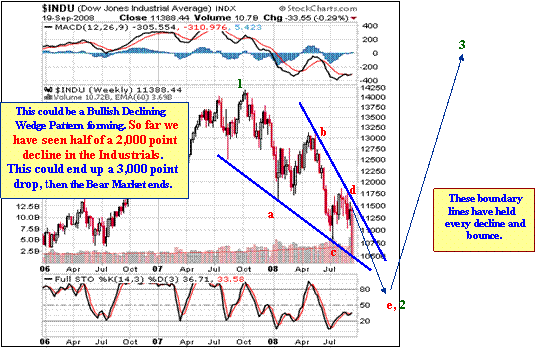
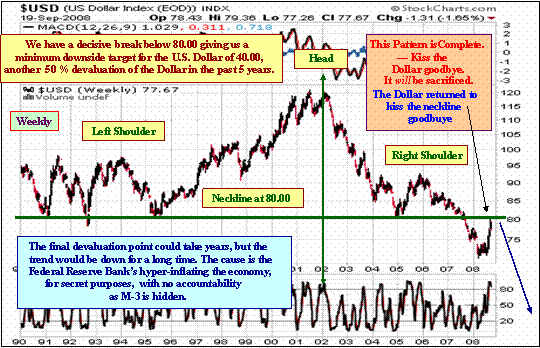
The next two charts tell us all we need to know. The first shows the fate of the U.S. Dollar. Down. Big. A massive Head & Shoulders top with an eventual downside target of 40.00. The second chart shows the fate for stocks. More downside, to be followed by an inflationary nominal Bull Market once the downside has been achieved. More downside is coming before that inflationary nominal Bull Market starts.

Last Friday, September 12 th , 2008, we warned our subscribers, “ a sharp decline will be the market's fate dead ahead. Everything is pointing toward a crash at any time.” The next trading day, Monday, September 15 th , the Industrials lost 504.48 points, the largest one day decline since the 9/11 attacks in 2001. Two days later, the Industrials lost another 449.36 points. But we noted that our PPT Indicator just generated a new buy on Monday, suggesting a bottom was imminent. The Industrials then rallied 410 points Thursday the 18 th , and another 368 on Friday the 19 th .

Further, on Friday September 12 th , we wrote to subscribers, “ A great development for Gold bugs is that the HUI's Daily Full Stochastics generated a new buy signal Thursday, and at a level where significant rallies have started in the past. The PPT's involvement in bailouts, and in stock and bond markets, takes money, and is hyperinflationary. This should be the catalyst for a reversal in commodities, precious metals, and the HUI. We got a new buy signal in the HUI PPI Friday (Sept. 12 th ), and the chart on page 24 (of last weekend's market newsletter to subscribers) shows a good track record for this indicator.”

Of course Gold rose nearly 20 percent at one point this past week, with metals showing the largest one-day price gain ever on Wednesday, the 17 th . The HUI also rose sharply, up 50 points, about 20 percent, this past week.
If you would like to become a subscriber, you can grab a great 5 months for $99 special at the Subscribe Today button at www.technicalindicatorindex.com If you would like a Free 30 Day Trial, simply click on the button at the upper right of the home page.

“Jesus said to them, “I am the bread of life; he who comes to Me
shall not hunger, and he who believes in Me shall never thirst.
For I have come down from heaven,
For this is the will of My Father, that everyone who beholds
the Son and believes in Him, may have eternal life;
and I Myself will raise him up on the last day.”

John 6: 35, 38, 40


by Robert McHugh, Ph.D.
technicalindicatorindex.com

Robert McHugh Ph.D. is President and CEO of Main Line Investors, Inc., a registered investment advisor in the Commonwealth of Pennsylvania, and can be reached at www.technicalindicatorindex.com.

Source : The Market Oracle

Related Posts :
  1. Timeline Of The Weeks Events In The face Of The Worst Financial Crisis Since The Great Depression
  2. Buying $700 Bn In Troubled Assets With Taxpayer Money
  3. Resurrecting the Resolution Trust Corp: Will it Help?
Please Note!
This is generally never true. Before buying or selling any stock you should do your own research and reach your own conclusion. See my Disclaimer on the bottom for more information.

You are welcome to republish this article, or any portion thereof.
Please, cite the actual/original source. I would be grateful if you could link back.



Stumble Upon Toolbar Add to Technorati Favorites Bookmark and Share