Translate this page from English into :

Friday, October 10, 2008

10/10/2008 : Global Gloom!!!


Dow Jones -7.33%
S&P 500 -5.47%
Nasdaq -7.62%

Nikkei 225 -9.6%
Hang Seng -7%
ASX 100 -8.3%

FTSE 100 -7.3%
CAC -8.4%
DAX 30 -8.9%


Related Posts :

10/9/2008 : Market Panic

Please Note!
This is generally never true. Before buying or selling any stock you should do your own research and reach your own conclusion. See my Disclaimer on the bottom for more information.

You are welcome to republish this article, or any portion thereof.
Please, cite the actual/original source. I would be grateful if you could link back.


Stumble Upon Toolbar Add to Technorati Favorites Bookmark and Share

China tries again to boost the stock market

From China Financial Markets Blog : China tries again to boost the stock market, Oct 10, 2008 04:37 am

Yesterday, after listing the several bad days in a row we have had on the local stock markets, I suggested that we would soon be testing 2000 again. It happened sooner than I expected. Today the market had another awful day, with the SSE Composite losing 3.0% to close the day at 2013, although at its low late in the morning the market actually traded well below 2000, to touch 1963.

Once again the regulators have responded by trying to force the market up. Here is what the South China Morning Post says about it:
    The China Securities Regulatory Commission has temporarily stopped reviewing applications for initial public offerings, sources said, a sign that Beijing is serious about bolstering the mainland's embattled stock market. The initial public offerings review committee of the CSRC had stopped processing applications between September 16 and the end of this month and the suspension was likely to be prolonged, the sources said.

    The sources, who work at brokerages of investment banking units, said the CSRC did not officially inform them of the suspension. However, they said the review process had been frozen as the regulator hoped to curb equity supply to the weak market.
I hate to repeat myself so often, but although preventing IPOs may indicate how serious Beijing is about the stock market decline, it is not going to have any real impact beyond further undermining the government’s credibility in bolstering the market. After trying and failing so many times, every new attempt is likely to be taken less seriously by investors. It would be better to hold back on administrative attempts to support the market and to wait until we really need a confidence booster – something which I suspect is going to happen soon enough.

This may be a smaller point, because I suspect there weren’t going to be many IPOs, anyway, but I wonder if restricting the ability of companies to raise equity (and last week’s new rules allowing companies to issue bonds and use the proceeds to repurchase stock) is a good idea. More equity, not more leverage, will reduce the impact of the crisis if it spreads to China (and obviously enough to most of my blog readers I think it will). This is a time for companies to be restructuring their balance sheets in the direction of greater conservatism, even if that comes at a high cost. The more leverage there is out there, the more difficult the crisis is likely to be, and the greater the financial distress costs. We should be moving in the opposite direction.

On a related issue Macquarie’s Paul Cavey has a very interesting research piece today on why China shouldn’t have cut interest rates. He argues that the main source of China’s imbalances has been the mis-pricing of money via interest rate controls, and that this mis-pricing, coupled with China’s expansionary monetary policy, has led to misallocation of capital on a massive scale and unstable conditions within the financial system. Cutting interest rates only exacerbates the problem.
    This issue certainly hasn’t escaped attention in recent years. Calls for appreciation of the renminbi have clearly been loud. While often motivated more from a perception of US national interest, there have also been claims that appreciation would help China. The reason is the tremendous build-up of foreign exchange reserves that is the surest sign of undervaluation. To prevent exacerbating this inflow further, the authorities have kept interest rates low.

    The combination is a classic recipe for a bubble. The liquidity creates the excess supply of credit, and the low rates the demand. Indeed, with nominal lending rates of now just 6.9% – the cost of capital – well below nominal GDP growth of 20% – the potential return – borrowing from banks isn’t just cheap for companies, it is a positive no brainer.

    In reality, it is hard to find evidence of a credit bubble. Take bank lending growth of around 15% pa. Admittedly, this is a big number in absolute terms. But so are any of the figures that could be used to describe China’s economic growth. Thus, while growing quickly in absolute terms, the stock of outstanding credit has actually fallen relative to the size of the economy, from 125% of GDP in 2003 to around 100% now. This compares with the US, where in the same period credit has ballooned to almost 180% of GDP – and this does not even include the liabilities of the super-leveraged financial sector.

    So, contrary to expectations of an unsustainable credit bubble, it looks like bank lending in China has been only just enough to grease the wheels of the rapidly growing economy. The reason is China’s banking sector has been effectively held in a straightjacket. The banks have been ordered not to lend, instructions which particularly this year has been backed up with sterilisation, the process by which the central bank uses reserve requirements and sales of central bank bills to soak up excess renminbi and stop the banks from lending.
Where I disagree with Paul is his implication that we have not seen a credit bubble. I have written extensively about why I believe that strict credit loan constraints, and maybe even interest rate controls, are undermined (and necessarily so) in a system whose monetary policy is consistent with massive credit expansion.

The way I see it, in such a system credit controls are likely simply to push loan growth into less visible parts of the economy, and from what we have seen on the growth of off-balance-sheet transactions and from the anecdotal evidence about growth in the informal and underground banking sector, I would say that China has not been an exception. If there were a good way to measure total credit in the economy, I don’t think we would see the decline over five years of total credit from 125% of GDP to 100% of GDP that Paul cites. I think the problems he warns about have already happened – there has been a credit bubble and we are not sure what will happen when it deflates.


Related Posts :
  1. 10/09/2008 Market Recap: Is this time different?
  2. 10/9/2008 : Market Panic
  3. Roubini Warns of Possible Systemic Meltdown, "Severe Global Depression"
Please Note!
This is generally never true. Before buying or selling any stock you should do your own research and reach your own conclusion. See my Disclaimer on the bottom for more information.

You are welcome to republish this article, or any portion thereof.
Please, cite the actual/original source. I would be grateful if you could link back.


Stumble Upon Toolbar Add to Technorati Favorites Bookmark and Share

Are Equities the Least of Our Worries?

From Econompic Data : Are Equities the Least of Our Worries?, Oct 9, 2008 08:35 pm

Per Paul Krugman:
    Stock prices are, however, the least of our worries. The money markets are frozen; the TED spread is 4.14%.

    G7 meeting tomorrow, IMF-World Bank over the weekend. Now is the time for major action — an announcement of coordinated capital injections, liquidity measures, and more. If we’ve had nothing except vague assurances by Monday ….

I'd have to agree. Equity market crashes are painful. No credit market = no global economy.


Related Posts :
  1. 10/9/2008 : Market Panic
  2. 6.875%: LIBOR Tags All Time High
  3. Roubini: Risk of Financial Armageddon As High As Ever
Please Note!
This is generally never true. Before buying or selling any stock you should do your own research and reach your own conclusion. See my Disclaimer on the bottom for more information.

You are welcome to republish this article, or any portion thereof.
Please, cite the actual/original source. I would be grateful if you could link back.


Stumble Upon Toolbar Add to Technorati Favorites Bookmark and Share

Muni Close-end Funds SCREAMING Buy?

From Econompic Data : Muni Close-end Funds SCREAMING Buy?, Oct 9, 2008 05:45 am

Back in February Fortune ran a nice article as to why non-taxable municipal bonds "muni's" were a buy NOW:
    Forget what you may have read in the newspaper about state budget problems or bond insurer meltdowns. This is a perfect time to be buying municipal bonds. The economy is slowing, the Federal Reserve is poised for more interest rate cuts (boosting bond prices), and a Democratic win in November would probably lead to higher taxes on the rich, thereby enhancing munis' tax advantages. Throw in munis' microscopic default rates, and you've got an ideal landing spot for investors weary of the stock market roller coaster.
In theory I agreed with all the points. The article even pinpointed the danger of investing in muni close-end funds, which trade like stocks:
    With a fund, given the vagaries of interest rates, bond prices and net asset values, there's no way of knowing what price you will get when you decide to sell your shares.
However, the author did not understand how large a risk this really was in an environment where returns of stocks and close-end funds become highly correlated, which is what happens when EVERYONE is deleveraging (i.e. selling) at the same time. Throw in the bad press many of these close-end funds had after the auction-rate security debacle and you get an investment (in a high-quality muni close-end fund) down as much as 35+% since February (of which about 10-15% is due to the underlying muni bond exposure).


What the author failed to foresee was that the while municipalities have low historical defaults (and high quality municipalities will likely remain that way through the turmoil), technical factors in credit AND equity markets were about to deteriorate, causing twice the pain for close-end muni funds:

Forced Muni Selling by Banks / Hedge Funds:
Broker-dealers and hedge funds were forced (and continue) to unwind major muni positions, shedding as much as 20% of all the outstanding issues held at brokerages, in an attempt to delever and raise capital.

Frozen Credit Markets:
There are currently no natural buyers of any risk in credit markets and muni bonds are no exception. Fear has driven many traditional investors to the safety of Treasuries. Thus, anyone selling muni's gets a significantly lower price, which in a mark to market and illiquid world becomes the new price. Long dated muni's currently trade at a yield 1.45x that of Treasuries (with the tax savings associated with muni's, this should be at or below 1x given conservative assumptions).

No Demand for Close-End Funds:
Muni close-end funds traded at a roughly 5% discount to the net asset value of the underlying holdings as recently as May of this year. The recent market turmoil has caused this discount to spike to 20+% in many instances as owners are unloading close-end funds, along with their equities (i.e. throwing the baby out with the bath water).


So where does this get us? The 20% discount presents a significant cushion and opportunity going forward. It is important to note that muni's have survived many brutal economic environments in the past, but did see high levels of defaults during the great depression (unlike many bears on the blogosphere, I do not see us approaching anything near that level - hopeful news here).

To be extra safe, I would sacrifice yield for additional credit quality, although in an environment in which a AA rated municipality is in trouble, it is highly likely a AAA one will be as well. However, in a low yielding environment (such as this one), I am happy to take on the risk associated with a AA rated muni-close end fund, at the current 20% discount, which yields MORE THAN 8% AFTER TAX in many cases. That is the equivalent to a before tax yield of 9.4% (if your tax rate is 20%) and a whopping 10.5% (if it is 35%). Considering the risk embedded in the S&P 500, and an average return on the S&P 500 (including reinvestment of dividends) of only 8% over the last 20 years BEFORE taxes, I like the risk-return profile.


My obvious hope is the market rebounds significantly, but even if the underlying asset values and close-end continue to sell off due to continued selling pressure, I'll collect my boring 7.5% tax free coupon until the cows come home.

Note: Before any investment, please do your own research. 'Muni X Close End Fund' is "based" on a real fund (i.e. it's real).


Related Posts :
  1. Roubini Warns of Possible Systemic Meltdown, "Severe Global Depression"
  2. Rate Cut : Conventional Monetary Policy Has Much Traction
  3. From Wall Street to Main Street... Credit Frozen
  4. 30 Year Treasuries Below 4%
Please Note!
This is generally never true. Before buying or selling any stock you should do your own research and reach your own conclusion. See my Disclaimer on the bottom for more information.

You are welcome to republish this article, or any portion thereof.
Please, cite the actual/original source. I would be grateful if you could link back.



Stumble Upon Toolbar Add to Technorati Favorites Bookmark and Share

10/09/2008 Market Recap: Is this time different?

From Cobra's Market View : 10/09/2008 Market Recap: Is this time different?, Oct 9, 2008 08:20 pm

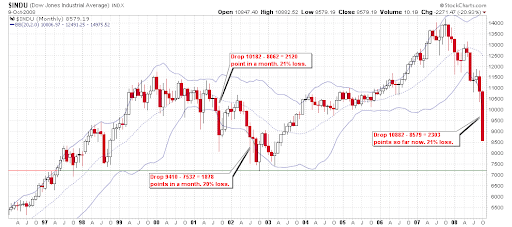
The market dropped almost like a free fall, which is totally out of my expectation. Today I nearly believed that this time might be indeed different until I checked the monthly chart of major indices and calculated the declining in the worst months in 2001 and 2002. I hope the following chart could let you feel better. What I want to say is that the history will repeat and it is ultimately important to be patient no matter you hold any position or not.


Here is an excerpt from a blog(http://www.thekirkreport.com/2008/10/the-stock-marke.html), which is helpful in my opinion:
    They say you have to listen to the message of the market and that message today is to run for your life. Every business in America is going bankrupt and taking you, your financial future, job, savings, and everything you know with it. If you believe that, you should have been selling everything today. I don't, which is why I'm going to the mattresses and fighting the good fight every single day. Sure, the battle scars are starting to get numerous and even I am having a difficult time staying opportunistic, but everything I've worked for and learned over the past twenty years has prepared me for what we're seeing now. My only hope is that I stay up to the challenge and hold true to my strategy even though like everyone else, I'd very much like to run for my life and sell & short everything in sight.
2.4.2 NYSE - Issues Advancing. NYADV is still a higher low today. Therefore the hope isn't gone.


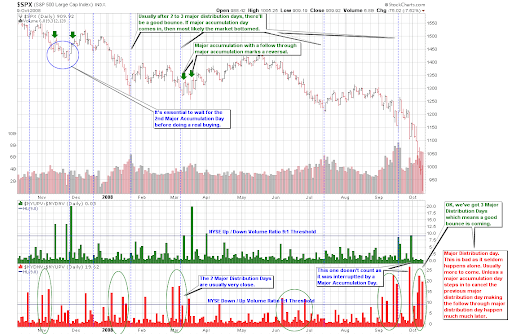
1.0.5 Major Accumulation/Distribution Days. Today is the third Major Distribution Day. According to the history there will be a decent rally after three major distribution days. However note that last time the rally came after four major distribution days. So it is not the time to be optimistic yet.


1.1.4 PowerShares QQQ Trust (QQQQ 60 min). Among all major indices only QQQQ shows a piece of hope. It is still in a bullish falling wedge, and MACD and RSI show positive divergence as well.


2.0.0 Volatility Index (Daily). The chart says today is not the bottom, but STO has reached a level where a reversal happened several times in the past.


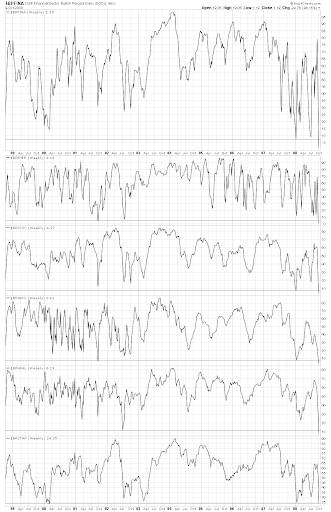
5.0.2 S&P Sector Bullish Percent Index. Maybe "overbought" doesn't mean anything at the time being. But let's take a look at major sectors anyway. Bullish Percent Index has reached a 10-year low now.


Related Posts :
  1. 10/9/2008 : Market Panic
  2. Bear Market of 2000-2003
  3. 1929-32 Rallies
  4. 10/08/2008 Market Recap: Almost a reversal day
Please Note!
This is generally never true. Before buying or selling any stock you should do your own research and reach your own conclusion. See my Disclaimer on the bottom for more information.

You are welcome to republish this article, or any portion thereof.
Please, cite the actual/original source. I would be grateful if you could link back.


Stumble Upon Toolbar Add to Technorati Favorites Bookmark and Share