Translate this page from English into :

Saturday, October 25, 2008

Ukraine asks for IMF bailouts along with Hungary and Belarus

The National Bank of Ukraine (Ukrainian: Національний банк України) is the central bank of Ukraine.
Photo courtesy of Flickr

Ukraine's currency, the hryvnia, has lost a fifth of its value in the last eight days. It now leads a host of former Soviet-controlled states in Eastern Europe that, severely exposed by the new mood of fiscal rectitude on the financial markets, have turned to the IMF to stave off collapse. This week it hopes to enter the equivalent of receivership, but only if it can meet the terms of a $14 billion International Monetary Fund (IMF) bail-out.

The Eastern bloc states, Hungary and Belarus, have joined Ukraine in making formal applications for IMF bailouts but others, including the Baltic States, all members of the EU, have entered secret consultations for international help.

With a range of continuing disputes with the Kremlin during an intractable domestic political dispute, economic collapse has rendered Ukraine vulnerable to a resurgence of Russian influence. Last week a Russian consortium was seen as a leading contender to take over the failed Ukrainian bank, Prominvest.

Ukraine's pro-Moscow opposition has spent months warning that the government had steered disastrously away from Russia, a path that jeopardised its economy. Last week Serhyi Taruta, the country's leading steel magnate, compounded its crisis by warning of mass lay-offs in the vital industry.

"The main effect on Latvia has been a dramatic fall in economic growth, from 12 per cent when we joined the EU to 1 per cent now," said MEP Rihard Piks, who was the Latvian foreign minister when the country joined the EU in 2004.

Related Posts :
  1. IMF loans US $2 bln to Iceland
  2. Four Currency Crises: Hungary, Iceland, Pakistan, and Argentina
  3. Swiss banking collapse is going to be one biggest domino to fall
  4. Iceland receives $6 bln rescue package
  5. Will Hungary be the next Iceland?
Sources :
Please Note!
This is generally never true. Before buying or selling any stock you should do your own research and reach your own conclusion. See my Disclaimer on the bottom for more information.

You are welcome to republish this article, or any portion thereof.
Please, cite the actual/original source. I would be grateful if you could link back.


Stumble Upon Toolbar Add to Technorati Favorites Bookmark and Share

The Worldwide is waiting for The Fed's benchmark rate decision policy

The rest of the world focus will be on how far the U.S. The Fed in the next week will go to in cutting interest rates to revive an economy that most analysts now agree is already in a recession. The Fed as having no reason to go light on its rate cut, according to Avery Shenfeld, economist at CIBC World Markets, which expects a half-point cut on Wednesday after its two-day rate review meeting.

And that's even before economists see the third quarter gross domestic product (GDP) report, which comes out Thursday. The consensus among economists is that the report will show the U.S. economy contracted at an annualized pace of 0.5%.

Even without the latest GDP data in hand, a steady stream of grim economic data, including nine consecutive months of non-farm job losses, has made it abundantly clear that the United States is in recession, according to Meny Grauman, another analyst at CIBC, which projects the shrinkage will be an even greater 0.7%. This makes the expected drop in third quarter real GDP growth less of a surprise and more of a confirmation of an open secret.

But the big picture report on the U.S. economy will be only one of a string of bad reports out of the U.S. through the week, which analysts say will include further declines in new home sales, house prices, consumer confidence, durable goods orders, and personal income and spending.

According to Kathy Lien, analyst at Global Futures & Forex, Ltd. (GFT), the market is now pricing in an 68 percent chance of a 50bp rate cut and an 32 percent chance of a 75bp rate cut.

Table courtesy of Kathy Lien

This indicates that the market believes 25bp will be the minimum that the Fed eases on Wednesday. She believe that a 75bp rate cut will be a too aggressive because it leaves the central bank with next to no room to cut interest rates in case things get worse – and they will.

The three most realistic options are:

1. 50bp rate cut
2. 50bp coordinated easing along with other central banks
3. 25bp rate cut

A coordinated easing will probably have the most significant impact on the financial markets and given the drop in oil prices and the deterioration in European economic data, the ECB and the BoE may not be opposed to this option.

Although the Fed may have considered a 25bp rate cut earlier this week, they know that if they under deliver now, the consequences for the equity market could be severe. A larger interest rate cut could put a stop to the dollar’s rally.


Related Posts :
  1. US mulls buying stakes In US Insurers
  2. Citadel Denies Rumors of Trouble
  3. U.S. Investing $250 Billion in Banks
  4. Senate Passes $700 Bn Bailout!
Sources :
  1. Kathy Lien: Fed Fund Futures Pricing in 75bp Rate Cut on Oct 29?!, October 24, 2008
  2. The Financial Post: World markets await U.S. interest rates decision, October 24, 2008
Please Note!
This is generally never true. Before buying or selling any stock you should do your own research and reach your own conclusion. See my Disclaimer on the bottom for more information.

You are welcome to republish this article, or any portion thereof.
Please, cite the actual/original source. I would be grateful if you could link back.


Stumble Upon Toolbar Add to Technorati Favorites Bookmark and Share

US mulls buying stakes In US Insurers

Photo courtesy of The Huffington Post

WSJ - The Treasury Department is considering buying equity stakes in insurance companies, a sign of how the government's $700 billion rescue program could turn into a piggy bank for a range of beleaguered industries.

The availability of U.S. government cash in the middle of a global credit squeeze is drawing requests from insurance firms, auto makers, state governments and transit agencies. While Treasury intended for the program to apply broadly, the growing requests could put a strain on the $700 billion, a sum that only last month stunned lawmakers.

Image courtesy of The Big Picture

MetLife Inc. and Prudential Financial Inc., two of the nation's largest publicly traded life insurers, and New York Life Insurance Co., one of the highest rated insurers in the U.S., are interested in exploring a sale of equity stakes to the government, according to people familiar with the matter.

Broad participation in the rescue program would put more power in the hands of government to reshape the finance industry. On Friday, PNC Financial Services Group Inc., said Treasury would buy $7.7 billion of preferred stock and warrants. The cash injection will help the bank purchase struggling National City Corp., a move pushed by federal regulators.

In September, the government extended an $85 billion rescue loan to giant insurer American International Group Inc. (AIG) in exchange for an 80% stake.

Insurers are critical to market stability. Signs of eroding confidence at life insurers could further dent fragile business and consumer confidence. Insurers are among the biggest holders of the nation's corporate debt, with $1.3 trillion on their books. They are long-term investors, holding the securities for years, even decades.

As they've sought to shore up their own balance sheets in recent weeks, insurance companies, like banks, have retreated from this role as lender, instead hoarding cash, according to Robert Riegel, a managing director at ratings firm Moody's Investors Service, which exacerbates the credit crunch.

Most insurance companies are financially sound but have seen their long-term investments and stock prices fall in value. Some have holdings of riskier alt-A and subprime-mortgage backed securities. Insurers have suffered losses in bond and preferred-stock holdings from the collapse of companies including Lehman Brothers Holdings Inc. Insurers also have been hit with billions of dollars in unrealized losses as corporate bonds of all stripes suffered big declines. Low interest rates have damped interest income and a prolonged economic slump could dent the variable-annuity business and even hurt sales of core life-insurance policies.

Insurers would normally tap capital markets to raise money. But many are loath to attempt selling common stock because their share prices have been so battered. That's one reason many insurers have been pushing the expansion of Treasury's equity-stake program to raise capital.

Treasury had already envisioned insurance companies using one element of its rescue program: selling bad assets, such as mortgage-backed securities, to the government. But Treasury officials are considering whether to buy equity stakes in certain firms, according to people familiar with the matter.

Under the terms of Treasury's program, eligible insurers must be operated by either a financial institution holding company or a savings and loan holding company. The holding companies must also be regulated by a federal agency.

The investment funds would come from Treasury's recently announced plan to invest $250 billion in U.S. banks. Treasury has already committed $125 billion to nine large banks. More than 20 additional banks are expected to receive equity infusions in coming days.

Treasury Secretary Henry Paulson asked Congress for wide discretion in the program. That's prompting requests from myriad industries. Some want capital injections. Others want to sell troubled assets, such as bad loans, to the government.

The Financial Services Roundtable, a Washington trade group, sent a letter Friday to Treasury asking for expansion of the government's equity injection program to include broker-dealers, insurance companies, auto makers and foreign-controlled firms.

Auto makers in particular are looking for a lifeline. On Thursday, members of Michigan's congressional delegation sent a letter to Mr. Paulson and Federal Reserve Chairman Ben Bernanke, urging the Bush administration to allow auto companies to participate in the program, a move many in Detroit hope would smooth the way for a merger of General Motors Corp. with Chrysler LLC.

State and local governments also are angling for help as they struggle to raise money. Members of Congress and several mayors have asked Mr. Paulson to use the rescue funds to buy state and municipal bonds.

For most of this year, the insurance industry seemed to be weathering the credit crisis. The industry has plenty of capital to pay policyholders, according to insurance regulators in two big states and senior executives at credit-ratings firms. But in recent weeks, the stocks of some of these firms have been slammed. More bad news is expected next week, when many of the large publicly traded life insurers report third-quarter earnings.

After Allstate Corp. released disappointing third-quarter results, Moody's Investors Service lowered ratings on the company's life-insurance unit to Aa3 from Aa2. The stated reasons included "the weakening of the [life] company's intrinsic credit profile," though it maintained the Aa2 rating for Allstate's core car-insurance business.

The big ratings agencies have the life-insurance sector on "negative" outlook, anticipating a round of one- to two-notch downgrades, as companies brace for additional investment losses, weaker earnings and reduced financial flexibility. Many life-insurance products are pitched to consumers on the basis of an insurer's financial strength, so moving to a lower rating can have an impact on sales.

Related Posts :
  1. IMF loans US $2 bln to Iceland
  2. Citadel Denies Rumors of Trouble
  3. U.S. Investing $250 Billion in Banks
  4. Senate Passes $700 Bn Bailout!
Sources :
Please Note!
This is generally never true. Before buying or selling any stock you should do your own research and reach your own conclusion. See my Disclaimer on the bottom for more information.

You are welcome to republish this article, or any portion thereof.
Please, cite the actual/original source. I would be grateful if you could link back.



Stumble Upon Toolbar Add to Technorati Favorites Bookmark and Share

IMF loans US $2 bln to Iceland

Geir Haarde, Iceland's Prime Minister, expects the IMF to grant the loan within the next 10 days. Photo: AP

Iceland reached a deal for a $2 billion loan from the International Monetary Fund and said it hoped to secure additional support from other countries, as it hurries to rescue a financial system brought down by the credit crisis and an economy teetering on the brink of collapse.

Iceland's turn to the IMF led to a rare loan from the organization to a Western nation after the nation had scrambled to find a way to avoid the financial system collapsed, even sending a delegation to Moscow to negotiate a loan with Russia. But it returned empty-handed. Other Nordic countries indicated that they might help out, but they signaled the IMF would have to take a lead role first.

Iceland had effectively run out of other options for attracting the foreign cash needed to reanimate its currency. The Icelandic krona, under pressure all year, wilted this month when the three banks that make up nearly the entire Icelandic financial system collapsed and were seized by the government. The krona stopped functioning off the island, throwing trade into chaos and causing a potentially dire situation for an isolated population heavily dependent on imports. The currency crisis has sent inflation soaring.

In a statement, the Icelandic government said the loan will shore up foreign-currency reserves -- just €2 billion ($2.58 billion) when the crisis started. "The goal is to restore faith in the Icelandic economy and stabilise the currency and restructure the banking system," Prime Minister Geir Haarde told a news conference broadcast on national television. He added, "This program will enable us to secure funding and gain access to the necessary technical expertise required to stabilize the Icelandic krona and to provide support for the development of a healthier financial system. As a result, Iceland will commit to a sustainable long-term economic policy, and a plan for the recovery of the Icelandic economy".

Iceland said the loan will be voted on by the IMF executive board "as soon as possible." The IMF said the agreement could reach the board in early November. As soon as the package is approved, Iceland could initially draw as much as $830 million. The loan would be for two years with repayments likely to begin between 2012 and 2015. The IMF praised the "ambitious economic programme" put forward by Iceland, promising a loan nearly 12 times the Nordic nation's contributions to the fund despite a policy of granting just five times each country's quota. Britain was the last European country to require an IMF loan, when it was forced to borrow from the global lender of last resort in 1976.

Accepting assistance from the IMF means tough budgetary strictures. Iceland said it will tighten its fiscal policy, committing "to a sustainable long-term economic policy, and a plan for the recovery of the Icelandic economy".

Iceland's crisis was triggered by its three big banks, who grew rapidly over the past half-dozen years by borrowing and lending abroad. Their swelling size delivered profits, but it also left Iceland exposed: When the credit crunch struck, the Icelandic banks -- like others around the world -- faced trouble refinancing their borrowings. But unlike banks in larger countries, the Icelandic banks found their small home country simply didn't have the resources to back them up. The assets of the three largest banks reached some €100 billion -- 10 times Iceland's annual economic output.

Related Posts :
  1. Four Currency Crises: Hungary, Iceland, Pakistan, and Argentina
  2. Iceland receives $6 bln rescue package
  3. Will Hungary be the next Iceland?
  4. Iceland Meltdowns
  5. The Stunning Collapse of Iceland
Sources :
  1. The Wall Street Journal: Iceland Borrows $2 Billion From IMF, October 25, 2008
  2. The Financial Post: Iceland reaches deal for US$2-billion IMF bailout, October 24, 2008
  3. The New York Times: I.M.F. Loan to Iceland Moves Ahead, October 25, 2008
  4. Telegraph.co.uk: Iceland to get £1.3bn IMF loan, October 24, 2008
Please Note!
This is generally never true. Before buying or selling any stock you should do your own research and reach your own conclusion. See my Disclaimer on the bottom for more information.

You are welcome to republish this article, or any portion thereof.
Please, cite the actual/original source. I would be grateful if you could link back.


Stumble Upon Toolbar Add to Technorati Favorites Bookmark and Share

Citadel Denies Rumors of Trouble

Kenneth Griffin of Citadel called rumors “categorically false.” (Phil McCarten/Reuters)

The hedge fund manager Kenneth C. Griffin said that any rumors about liquidation, Fed intervention, or forced selling are “categorically false.” Rumors swirled that both the Federal Reserve and U.K. Financial Services Authority visited Citadel’s offices on Friday, October 24, discussing how to deal with a potential collapse of the $20 billion alternative investments giant. The rumors included word that Citadel was down 60 percent.

In the emergency conference call that transfixed Wall Street, Mr. Griffin said, The firm, which is based in Chicago, has ample cash and financing facilities on hand, and its investors have withdrawn only a small amount of their money

Mr. Griffin also said the Chicago-based hedge fund maintains 30% of its capital in cash. The recent market turmoil has been rough for hedge funds with many of them reporting record losses. Citadel has taken a hit and has reported returns that have dropped 26% to 30%, according to the Wall Street Journal.

The firm's largest hedge fund, known as Kensington/Wellington, had fallen 35% so far this year, through the end of Oct. 20. Still, Mr. Griffin noted that most of the losses happened in the month after Lehman Brothers collapsed and stressed that performance has been better recently. In contrast, Citadel's market-making business has performed "spectacularly" this year and will be a major driver for the firm in future, Mr. Griffin said during a conference call with holders of the firm's medium-term notes. Still, Citadel will have to change its business to reflect unprecedented de-leveraging and fear in the markets. Some businesses, such as long/short equity trading, won't be affected much, but others will have to be more efficient in their use of Citadel's balance sheet, Griffin explained.

Earlier in the month Mr. Griffin sent a letter to investors saying September was the "single worst month, by far, in the history of Citadel. Our performance reflected extraordinary market conditions that I did not fully anticipate, combined with regulatory changes driven more by populism than policy."

Mr. Griffin is not only famous for buying assets cheaply. Citadel in the past has been strong when others were weak. Mr. Griffin has often called his competitors at their weakest moments and offered pennies on the dollar for their portfolios. Some of his recent winnings came from trouble at E*Trade, and the collapse of the hedge funds Sowood Capital and Amaranth Advisors.

While Gerald Beeson, the company’s chief operating officer, said that the firm worked with a variety of prime brokers and had credit lines with commercial banks. Citadel has not tapped $8 billion of that credit, and the company has 30 percent of its capital in cash.

Citadel is leveraged just under 3 to 1 in its equity and credit-related businesses, which means it borrows $3 for every $1 it has in capital. That is a decrease from past levels.

Citadel also repurchased some 10 to 20 percent of its own debt in the last few days when approached by bondholders, according to a person with knowledge of the matter. Its bonds were put on negative watch by the ratings agencies in recent weeks. Mr. Beeson said that most of the funds’ losses were mark-to-market losses, which he thought were caused by a lack of liquidity and not by weakened assets. Earlier this year, investment banks said their losses were being caused by similar liquidity problems. Asked how Citadel’s paper losses differed, Mr. Beeson said, “This is not a portfolio of illiquid real estate assets. It is a portfolio principally consisting of bonds, equities and related assets.”


Related Posts :
  1. Rumors: The Fed is visiting some midwest hedge fund
  2. 10/24/2008 Market Recap - Global Investors Retreat (Update 1)
  3. Nouriel Roubini: Stay away from 'risky' assets
  4. 10/23/2008 - October Blues
  5. Trading in the panic mode, futures halted
  6. Markets are in absolute freefall
Sources :
  1. Fox Business: Citadel Investment Group Stamps Out Rumors, October 24, 2008
  2. Fox Business: Citadel: Main Hedge Fund Down 35% This Year Through Oct. 20, October 24, 2008
  3. The New York Times: Citadel Chief Denies Rumors of Trouble, October 24, 2008
Please Note!
This is generally never true. Before buying or selling any stock you should do your own research and reach your own conclusion. See my Disclaimer on the bottom for more information.

You are welcome to republish this article, or any portion thereof.
Please, cite the actual/original source. I would be grateful if you could link back.


Stumble Upon Toolbar Add to Technorati Favorites Bookmark and Share

10/24/2008 Market Recap - Global Investors Retreat (Update 2)

Chart courtesy of http://finance.google.com (Click to enlarge)

According to Reuters, Stocks dropped on Friday in a worldwide sell-off with investors cashing out of stocks as signs mounted that the global economic slowdown could be deeper than feared and the corporate profit outlook darkened.

A man walks past an electronic board displaying major indices in Tokyo October 24, 2008. (REUTERS/Toru Hanai)


An employee of the Korea Stock Exchange works in front of a screen that shows the falling Korean benchmark stock index in Seoul, South Korea, Friday, Oct. 24, 2008. The Korea Composite Stock Price Index plummeted 110.96 points, or 10.6 percent, to finish at 938.75, its lowest close since May 2005.(AP Photo/Ahn Young-joon)

It was not the bloodbath many had feared, however, even though stocks ended at 5-1/2-year lows. In the overnight hours, selling was so fierce that index futures were halted until after Wall Street's opening bell. ( see: Markets are in absolute freefall and Trading in the panic mode, futures halted )

Stock markets tumbled around the globe on Friday were due to forced liquidations by hedge funds and mutual funds to raise cash to meet large-scale redemptions by investors made the losses even steeper. The MSCI's all-country world index dropped 5 percent on more evidence of a sharp slowdown in Europe and a rash of profit warnings worldwide. ( see: 10/24/2008 - October Blues ).

A rout in Asian and European stock markets sent the Dow Jones industrial average swooning by more than 500 points in early trading in New York, but trading recovered enough ground through the day to leave the Dow down 312.30 points, or 3.6 percent.

Just a year ago, a drop of that size would have been considered a black day in the markets, but in these days of routine triple-digit declines, it offered a modicum of relief to traumatized investors.

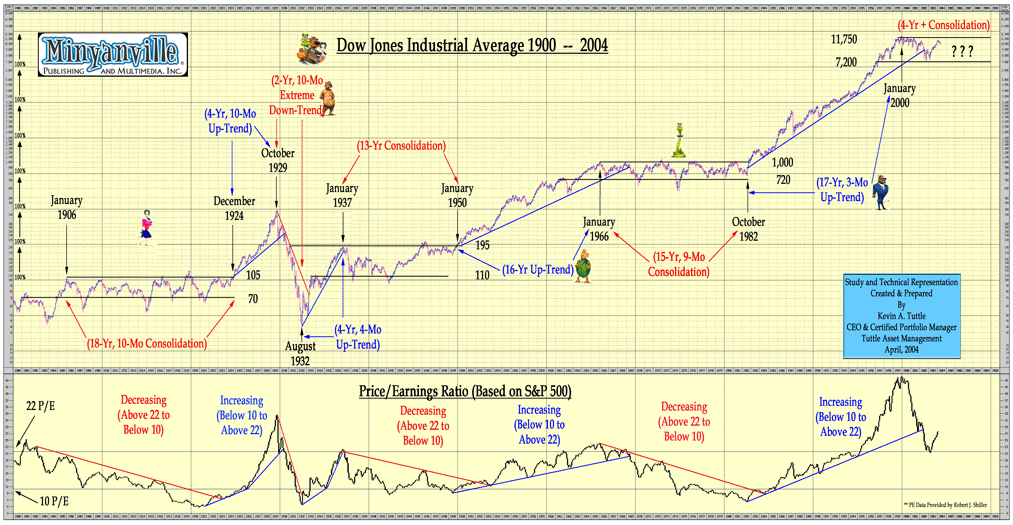
The moves in the Dow Jones Industrial Average these days is strikingly similar to the move in 1906 and 1907
Chart courtesy of Barclays Capital (Click to enlarge)

The Dow from 1900 - 2004
Chart courtesy of Minyanville (Click to enlarge)


Here is an article of S&P 500 forming "W" Bottom from The Big Picture :
    Chart courtesy of The Big Picture (Click to enlarge)

    Watch today's volume --

    As seen in the chart above the 3 heaviest volume days (highlighted by green circles) in the last two weeks on SSO (Ultra S&P 500 ProShares) an ETF that seeks daily investment returns that correspond to twice (200%) the daily performance of the S&P 500 Index, were on days the index finished up in price.

    This suggests accumulation and could suggest a complex bottoming formation is occurring, particularly when one looks at the recent extremes in sentiment data.

    A minor downtrend line (red line) comes into play near $ 31.90. Above this level would suggest that the SSO’s are indeed forming a “W” low here. Only a high volume break below the 52 Week lows would turn the technical picture decidedly negative again.

Related Posts :
  1. Nouriel Roubini: Stay away from 'risky' assets
  2. The top 10 Benjamin Graham value plays
  3. 10/23/2008 - October Blues
  4. Trading in the panic mode, futures halted
  5. Markets are in absolute freefall
Sources :
  1. The New York Times: Currencies Fall as Fears Spread and Stocks Slip, October 24, 2008
  2. Kathy Lien: Dollar Closing In on 5% Targets, Where are the Value Points?, October 24, 2008
  3. Kathy Lien: Dow Jones Industrial: Does the Past Offer Hope?, October 15, 2008
Please Note!
This is generally never true. Before buying or selling any stock you should do your own research and reach your own conclusion. See my Disclaimer on the bottom for more information.

You are welcome to republish this article, or any portion thereof.
Please, cite the actual/original source. I would be grateful if you could link back.


Stumble Upon Toolbar Add to Technorati Favorites Bookmark and Share