Translate this page from English into :

Thursday, October 23, 2008

Greenspan: Incredible Testimony!

Former Federal Reserve Chairman Alan Greenspan testifies during a House Oversight and Government Reform Committee hearing on Capitol Hill Thursday.
Photo courtesy of WSJ

The former Fed chairman, Mr. Alan Greenspan, finally admits his mistakes. In a four-hour appearance before the House Oversight Committee Thursday, Mr. Greenspan encountered legislators who interrupted his answers, caustically read back his own words from years ago, and forced him to admit that, at least in some ways, his predictions and policies had been wrong.

Mr. Greenspan though banks were able to assess risk and their self-interest would protect them from excesses. So, he kept short-term interest rates at 1% for a year earlier this decade. He argued, " no one could have predicted the collapse of the housing boom and the financial disaster that followed".

Despite being Fed chairman had the authority to prevent irresponsible lending practices that led to the subprime-mortgage crisis. But he would not like to intervene into market although he was advised to do so by many others. And now our whole economy is paying its price.

In the recent years, Mr. Greenspan said there's "no evidence" home prices would collapse and "the worst may well be over". He quoted something he had written in March: "Those of us who have looked to the self-interest of lending institutions to protect shareholder's equity (myself especially) are in a state of shocked disbelief." He conceded that he has "found a flaw" in his ideology and said he was "distressed by that." Yet Mr. Greenspan maintained that no regulator was smart enough to foresee the "once-in-a-century credit tsunami."

The difficulties of forecasting served as a key defense for Mr. Greenspan. The Federal Reserve, with its legions of Ph.D. economists, has a better forecasting record than the private sector, he said, but that's still not enough to prevent every problem. "We were wrong quite a good deal of the time," he said. Forecasting "never gets to the point where it's 100% accurate". If the best experts were not able to foresee the development, "I think we have to ask ourselves, 'Why is that?'" Mr. Greenspan said. "And the answer is that we're not smart enough as people. We just cannot see events that far in advance."

When Rep. Waxman asked pointedly, "Were you wrong?"

Mr. Greenspan said, "Partially." While he cautioned the lawmakers against excessive regulation, he said credit-default swaps "have serious problems" and, after some pointed questions, agreed they should be subject to oversight.

Related Posts :
  1. Four Currency Crises: Hungary, Iceland, Pakistan, and Argentina
  2. Nouriel Roubini:"Panic" May Force Market Shutdown
  3. 10/22/2008 - Nouriel Roubini on CNBC this morning
  4. Never Fight the Fed, Treasury, ECB, BOE and Bank of Japan
  5. The Full Nouriel Roubini Horror Speech
  6. George Soros: Global Capital Meltdown
  7. Warren Buffett: We Have "Terrible, Terrible Problems
Source :
Please Note!
This is generally never true. Before buying or selling any stock you should do your own research and reach your own conclusion. See my Disclaimer on the bottom for more information.

You are welcome to republish this article, or any portion thereof.
Please, cite the actual/original source. I would be grateful if you could link back.



Stumble Upon Toolbar Add to Technorati Favorites Bookmark and Share

10/23/2008 - Upgrade & Downgrade (Update 2)

From theflyonthewall:
    Analyst upgrades:

    1. Keefe Bruyette upgraded shares of Colonial Bancgroup (NYSE: CNB) to Outperform from Market Perform on valuation following the recent weakness and believes the company will be eligible to receive TARP funds. Morgan Stanley believes the company's valuation adequately reflects risk to the loan portfolio; the firm raised shares to Equal Weight from Underweight.

    2. Merrill upgraded Ericsson (NASDAQ: ERIC) and ASML Holding (NASDAQ: ASML) to Buy from Underperform and believes their valuation reflects the worst-case for bad news.

    3. Oppenheimer upgraded Trimble Navigation to Outperform from Perform on valuation as they believe the company's long-term growth story is intact.

    4. Celestica (NYSE: CLS) was upgraded to Sector Outperformer from Sector Performer at CIBC.

    5. KeyCorp (NYSE: KEY) was added to Goldman's Conviction Buy List.

    6. Wachovia raised EastGroup Properties (NYSE: EGP) to Outperform from Market Perform.

    Analyst downgrades:

    1. UBS cut Barclays (NYSE: BCS) to Neutral from Buy as they believe capital raises could negatively impact earnings and that the dividend is likely to be cut.

    2. JP Morgan downgraded Discovery Holdings (NASDAQ: DISCA) to Underweight from Neutral based on valuation and the deteriorating economic outlook.

    3. Friedman Billings downgraded shares of Janus Capital (NYSE: JNS) to Underperform from Market Perform and lowered its target to $7 from $23 as they see further risk to the downside following the company's weaker-than-expected results.

    4. LKQ Corp (NASDAQ: LKQX) was cut to Sector Perform from Outperform at RBC Capital.

    5. Affymetrix (NASDAQ: AFFX) was lowered to Sell from Hold at Deutsche Bank.

    6. RightNow Tech (NASDAQ: RNOW) was downgraded at Baird to Neutral from Outperform.

From Standard & Poor's Equity Research:
    Amazon.com, Inc. (AMZN)

    Citigroup cuts target, reiterates buy

    Amazon.com (AMZN) reported third-quarter EPS of 27 cents. Citigroup analyst Mark Mahaney says Amazon's $4.26 billion in revenue was slightly lower than his $4.28 billion estimate and Wall Street's forecast of $4.27 billion; the 27 cents GAAP EPS would have been in line with the Street's 25 cents estimate if adjusted for a $24 million forex re-measurement gain. Mahaney notes the big surprise in the report was Amazon's guidance, with the company lowering midpoint fourth quarter revenue to $6.50 billion vs. the Street's $7.05 billion, and reducing midpoint operating income for the period by 24% to $310 million vs. the Street's roughly $401 million view. Mahaney cut his $1.49 2008 EPS estimate to $1.38, his $1.79 2009 forecast to $1.50, and his $93 price target to $52, implying 21% estimated total return from $43 aftermarket price. The analyst kept his buy rating on the shares.

    Cadence Design Systems (CDNS)

    Citigroup downgrades to hold from buy

    Cadence Design Systems (CDNS) announced an accounting review. Citigroup analyst Terrance Whelan says he's downgrading Cadence to hold from buy and removing it from the firm's Top Picks Live list, as Cadence's accounting review of first quarter revenues removes three of four catalysts behind his upgrade on Aug. 17. Whelan says the accounting review freezes stock buybacks and casts doubt on results/guidance timing. Also, the Oct. 16 management exodus was deeper and potentially more disruptive than he expected. According to the analyst, this leaves Cadence's October cost cuts as a near-term catalyst, but this appears already modeled and "known" by Wall Street. Whelan cut his $11.50 price target on the shares to $5.50.

    Tractor Supply Co. (TSCO)

    Raymond James ups to outperform from market perform

    Tractor Supply (TSCO) posted third-quarter results that beat Wall Street expectations. Raymond James analyst Dan Wewer says Tractor Supply's EPS of 53 cents was well ahead of his and Street's 47 cents forecast. He notes two sources of the EPS upside were a 6.2% same-store sales gain and better-than-anticipated expense management. Wewer notes inventory productivity improved for the fourth consecutive quarter. He says the company's improved inventory management and greater focus on controlling expense increases during this cycle are impressive. The analyst raised his 2008 EPS estimate to $2.58, and 2009's to $2.88, to reflect better-than-anticipated year-to-date performance. He has a $38.50 price target on the shares.

    S&P UPGRADES OPINION ON SHARES OF AMAZON.COM TO BUY FROM HOLD

    AMZN; $49.99

    Amazon.com posts third quarter EPS of $0.27 vs. $0.19, a penny higher than our estimate. Sales grew 31%, in line with our projection, driven by impressive growth in electronics. Given expected weakness in consumer spending and a projected headwind from forex, we are lowering our 2008 and 2009 operating EPS estimates to $1.35 and $1.63, from $1.41 and $1.77. We are also cutting our discounted cash flow (DCF)-based 12-month target price by $5 to $62. However, we think the shares are now attractive after a severe decline so far in 2008, as we think market-share gains will lead to significant long-term operating margin improvement. /M. Souers

    S&P REITERATES HOLD OPINION ON ADSS OF BAIDU.COM

    BIDU; $237.08

    Baidu.com posts third quarter earnings per American Depositary Share (ADS) of $1.47 vs. $0.70, well above our $1.15 estimate. Revenues rose 85%, in line with our forecast. The company's operating margin was also notably higher than our projection, reflecting scale in the business. Baidu.com indicated its businesses have not been materially impacted by the global financial crises, but noted that certain export customers have been adversely affected. We are raising our per-ADS profit estimates for 2008 to $4.62 from $4.23 and 2009 to $6.79 from $6.46, and setting an 2010 projection of $9.93. Our 12-month target price remains $300. /S. Kessler

    S&P REITERATES HOLD OPINION ON SHARES OF UNITED PARCEL SERVICE

    UPS; $46.39

    Third quarter EPS of $0.96 vs. $1.05 beats our $0.89 estimate, as fuel surcharges helped revenue growth and salaries and wages were well controlled. UPS expects a challenging environment and thinks 2008 EPS should be "toward the lower end" of its previous guidance of $3.50-$3.70. We are cutting our 2008 and 2009 EPS estimates to $3.55 and $3.60, respectively, from $3.58 and $3.75, and our 12-month target price to $50 from $60; 13.8X our 2009 EPS estimate, below both the S&P 500 and the low end of UPS's 5-year historical P/E range of 17.0X-30.4X trailing EPS, to reflect the economy. /J. Corridore

    S&P MAINTAINS STRONG BUY OPINION ON SHARES OF NOBLE CORP.

    NE; $5.59

    Noble Corp. posts third quarter EPS of $1.47 before $0.04 of one-time charges, vs. $1.18, $0.19 shy of our estimate. Results were led by higher dayrates for jackups and floaters, partly offset by weaker utilization. Contract drilling operating expense came in at approximately $54,000 per operating day, down 1.3% from Q2, which we view as a strong cost control performance. Notably, Noble said that it is seeing incremental tender activity in all its major jackup markets, which we think bodes well for potential renewals in 2009. We will update following today's 2 PM conference call. /S. Glickman

    S&P MAINTAINS SELL RECOMMENDATION ON SHARES OF ALLSTATE CORP.

    ALL; $28.23

    Allstate posts a third quarter operating loss of $0.35 vs. operating EPS of $1.54, missing our $1.00 EPS estimate, mainly due to $1.8 billion of catastrophe claims, as, in our view, Allstate's broad market presence is difficult to effectively reinsure. We remain concerned about credit quality and liquidity in Allstate's investment portfolio, despite recent "risk mitigation" efforts. We are cutting our 2008 operating EPS estimate by $1.45 to $3.60, and 2009's by $0.60 to $5.20. We are raising our target price by $3 to $26; 0.9X estimated 2008 tangible book value - the low end of historical averages. /C. Seifert

    S&P UPGRADES OPINION ON PULTE HOMES SHARES TO BUY FROM HOLD, ON VALUATION

    PHM; $9.95

    Pulte posts a third quarter loss of $1.11 per share vs. a $3.12 loss, after $266M in asset impairments, wider than our $0.33 loss estimate. Pulte again reduced debt by $300M and has $1.2B in cash, with a target of $1.6B-$1.8B by end of 2008. Third quarter homebuilding revenues declined 37% year-over-year, but was flat with Q2. With Pulte's net orders down, we forecast a 35% sales decline for full-year 2008, followed by a further 24% decline in 2009. We are widening our 2008 loss estimate to $5 from $4 and 2009's loss to $1 from $0.50. Applying a price-to-book slightly above 1X, we are lowering our target price to $13 from $14. /K. Leon, CPA


Related Posts :
  1. 10/22/2008 - Upgrade & Downgrade (Update 1)
  2. 10/21/2008 - Upgrade & Downgrade
Sources :
  1. BloggingStocks: Analyst calls: CNB, ERIC, ASML, TRMB, BCS, DISCA, JNS, RGEN, GPS and NTY, October 23, 2008
  2. BusinessWeek: Analyst Actions: Amazon.com, Cadence Design, Tractor Supply, October 23, 2008, 12:34PM EST
  3. BusinessWeek: S&P Picks and Pans: Amazon.com, Baidu.com, UPS, Allstate, October 23, 2008, 09:52AM EST
Please Note!
This is generally never true. Before buying or selling any stock you should do your own research and reach your own conclusion. See my Disclaimer on the bottom for more information.

You are welcome to republish this article, or any portion thereof.
Please, cite the actual/original source. I would be grateful if you could link back.


Stumble Upon Toolbar Add to Technorati Favorites Bookmark and Share

Four Currency Crises: Hungary, Iceland, Pakistan, and Argentina

From Paul Kedrosky:
    Compare the recent performance of four currencies now going through economic crises. Argentina is nationalizing its pension system to bail itself out of debt obligations; Hungary has had foreign lending dry up and force it to yank rates to double-digits; the Iceland story is well known; and Pakistan is looking for $4b in IMF support to meet looming debt obligations.

    Click to enlarge

Related Posts :
  1. Nouriel Roubini:"Panic" May Force Market Shutdown
  2. Argentina crisis could have global impact
  3. Iceland receives $6 bln rescue package
  4. Nouriel Roubini: How to prevent contagion effects of the financial crisis in Hungary
  5. Will Hungary be the next Iceland?
Source :
Please Note!
This is generally never true. Before buying or selling any stock you should do your own research and reach your own conclusion. See my Disclaimer on the bottom for more information.

You are welcome to republish this article, or any portion thereof.
Please, cite the actual/original source. I would be grateful if you could link back.


Stumble Upon Toolbar Add to Technorati Favorites Bookmark and Share

Nouriel Roubini:"Panic" May Force Market Shutdown


From Bloomberg:
    Oct. 23 (Bloomberg) -- Hundreds of hedge funds will fail and policy makers may need to shut financial markets for a week or more as the crisis forces investors to dump assets, New York University Professor Nouriel Roubini said.

    ``We've reached a situation of sheer panic,'' Roubini, who predicted the financial crisis in 2006, said at a conference in London today. ``There will be massive dumping of assets,'' and ``hundreds of hedge funds are going to go bust,'' he said.

    Group of Seven policy makers have stopped short of market suspensions to stem the crisis after the U.S. pledged on Oct. 14 to invest about $125 billion in nine banks and the Federal Reserve led a global coordinated move to cut interest rates on Oct. 8. Emmanuel Roman, co-chief executive officer at GLG Partners Inc., said today that as many as 30 percent of hedge funds will close.

    ``Systemic risk has become bigger and bigger,'' Roubini said at the Hedge 2008 conference. ``We're seeing the beginning of a run on a big chunk of the hedge funds,'' and ``don't be surprised if policy makers need to close down markets for a week or two in coming days,'' he said.

    Roubini predicted in July 2006 that the U.S. would enter an economic recession. In February this year, he forecast a ``catastrophic'' financial meltdown that central bankers would fail to prevent, leading to the bankruptcy of large banks exposed to mortgages and a ``sharp drop'' in equities.

    Bear, Lehman

    The comments preceded the collapse of Bear Stearns & Cos. and Lehman Brothers Holdings Inc. as well as the government seizure of Freddie Mac and Fannie Mae. The Dow Jones Industrial Average, a benchmark for American equities, has lost 37 percent this year, including its biggest daily drop in more than twenty years on Oct. 15.

    The Dow average rose 0.5 percent to 8563.42 as of 10:09 a.m. today in New York.

    Italian Prime Minister Silvio Berlusconi roiled international markets on Oct. 10, first saying world leaders were discussing shutting down global financial exchanges, and then saying he didn't mean it.

    ``In a fairly Darwinian manner, many hedge funds will simply disappear,'' Roman said, speaking at the same event as Roubini.

    The hedge fund industry is stumbling through its worst year in two decades and posted its biggest monthly drop for a decade in September. Hedge funds are mostly private pools of capital whose managers participate substantially in the profits from their speculation on whether the price of assets will rise or fall.

    `Very Ugly'

    ``Things are getting very ugly also in the emerging markets,'' Roubini said. ``We used to say when the U.S. catches a cold, the rest of the world sneezes. Well, the U.S. now has chronic and persistent pneumonia. It's becoming a mess in emerging markets.''

    Developing nations' borrowing costs jumped to the highest in six years today as Belarus joined Hungary, Ukraine and Pakistan in seeking a bailout from the International Monetary Fund to help weather frozen money markets and a slump in commodities. Argentina risks defaulting for the second time this decade.

    ``There are about a dozen emerging markets that are now in severe financial trouble,'' Roubini said. ``Even a small country can have a systemic effect on the global economy,'' he added. ``There is not going to be enough IMF money to support them.''

    Roubini, a former senior adviser to the U.S. Treasury Department, earlier this month said that the world's biggest economy will suffer its worst recession in 40 years.

    ``This is the worst financial crisis in the U.S., Europe and now emerging markets that we've seen in a long time,'' Roubini said. ``Things will get much worse before they get better. I fear the worst is ahead of us.''

Related Posts :
  1. 10/22/2008 - Nouriel Roubini on CNBC this morning
  2. Nouriel Roubini: How to prevent contagion effects of the financial crisis in Hungary
  3. The Full Nouriel Roubini Horror Speech
  4. Roubini Warns of Possible Systemic Meltdown, "Severe Global Depression"
Source :
Please Note!
This is generally never true. Before buying or selling any stock you should do your own research and reach your own conclusion. See my Disclaimer on the bottom for more information.

You are welcome to republish this article, or any portion thereof.
Please, cite the actual/original source. I would be grateful if you could link back.


Stumble Upon Toolbar Add to Technorati Favorites Bookmark and Share

Bunge's Profit Fall - Fertilizer & Agriculture crash boom bang! (Update 1)

According to Marketwatch, Bunge (BG) , the agribusiness firm, said third-quarter net income fell 33% to $234 million, or $1.70 a share, while sales shot up 52% to $14.8 billion. It still sees 2008 earnings between $11.60 and $11.90 per share. Bunge saw fertilizer sales fall in Brazil, where farmers were having more difficulty getting credit. Agribusiness earnings suffered as a nearly 50 percent drop in corn and soybean prices slowed farmers' sales to Bunge in both Brazil and the United States. The company also reported foreign exchange losses of $471 million, compared with a year-earlier gain of $56 million. The Brazilian real fell 17 percent against the U.S. dollar in the third quarter. I have written this problem prediction since July 29 that the real problem is not the price, but costs and the currency exchange. See the article here.

The investors have been totally irrational when bought the shares was due to too high expectation of Corn Product Company (CPO) acquisition. As result, the prices went up from the April low to the June high. According to its negative cash flow, there were just few peoples who asked Bunge's capabilities to buy CPO. If the company had cash, it was not going to use its shares as currency to buy CPO. ( Bunge used its shares as currency to buy Corn Products (CPO). Each share of Corn Products common stock will be exchanged for 0.4207 of a Bunge common share, and if this average closing price is equal to or less than $108.90, each share of Corn Products common stock will be exchanged for 0.5142 of a Bunge common share.)

The company has a huge amount of debt tied to its fails when gave fertilizers loan to Mato Grosso’s farmers in Brazil.

Here is what I wrote on July 15:
    Bunge (BG)’s Negative Cash Flow and Credit Delinquencies

    Bunge has given fertilizers loan to Mato Grosso’s farmers in Brazil and they obligated that the harvest of Soybean would be delivered to pay their debt. Because the farmers are paying the company in soybeans - which amounted to a bet on rising soybean prices - Bunge hedged its exposure by selling short soybean futures. That's a standard practice for commodities producers. In normal markets, the strategy works, providing Bunge with protection should the price of soybeans decline.

    But with soybean futures shooting up nearly 75% at various points last year, Bunge's hedges have absorbed even more of its precious cash. (As the contracts increase in price, the company is hit with margin calls requiring it to put up more cash to keep the contract open in the hopes prices will drop later.)

    That negative-$411 million in cash flow doesn't even include the unpaid debts from farmers, which Bunge has yet to take charges for. Should Bunge write down its troubled uncollectible accounts receivable by, say, $500 million, that could wipe out almost half of next year's projected earnings.
Now, the share prices have plunged by 70.6% since the June high.

Chart courtesy of StockCharts (Click to enlarge)

Related Posts :
  1. The Agriculture's Bear Market
  2. Forget Oil, the New Bubble Burst is Agriculture
  3. Dennis Gartman Predicts Corn Ethanol Producers Bankruptcy
  4. More Bearish Alert on Bunge(BG)
  5. Bunge (BG)’s Negative Cash Flow and Credit Delinquencies
Sources :
Please Note!
This is generally never true. Before buying or selling any stock you should do your own research and reach your own conclusion. See my Disclaimer on the bottom for more information.

You are welcome to republish this article, or any portion thereof.
Please, cite the actual/original source. I would be grateful if you could link back.


Stumble Upon Toolbar Add to Technorati Favorites Bookmark and Share

10/22/2008 Market Rekap - Global Panic Selling Continues

Chart courtesy of http://finance.google.com

US stocks dived Wednesday on growing global recession fears and skidding oil prices, with the Dow industrials down more than 5.5 percent at the market close.

The Dow Jones Industrial Average dropped 509.83 points (5.64 percent) to 8,523.83 and the tech-heavy Nasdaq composite slid 80.93 points (4.77 percent) to 1,615.75.

The broad Standard & Poor's 500 index fell 57.53 points (6.02 percent) to 897.52, according to preliminary closing figures.

Traders work on the floor of the New York Stock Exchange. Panic-selling has returned to global stock markets with the leading Dow Jones industrial index shedding 5.6 percent and Japan's Nikkei index dropping seven percent in early trade, as fears of a global recession stalked investors.
Source: AFP - Copyright AFP 2008, AFP stories and photos shall not be published, broadcast, rewritten for broadcast or publication or redistributed directly or indirectly in any medium

Corporate profit forecasts, a jump in the dollar and falling commodity prices signaled investors are fearful that an economic slowdown will sweep the globe even if lending begins to approach more normal levels as credit markets ease.

The dollar hit multi year highs against several other major currencies, weighing on commodity prices. That hurt materials and energy companies, while the fall in oil gave a boost to airlines. Light, sweet crude fell $5.43 to $66.75 a barrel on the New York Mercantile Exchange, after falling as low as $66.20.

Gold fell sharply as the dollar rose. Gold for December delivery fell $32.80 to settle at $735.20 an ounce on the Nymex, after dipping to a 13-month low of $735.20 during the session. Silver and copper also fell. Technology shares fared better than the broader market following quarterly reports from Apple Inc. and Yahoo Inc.

While reduced strains in global credit markets have eased some investors' nervousness about the economy, market anxiety remains as hundreds of companies this week report third-quarter results and issue somewhat murky forecasts that are stirring unease about the economic bumps that may lay ahead.

Wachovia Corp., which is being bought by Wells Fargo & Co., reported that it swung to a huge loss in the third quarter by as much as $23.9 billion while the drugmaker Merck & Co. said its quarterly profit fell 28 percent and that it would cut more than 10 percent of its work force.

A man walks past an electric quotation board flashing the Nikkei key index of the Tokyo Stock Exchange in front of a securities company in Tokyo. Panic-selling has returned to global stock markets with the leading Dow Jones industrial index shedding 5.6 percent and Japan's Nikkei index dropping seven percent in early trade, as fears of a global recession stalked investors
Source: AFP - Copyright AFP 2008, AFP stories and photos shall not be published, broadcast, rewritten for broadcast or publication or redistributed directly or indirectly in any medium

In the next day, Japan's Nikkei stock index followed the trend on Thursday tumbling more than seven percent in early trade and hitting the lowest level in more than five years.

The Nikkei-225 lost 658.08 points, or 7.59 %, to 8,016.61, levels last seen in May 2003. Hong Kong's Hang Seng is declining 5.5%, China's Shanghai Composite index is giving away 2.6%, Australia's All Ordinaries index is shedding 4.1%, and South Korea's KOSPI is plunging 9.3%.

Trading on Brazil's stockmarket, the biggest in Latin America, was automatically suspended Wednesday when the main Bovespa index plunged more than 10 percent.

The stockmarket was suspended for 30 minutes at 19:17 GMT, the fifth time in three weeks that the automatic suspension has gone into effect.

Operations were to resume at 19:58 GMT from when a new limit of a 15 percent loss would be set for triggering an automatic suspension of the market, officials said.

Will market rebound tomorrow morning?

Here is the summary of Cobra's chart analysis :
    Today a bad news is that SPX has reached the lowest close in 2008, another one is that the symmetrical triangle we talked about before has broken out at the down side. At the market close SPX went back to the triangle, which means it must go up tomorrow otherwise the Oct 10th low will be in danger. Will the market rise tomorrow? If the market is rational, the probability of bounce back is high.

    NYSE

    Issues Advancing chart is the only hope of bulls recently. NYADV has not shown a lower low so far, which is a characteristics of market bottom. Note the SPX close only chart at the bottom clearly shows that today is the lowest 2008 close.

    Click to enlarge


    Russell 3000 Dominant Price - Volume Relationships

    The dominant price-volume relationships today are 1721 stocks price down volume up, which shows that the market is oversold and due for a rebound.

    Click to enlarge

Related Posts :
  1. 10/22/2008 Market opened by fears (Update 2)
  2. 10/22/2008 - Upgrade & Downgrade (Update 1)
  3. 10/21/2008 Market Recap - Lehman CDS Settlements & Dispointed Earnings
  4. 10/21/2008 - Upgrade & Downgrade
Sources :
  1. AOL Money & Finance: Stocks tumble on worries about earnings forecasts, October 22, 2008 18:35 EDT
  2. Breitbart.com: Brazilian stock market suspended as index plunges, October 22, 2008 03:40 PM US/Eastern
  3. Breitbart.com: US stocks plunge, Dow down more than 5.5 pct, October 22, 2008 04:10 PM US/Eastern
  4. Breitbart.com: Panic-selling returns to world stock markets, Japan stocks drop 7 percent, October 22, 2008 09:28 PM US/Eastern
  5. Cobra's Market View: 10/22/2008 Market Recap: Lowest Close 2008
Please Note!
This is generally never true. Before buying or selling any stock you should do your own research and reach your own conclusion. See my Disclaimer on the bottom for more information.

You are welcome to republish this article, or any portion thereof.
Please, cite the actual/original source. I would be grateful if you could link back.


Stumble Upon Toolbar Add to Technorati Favorites Bookmark and Share

China cuts its housing lending rates and taxes

Estate brokers introduce apartments for sales to potential home buyers at a housing exhibition in Shenyang, Northeast China's Liaoning Province, September 12, 2008. [Xinhua]

Beijing has decided to reduce taxation on home buying, do away with property stamp tax, and cut the mortgage rates by as deep as 30 percent, in a concerted package of new policies to stave off a housing sector slump. from November 1, the property deed tax will decline to 1 percent from 3-5 percent for people buying their first home if it is or smaller than 90 square meters.

For those buying their first home, regardless of the size, the down payment requirement will be lowered to 20 percent from the present 30 percent, and banks will be allowed to charge as little as 70 percent of benchmark lending rates for the mortgages. The new policy also removed the 0.05 percent stamp tax and land value-added tax for home purchases starting from next month.

Real estate investment is the second-largest contributor to China's urban fixed-asset investment, which is a major driver of the overall economy. To build more affordable housing, Beijing may launch a 1 trillion yuan fund to build affordable houses for poorer citizens.

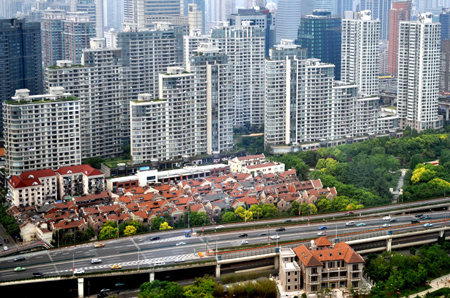
A view of apartment buildings in Shanghai, May 18, 2008. [Xinhua]

Chinese economists have cautioned that a worsening slump in the real estate market in China would not only undermine the healthy growth of the economy, but also put the country's financial system at risk. Housing prices have drop at least four months consecutive in China. For example, in September, the housing price in southern city of Shenzhen plunged by 5.3 percent from a month ago.

To prevent the same scenario from happening mortgage meltdown in the US and Europe, the 18 Chinese cities have resorted to measures, including doling out subsidies to private homebuyers, unprecedented since former Prime Minister Zhu Rongji launched privatization policies of housing; cutting taxes on housing deeds, and even giving permanent urban residents permits to lure outside homebuyers, in Hangzhou's case.


Related Posts :
  1. Argentina crisis could have global impact
  2. Nouriel Roubini: How to prevent contagion effects of the financial crisis in Hungary
  3. Iceland receives $6 bln rescue package
  4. Will Hungary be the next Iceland?
Sources :
Please Note!
This is generally never true. Before buying or selling any stock you should do your own research and reach your own conclusion. See my Disclaimer on the bottom for more information.

You are welcome to republish this article, or any portion thereof.
Please, cite the actual/original source. I would be grateful if you could link back.


Stumble Upon Toolbar Add to Technorati Favorites Bookmark and Share