Translate this page from English into :

Tuesday, December 9, 2008

Canada unexpectedly cut its interest rate by 75 bps to 1.5%

The Bank of Canada surprised markets Tuesday with a deeper-than-expected 75bps cut to its benchmark-lending rate, to 1.5% a 50-year low, as it warned that Canada is entering a recession and global economic conditions are deteriorating at a deeper rate than anticipated. Canada has lowered its key lending rate by a combined 150bps in the span of two months. The last time the bank's key lending rate was this low was in July, 1958.

The Bank of Canada projected core inflation would remain below 2% in both 2009 and 2010. The Bank of Canada sets its benchmark rate to meet a 2% inflation target.

Here is from the New York Times:
The lack of a mortgage and banking crisis in Canada had shielded the country somewhat from the economic downturn. But a dramatic drop in exports to the United States, particularly of automobiles and auto parts, combined with a collapse in energy and commodity prices has brought an end to the country’s isolation.

“While Canada’s economy evolved largely as expected during the summer and early autumn, it is now entering a recession as a result of the weakness in global economic activity,” the Bank of Canada said in its announcement. “The recent declines in terms of trade, real income growth and confidence are prompting more cautious behavior by households and businesses.”

The central bank’s level of concern was highlighted by the extent of Tuesday’s rate cut. Most economists had anticipated half a percentage point.

The announcement may further inflame an economic debate that has created political turmoil in Canada. The Conservative government of Prime Minister Stephen Harper shut down Parliament last week to avoid a vote of no-confidence in an economic program it announced in late November.


Sources :
  1. The Financial Post: Bank of Canada cuts rates to 50-year low, December 9, 2008
  2. The New York Times: Bank of Canada Cuts Rate to 50-Year Low , December 9, 2008
Please Note!

This is generally never true. Before buying or selling any asset you should do your own research and reach your own conclusion. See my Disclaimer on the bottom for more information.

You are welcome to republish this article, or any portion thereof.
Please, cite the actual/original source. I would be grateful if you could link back.



Stumble Upon Toolbar Add to Technorati Favorites Bookmark and Share

IATA forecasts the global airline industry will severe a far smaller loss in 2009

The International Air Transport Association (IATA) forecasts the industry will lose $2.5 billion in 2009, compared to the $4.1 billion loss predicted in early September. Reducing the industry losses outlook was based on rapidly the recent oil prices decline. The global airline industry is likely to see a far smaller loss next year.

Here is from Aviationweek today:
The global airline industry is likely to see a far smaller loss next year than it predicted just three months ago, mainly due to a remarkable turnaround in the fortunes of U.S. airlines that will be only partly offset by a worsening outlook for European and Asia-Pacific carriers.

The International Air Transport Association (IATA) forecasts the industry will lose $2.5 billion in 2009, compared to the $4.1 billion loss predicted in early September. Where IATA earlier saw North American carriers losing $4 billion in 2009, the group now predicts a $300 million profit. The reverse is true for European and Asia-Pacific carriers; in September IATA forecast essentially flat growth in 2009, and now it sees losses of around $1 billion for each region. Latin American carriers are expected to record losses of $200 million, the same as Middle East airlines.

IATA bases its new outlook on oil prices averaging US$60 per barrel in 2009, producing a total industry bill of $142 billion. As for 2008, IATA also adjusted its forecast slightly. It now sees an industry loss of $5 billion, compared to the $5.2 billion loss predicted earlier. However, the picture varies so much from region to region that it is “increasingly difficult to talk about what’s happening in the industry overall,” said IATA Chief Economist Brian Pearce.

The big swings in the latest forecast, of course, are due to the rapidly changing fuel price and demand outlooks. As fuel dipped, U.S. carriers have found that their drastic capacity cuts have set them up very well for the demand drop. The others have yet to make such severe capacity cuts. Most non-U.S. regions have a major wave of reductions ahead of them, Pearce believes. Both Europe and Asia-Pacific carriers have slowed growth plans, but have yet to see a decrease, he said.

Another factor is that airlines in other regions generally have stronger fuel hedge positions. While this put the U.S. carriers at a disadvantage when fuel soared to record levels earlier this year, it also means they will reap the rewards of lower fuel prices more quickly than European and Asia-Pacific airlines.

These other regions will not reap the full benefit of lower fuel prices until 2010, said Pearce. This lag explains why while jet fuel spot prices will be down about 40% next year, the effective price after hedging will be more like 10%-15% lower.

The prediction of a slight profit for North American airlines aligns with recent commentary from U.S. airline executives and analysts. North American airlines were in many regards fortunate, Pearce point out, because they didn’t choose to hedge less than their European counterparts, and the capacity cuts were made for a reason that no longer applies. Given the deteriorating demand environment, these moves “were fantastic strategy in hindsight,” Pearce said.

While the situation is looking better on the cost front, the revenue outlook has worsened dramatically with the realization the global recession will be more extensive than previously realized. In fact, Pearce said this recession will be worse than those in both 1991 and 2001. Airlines, like other sectors, “are not looking at a quick turnaround,” and any “robust recovery” is now expected to be in 2011 at the earliest.

The airline revenue outlook for a two-year period appears to be the worst in the post-World War II period, IATA says. A 6.5% decline in revenue for 2009 would be equivalent to the drop following the 9/11 terrorist attacks, and worse in percentage terms than in the previous two economic recessions.

The revenue loss for 2009 is expected to be $35 billion, which would outweigh the $32 billion drop in fuel costs forecast next year. For 2010, IATA sees revenue down $3 billion compared to a fuel cost drop of $17 billion. Revenues are expected to rise by $48 billion in 2011, and fuel costs will increase by $29 billion. Yields will also be down this year, by about 3%. The cost of travel from a consumer perspective will be about 5% lower, Pearce believes.

Passenger traffic is likely to be down 3% in 2009, following a 2% drop in 2008. All regions will be affected, including Latin America, which has so far resisted the traffic weakness seen in North America. Traffic within this region – as distinct from intra-region travel – has stayed fairly strong, as it has in other areas like the Middle East and China.

Sources :
    Aviationweek: IATA Predicts Smaller Global Loss, Profits, December 9, 2008
Please Note!

This is generally never true. Before buying or selling any asset you should do your own research and reach your own conclusion. See my Disclaimer on the bottom for more information.

You are welcome to republish this article, or any portion thereof.
Please, cite the actual/original source. I would be grateful if you could link back.


Stumble Upon Toolbar Add to Technorati Favorites Bookmark and Share

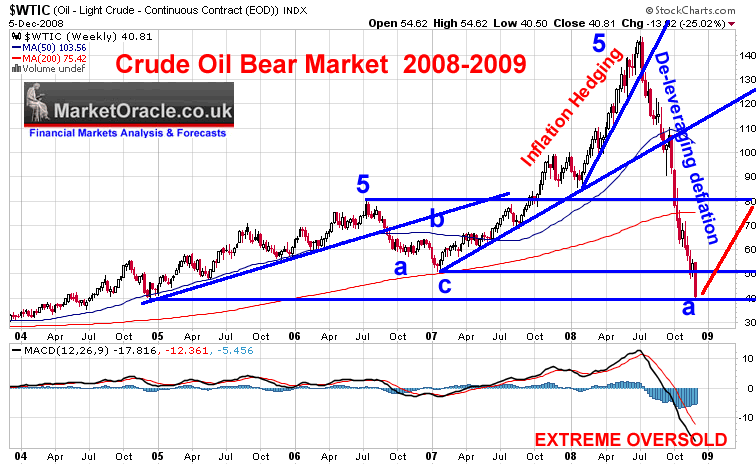
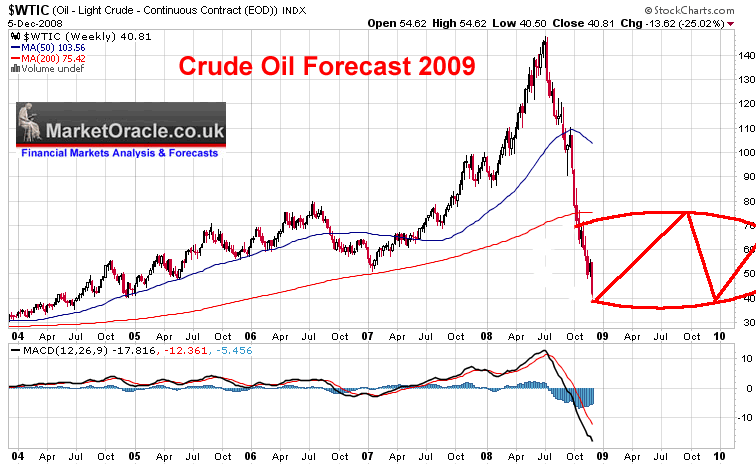
Crude oil forecast for 2009

After plunge about 70% since its recent peak at $147 due to deflation, Oil prices remains to need finding its bottom. It will take much time for crude oil to formulate a bottom that is expected will form a very volatile double or even triple bottom pattern.

Nadeem Walayat, A contributor to Market oracle, wrote, “However the long-term trend for crude oil remains higher, when I mean long-term I am looking at well beyond the next 12 months towards 5 to 10 years, when I would not be surprised given the peak oil fundamentals that we will actually be visiting the $200 crude targets that were loudly pronounced during mid 2008 as being imminent when crude oil was trading at $147. This scenarios should not be surprising given that the US Dollar bull market remains in tact that will continue to bear down on all commodities during 2009, but more on the dollar in my next (fourth) US Dollar bull market update.”

Click the images to enlarge

Charts courtesy of Market Oracle

ETFs/Stocks :
    Ultra DJ-AIG Crude Oil ETF          UCO
    UltraShort DJ-AIG Crude Oil ETF SCO
    ProShares Ultra Oil & Gas ETF DIG
    ProShares UltraShort Oil & Gas ETF DUG
Related Posts :
    Merril Lynch: Oil prices could fall to $25
Sources :
    Market Oracle: Crude Oil Forecast 2009- Time to Buy?
Please Note!

This is generally never true. Before buying or selling any asset you should do your own research and reach your own conclusion. See my Disclaimer on the bottom for more information.

You are welcome to republish this article, or any portion thereof.
Please, cite the actual/original source. I would be grateful if you could link back.


Stumble Upon Toolbar Add to Technorati Favorites Bookmark and Share

borrowing in the world debt securities market plunged 77% in the Q3 of 2008

The Bank for International Settlements (BIS) said on December 7, that borrowing in the world debt securities market plunged 77% to $247 billion in the third quarter of 2008 compared with the second quarter, amid the continued turmoil in financial markets.

The decline is "well beyond normal seasonal patterns" and resulted in the lowest level of net issuance since the third quarter of 2005.

Here is from FinFacts:
Net issuance of bonds and notes decreased to $247 billion, down substantially from $1,086 billion in the second quarter. The decline was well in excess of normal seasonal patterns, and resulted in the lowest level of net issuance since the third quarter of 2005.

Money market borrowing also stagnated, with net issuance falling into negative territory in the third quarter. By currency of denomination, the largest decrease in bond and note issuance came from the euro-denominated segment, followed by the dollar-denominated segment, while the breakdown by nationality of issuers indicates that the largest contraction in net issuance came from US borrowers, down from $308 billion in the second quarter to $46 billion in the third quarter.

Outstanding claims in the international banking market diminished sharply during the second quarter of 2008 . BIS reporting banks' international claims fell by an unprecedented $1.1 trillion, with sizeable declines recorded across claims in most currencies of denomination. While a significant decrease in interbank claims (-$812 billion) accounted for most of that decline, international claims on non-banks also fell for the first time since 1998, mainly vis-à-vis the United States, the United Kingdom and Japan. At the same time, residents of emerging markets and many central banks around the world reduced their placements of funds with BIS reporting banks.

The BIS said market developments over the period under review went through four more or less distinct stages. Stage one, which led into the Lehman bankruptcy in mid-September, was marked by the takeover by the US authorities of the government-sponsored housing finance agencies Fannie Mae and Freddie Mac. Stage two encompassed the immediate implications of the Lehman bankruptcy and the crisis of confidence it triggered. Stage three, starting in late September, was characterised by fast-paced and increasingly broad policy actions, as the response to the crisis evolved from case by case reactions to a more international, system-wide approach. In the fourth stage, from mid-October, pricing patterns were increasingly dominated by recession fears, while markets continued to struggle with the uncertainties surrounding the large number of newly announced policy initiatives.


Related Posts :
    BIS warns global lending collapse, ZIRP & monetary stimulus may come at a cost
Sources :
  1. FinFacts: Bank for International Settlements says world debt borrowings plunged sharply in Q3 2008, December 8, 2008 9:06:41 AM
  2. The Wallstreet Journal: World Debt Borrowings Fall 77%, December 7, 2008, 8:39 P.M. ET
Please Note!

This is generally never true. Before buying or selling any asset you should do your own research and reach your own conclusion. See my Disclaimer on the bottom for more information.

You are welcome to republish this article, or any portion thereof.
Please, cite the actual/original source. I would be grateful if you could link back.

Stumble Upon Toolbar Add to Technorati Favorites Bookmark and Share

BIS warns global lending collapse, ZIRP & monetary stimulus may come at a cost

According to the Telegraph, Bank for International Settlements (BIS) warns cross-border loans worldwide fell by $1.1 trillion (£740bn) in the first half of the year, reflecting the scramble by the financial industry to cut leverage by pulling credit lines and slashing risky exposure.

Foreign lending by UK banks fell by a staggering $884bn, equal to 81% of the entire contraction in international lending.

London as the epicenter of Europe's structured credit industry, has suffered a dramatic collapse and facing a double blow since worldwide issuance of bonds and securities has also gone into freefall, plummeting 77% from over a trillion dollars to $247bn in the third quarter.

In its quarterly report, the BIS warned the US Federal Reserve, the Bank of England and other central banks that near-zero interest rates and emergency monetary stimulus may come at a cost.

By opening the cash spigot, the authorities risk displacing the money markets and may "discourage banks from lending to other banks".

The money markets are a crucial lubricant for the financial system, but they cannot function if rates fall too low. The sector can wither away, as Japan discovered during its "Lost Decade".

The BIS also hinted that the European Central Bank and Sweden's Riksbank may have blundered by raising rates this year to contain the oil shock. It said short-term energy spikes have no lasting effect on inflation or wage deals.

"Evidence suggests an absence of strong second-round effects on inflation. The temporary inflationary impulse will soon drop out," it said.

Related Posts :
    Banks ignore Gordon Brown’s request to cut its borrowing cost
Sources :
    Telegraph: BIS warns of collapse in global lending, December 9, 2008 8:53AM GMT
Please Note!

This is generally never true. Before buying or selling any asset you should do your own research and reach your own conclusion. See my Disclaimer on the bottom for more information.

You are welcome to republish this article, or any portion thereof.
Please, cite the actual/original source. I would be grateful if you could link back.

Stumble Upon Toolbar Add to Technorati Favorites Bookmark and Share

Japan sank more deeply into recession rather than initially thought

Japan revised its 3rd Quarter GDP today. The number is bigger than expected and signs that Japan’s economy as the second largest economy in the world, sank more deeply into recession rather than initially thought.

Here is from IHT:
Gross domestic product contracted 0.5 percent in July-September, far more than the preliminary figure of a 0.1 percent decrease and economists' median forecast of a 0.2 percent fall. Japan's economy shrank at an annual rate of 1.8 percent in the quarter, three times faster than the contraction in the U.S. economy in the same period.

"The revision was bigger than expected. Given further weakness in exports and capital spending since October, the economy's contraction will deepen in the fourth quarter," said Tatsushi Shikano, senior economist at Mitsubishi UFJ Securities. "The Japanese economy will likely shrink in the financial year to March."

The revision was mainly due to a markdown in inventory and government spending.

The export-driven economy now looks likely to keep contracting at least until the first quarter of next year, which would mark unprecedented four straight quarters of decline, as leading Japanese manufacturers cut outputs sharply to deal with slump in global demand.

The euro zone and the United States are also in recession and growth is slowing in big emerging markets, such as China, boding ill for big Japanese exporters like Toyota and Sony.

Capital spending, a key driver of growth until recently, was revised downward slightly to a 2.0 percent contraction, from 1.7 percent, a change not large enough to affect the overall growth rate.

The meltdown of global financial markets since mid-September has shattered hopes for a short and shallow recession in Japan. The previous record was three quarters in a row, as in the last contraction seven years ago in the wake of the dotcom bust.

While the weakness until the third quarter largely stemmed from high oil prices, the economy is expected to bear the full brunt of the global downturn in the fourth quarter and beyond.

Recent data showed that Japanese companies are curtailing production at an unprecedented pace as demand plunges not just in the United States, the world's biggest economy, and Europe but also in emerging nations that had until recently weathered the global financial storm.

A sharp appreciation in the yen since October is also hurting exporters, as a higher yen cuts overseas earnings in yen terms and also limits their competitiveness.

The downturn was much more severe than previously thought, said Susumu Kato, chief economist at Calyon. "We've been expecting a 0.4 percent contraction in fiscal 2008/09 but that now needs to be revised down. It's hard to see at this point how the economy will return to a recovery."

Japanese consumption should benefit from sharp drops in oil and other raw material prices but economists say it will take time before such positive effects are felt.

Economists say the closely watched "tankan" corporate survey by the Bank of Japan due next Monday will show a plunge in Japanese corporate sentiment.

Some analysts speculate the Bank of Japan will cut interest rates again by the end of the current business year next March, after trimming its key rate to 0.30 percent from 0.50 percent in October. However, derivative contracts are pricing in less than 30 percent chance of another 0.20 percentage point cut by then.

Related Posts :
    Japan deepens into unprecedented recession
Sources :
    The International Herald Tribune: Japan revises 3rd quarter GDP downward, December 9, 2008
Please Note!

This is generally never true. Before buying or selling any asset you should do your own research and reach your own conclusion. See my Disclaimer on the bottom for more information.

You are welcome to republish this article, or any portion thereof.
Please, cite the actual/original source. I would be grateful if you could link back.


Stumble Upon Toolbar Add to Technorati Favorites Bookmark and Share

S&P downgrades Russia’s rating


Cite capital outflows, 'rapid depletion' of foreign currency reserves;
Report and analysis by Ellen Pinchuk of Bloomberg News.
Video courtesy of Bloomberg via Clip Syndicate

Due to warning of the "rapid depletion" of Russia's massive reserves, Standard & Poor's has lowered Russia's long and short-term sovereign foreign currency credit ratings from BBB+/A-2 to BBB/A-3 with a negative outlook.

Here is from Novosti, the Russian News & Information Agency on December 8:
Standard & Poor's has lowered Russia's long and short-term sovereign foreign currency credit ratings from BBB+/A-2 to BBB/A-3 with a negative outlook, the international rating agency said on Monday.

The long-term local currency rating was also lowered to BBB+ from A-, while the short-term local currency rating was affirmed at A-2, S&P said.

"The lowering of the ratings on Russia reflects risks associated with the sharp reversal in external portfolio and other investment flows, which has increased the cost and difficulty of meeting the country's external financing needs," Standard & Poor's credit analyst Frank Gill said.

Since August 2008, Russia's international reserves, which hold gold and foreign currency, have plunged from $583 billion to $455 billion, amid the financial crisis.

"Pressures on the financial account stem from corporations prepaying or hedging foreign exchange borrowing, from banks refinancing their foreign currency obligations domestically with public sector banks, and from resident capital flight, while the central bank tries to offset intensifying pressures on the nominal exchange rate," S&P said.
Redemption profile as % of total liabilities on the r.h. scale
Source: company data, Dealogic, Cbonds, Raiffeisen RESEARCH
Via RZB

ETFs/Stocks :
    Market Vector Russia ETF Trust  RSX  14.55  +1.17 (8.74%)
Related Posts :
    Russia will likely face a very hard landing
Sources :
  1. Novosti: S&P downgrades Russia's rating to BBB/A-3, outlook negative, December 8, 2008 15:57
  2. RZB: S&P downgrades rating of Russian Standard Bank, November 19, 2008
  3. The Wallstreet Journal: S&P Downgrades Russia, Citing Falling Reserves, December 9, 2008
Please Note!

This is generally never true. Before buying or selling any asset you should do your own research and reach your own conclusion. See my Disclaimer on the bottom for more information.

You are welcome to republish this article, or any portion thereof.
Please, cite the actual/original source. I would be grateful if you could link back.


Stumble Upon Toolbar Add to Technorati Favorites Bookmark and Share

FedEx (FDX) cut its profit outlook for fiscal year (FY) 2009

FedEx (FDX) expected to report a better than expected second quarter profit result, but cut its profit outlook for fiscal year (FY) 2009 as oil prices decline. Here is from Reuters:
The package delivery company's earnings warning came minutes after trucking and logistics company Con-way Inc (CNW) cut its full-year 2008 earnings outlook.

Memphis-based FedEx estimated earnings of $1.58 per share for its fiscal 2009 second quarter ending November 30. Analysts had expected earnings of $1.51, according to Reuters Estimates.

The company is due to report the results on December 18.

But Fedex also sharply lowered its previously announced fiscal 2009 earnings forecast, to a range of $3.50 to $4.75 per share, from $4.75 to $5.25, as "significantly weaker macroeconomic conditions are expected to offset the benefits from lower fuel prices and the announced departure of DHL from the U.S. domestic package market."

Deutsche Post AG (DPWGn.DE) unit DHL said last month it would halt its U.S. domestic service as of January 30, with the loss of 9,500 jobs, citing a slowing U.S. economy and an uphill struggle against local behemoths FedEx and United Parcel Service Inc (UPS.N: Quote, Profile, Research, Stock Buzz).

Both UPS and FedEx are considered bellwethers of U.S. economic activity.

FedEx said it has lowered its target for capital expenditures for fiscal 2009 to $2.5 billion from a previously stated figure of $3.0 billion.

Separately, trucking firm Con-way said it was cutting its full-year earnings outlook to a range of $2.20 to $2.35 a share, from a previously announced target of $2.60 to $2.80. The previous target already had been reduced in October from a range of $3.00 to $3.40.

"With three weeks remaining to the end of the year, the company is maintaining a relatively wide range in guidance, due to turbulent market conditions and lack of reliable visibility into an economy which continues to deteriorate," San Mateo, California-based Con-way said in a statement.

Con-way is regarded by analysts as one of the better performing less-than-truckload operators, which consolidate smaller loads into a single truck.

In extended trading, FedEx's stock fell $8.43, or more than 11 percent, to $66.00 after closing up 72 cents at $74.43 on the New York Stock Exchange.

In after-hours trading, UPS shares were down nearly 5 percent, or $2.65, at $55.97, while Con-way stock slid less than 1 percent to $25.60.


Related Posts :
    RIMM cut its third-quarter profit outlook
Sources :
    Reuters: FedEx slashes outlook, shares fall 11 percent, December 8, 2008 5:58pm EST
Please Note!

This is generally never true. Before buying or selling any asset you should do your own research and reach your own conclusion. See my Disclaimer on the bottom for more information.

You are welcome to republish this article, or any portion thereof.
Please, cite the actual/original source. I would be grateful if you could link back.


Stumble Upon Toolbar Add to Technorati Favorites Bookmark and Share