Translate this page from English into :

Sunday, October 12, 2008

The Bottom's Within Sight - Barron's

From Seeking Alpha : The Bottom's Within Sight - Barron's by SA Editor Eli Hoffmann, October 12, 2008

Not withstanding a weak and most-likely recessionary economy, Barron's Jacqueline Doherty says that if history's any guide, U.S. stocks are likely to bottom within the next few months.
    The average U.S. recession since the late 1940s has lasted 10 months, and stocks typically hit their low point about three months before the recession ends. So, if the U.S. entered a recession on July 1, as many economists now suggest, and the recession was to last until April 2009, a typical bottom for stocks would occur some time in the next few months.
Flying in the face of many doomsday heralds, Pequot's Byron Wien thinks we're getting closer to rock bottom: "I don't think this is the end of America as we know it. I think it's conceivable that the markets will bottom before year end." He cites the Treasury's exceptional power to buy distressed assets and $80/barrel oil as catalysts, and notes "smart investors" (i.e. Barclays (BCS), Buffett (BRK.A), Wells Fargo (WFC)) are wading into the troubled waters.

Investors are worried this time will be different. The 'great credit supercycle' will take a long time to unwind, say some. Others liken the government's rescue plan to fighting a forest fire with a garden hose.

It may be, but the good news, Doherty says, is that stocks - down about 40% - have already priced much of the doom and gloom in. Only once since the 1930s has the Dow fallen more than 40%. It did plunge 89% during the Great Depression, but then it was sitting on frenzied 500% gains, and the markets lacked many of today's safety nets like FDIC insurance, not to mention a proactive and more-informed Fed and Treasury.

::::::::::::::::::::

  • Doherty was impressed by Friday's bounce, with the Dow closing down 128 points after having been down 700. Kevin Mackey hopes "the incredible turn of events... were a magnanimous shift in investor sentiment and going forward we will finally see buyers return to the market," but thinks it may more likely have been a hedge-fund short squeeze.
  • Alan Brochstein sees a parallel between Friday's 'exhaustion' gap down, and crude oil's upside peak - after which it came crashing down, and never looked back.
  • David Tsao, much like Doherty, looks at the last three market crashes - and concludes those with money on the sidelines should be plotting when to start easing in.


Related Posts :
  1. Boom and Bust Cycles of S&P's Chart Since The Greenspan Era
  2. The Next Meltdown: $950 bn Worth of Outstanding Credit-Card Debt—Much of it toxic
  3. How We Called the Stock Market Crash of 2008 To the Day
  4. 10/10/2008 Market Recap: Close near high of the day is needed
  5. George Soros: Global Capital Meltdown
  6. Tony Oz Calls The Stock Market Bottom
Please Note!
This is generally never true. Before buying or selling any stock you should do your own research and reach your own conclusion. See my Disclaimer on the bottom for more information.

You are welcome to republish this article, or any portion thereof.
Please, cite the actual/original source. I would be grateful if you could link back.


Stumble Upon Toolbar Add to Technorati Favorites Bookmark and Share

Boom and Bust Cycles of S&P's Chart Since The Greenspan Era

Here is the charts from Jesse's Café Américain - SP Long Term Charts and the Reckless Adventurism of the Greenspan Federal Reserve, October 10 2008 09:33 pm :


Related Posts :
  1. The Next Meltdown: $950 bn Worth of Outstanding Credit-Card Debt—Much of it toxic
  2. Worst. Week. Ever.
  3. George Soros: Global Capital Meltdown
Please Note!
This is generally never true. Before buying or selling any stock you should do your own research and reach your own conclusion. See my Disclaimer on the bottom for more information.

You are welcome to republish this article, or any portion thereof.
Please, cite the actual/original source. I would be grateful if you could link back.


Stumble Upon Toolbar Add to Technorati Favorites Bookmark and Share

The Next Meltdown: $950 bn Worth of Outstanding Credit-Card Debt—Much of it toxic

From BusinessWeek: The Next Meltdown: Credit-Card Debt - by Jessica Silver-Greenberg, October 9, 2008, 5:00PM EST

Rising rates are accelerating credit-card defaults and soured debt could further undermine the financial system


The troubles sound familiar. Borrowers falling behind on their payments. Defaults rising. Huge swaths of loans souring. Investors getting burned. But forget the now-familiar tales of mortgages gone bad. The next horror for beaten-down financial firms is the $950 billion worth of outstanding credit-card debt—much of it toxic.

That's bad news for players like JPMorgan Chase (JPM) and Bank of America (BAC) that have largely sidestepped—and even benefited from—the mortgage mess but have major credit-card operations. They're hardly alone. The consumer debt bomb is already beginning to spray shrapnel throughout the financial markets, further weakening the U.S. economy. "The next meltdown will be in credit cards," says Gregory Larkin, senior analyst at research firm Innovest Strategic Value Advisors. Adds William Black, senior vice-president of Moody's Investors Service's structured finance team: "We still haven't hit the post-recessionary peaks [in credit-card losses], so things will get worse before they get better." What's more, the U.S. Treasury Dept.'s $700 billion mortgage bailout won't be a lifeline for credit-card issuers.

The big firms say they're prepared for the storm. Early last year JPMorgan started reaching out to troubled borrowers, setting up payment programs and making other adjustments to accounts. "We have seen higher credit-card losses," acknowledges JPMorgan spokeswoman Tanya M. Madison. "We are concerned about [it] but believe we are taking the right steps to help our customers and manage our risk."

But some banks and credit-card companies may be exacerbating their problems. To boost profits and get ahead of coming regulation, they're hiking interest rates. But that's making it harder for consumers to keep up. That'll only make tomorrow's pain worse. Innovest estimates that credit-card issuers will take a $41 billion hit from rotten debt this year and a $96 billion blow in 2009.

Those losses, in turn, will wend their way through the $365 billion market for securities backed by credit-card debt. As with mortgages, banks bundle groups of so-called credit-card receivables, essentially consumers' outstanding balances, and sell them to big investors such as hedge funds and pension funds. Big issuers offload roughly 70% of their credit-card debt.

But it's getting harder for banks to find buyers for that debt. Interest rates have been rising on credit-card securities, a sign that investor appetite is waning. To help entice buyers, credit-card companies are having to put up more money as collateral, a guarantee in case something goes wrong with the securities. Mortgage lenders, in sharp contrast, typically aren't asked to do this—at least not yet. With consumers so shaky, now isn't a good time to put more skin in the game. "Costs will go up for issuers," warns Dennis Moroney of the consultancy Tower Group.

Sure, the credit-card market is just a fraction of the $11.9 trillion mortgage market. But sometimes the losses can be more painful. That's because most credit-card debt is unsecured, meaning consumers don't have to make down payments when opening up their accounts. If they stop making monthly payments and the account goes bad, there are no underlying assets for credit-card companies to recoup. With mortgages, in contrast, some banks are protected both by down payments and by the ability to recover at least some of the money by selling the property.


THE BIG BOYS' BURDEN

Making matters worse, the subprime threat is also greater in credit-card land. Risky borrowers with low credit scores account for roughly 30% of outstanding credit-card debt, compared with 11% of mortgage debt. More than 45% of Washington Mutual's credit-card portfolio is subprime, according to Innovest. That could become a headache for JPMorgan Chase, which agreed on Sept. 25 to buy the troubled thrift's credit-card business and other assets for $1.9 billion. Says a JPMorgan spokeswoman: "We are aware of the credit quality of [WaMu's] portfolios and will manage risk appropriately."

Credit-card losses are already taking a bite out of lenders' balance sheets. Bank of America, the nation's second-largest issuer behind JPMorgan, revealed on Oct. 6 that roughly $3 billion of its $184 billion credit-card portfolio has soured, a 50% increase from a year ago. At the same time the bank, which is also dealing with the broader financial tumult, said it would have to cut its dividend by 50% and raise $10 billion in fresh capital. The stock stumbled more than 25% the next day when investors largely scoffed at the new shares BofA was offering. "The good news for us is that we have the strength to get through this, but the bad news is that the earnings recovery does take a while," says BofA spokesman Bob Stickler. "We are prudently adjusting our underwriting standards to adapt to changing economic conditions."

Likewise, American Express (AXP), which caters to wealthier borrowers, upped its provisions for credit-card losses from $810 million to $1.5 billion in the latest quarter, a sign that even upscale consumers are having trouble. "We have enhanced our credit models and continue to prudently manage our risk by scaling back some card acquisition efforts and reducing credit lines where appropriate," says an AmEx spokeswoman.

The industry's practices during the lending boom are coming back to haunt many credit-card lenders now. Cate Colombo, a former call center staffer at MBNA, the big issuer bought by Bank of America in 2005, says her job was to develop a rapport with credit-card customers and advise them to use more of their available credit. Colleagues would often gather around her chair when she was on the phone with a consumer and chant: "Sell, sell." "It was like Boiler Room," says Colombo, referring to the 2000 movie about unscrupulous stock brokers. "I knew that they would probably be in debt for the rest of their lives." Unless, of course they default. Responds BofA spokeswoman Betty Riess: "The allegations do not reflect our practices. The bank has nothing to gain by extending credit to people who do not have the ability to pay us back."

Now regulators and politicians are trying to curb some of the industry's abusive practices by limiting interest rate hikes, abolishing certain fees, and cracking down on questionable billing practices. Under rules proposed by the Federal Reserve, a borrower would have a 21-day grace period before being hit with a late fee, instead of the few days offered by some firms now. A similar plan working its way through Congress would allow banks to increase rates only on consumers' future purchases—not existing balances. And under both proposals, credit-card companies would have to allocate account holders' payments equally to balances with different interest rates. Currently, firms first apply payments to the debt with the lowest rate, which means it takes longer and makes it costlier for consumers to pay off their debt.

LAST HURRAH

The Senate isn't expected to vote on the matter until early next year. The Fed's rules, currently being reviewed by the industry, could take effect around that same time. But lenders seem to be preparing for the worst-case scenario: an outright ban on some practices.

To get ahead of rules that would hamper their ability to reprice accounts, for example, many firms are jacking up interest rates. A survey of major issuers by consumer advocacy group Consumer Action found that 37% of firms have raised rates across the board, even for borrowers with relatively pristine credit records. "In anticipation of a federal crackdown, card companies are scouring their portfolios and tightening credit," says Tower Group's Moroney.

Polemeni's interest rate jumped to 30% after a missed payment - Photo by John Chiasson

Even consumers like Michael Polemeni, who miss only a single payment, can find themselves in the crosshairs of credit-card companies. The independent computer specialist relied heavily on his credit cards for child support payments and business expenses. Polemeni generally made more than the minimum payment each month, carrying a $2,000-or-so balance. But in July he missed a payment, and Providian, owned by Washington Mutual, jacked up his rate from 9% to 30%. "I was shocked because I am a very good customer," say Polemeni, who paid off the full balance immediately. WaMu didn't return calls for comment.

Not everyone will be able to pay down their debts like Polemeni. And that could make for a vicious cycle: As credit-card companies raise rates, more consumers fall behind on their payments, which then hurts the issuers. Says Innovest's Larkin: "We are going to see the banks massively hit."


Related Posts :

George Soros: Global Capital Meltdown

Please Note!
This is generally never true. Before buying or selling any stock you should do your own research and reach your own conclusion. See my Disclaimer on the bottom for more information.

You are welcome to republish this article, or any portion thereof.
Please, cite the actual/original source. I would be grateful if you could link back.



Stumble Upon Toolbar Add to Technorati Favorites Bookmark and Share

How We Called the Stock Market Crash of 2008 To the Day

From Safe Haven: How We Called the Stock Market Crash of 2008 To the Day - by Robert D. McHugh, Jr. Ph.D., October 11, 2008


We wrote in our September 12th, weekend newsletter, page 7, "September 29th could be a kickoff to a devastating stock market crash." That has proven true to the precise day, the Industrials crashing 3,260 points, or 29 percent since September 29th. But, how did we know?

There were several key indicators and patterns converging like the perfect storm. While we believed back in the spring that this autumn was to see a huge decline, in early September it became apparent to us that a crash similar in magnitude and scope to 1929's and 1987's was just a few weeks from starting.

First, we identified a huge Declining Bullish Wedge pattern, one that started back at the October 2007 top, when the Industrials hit an all-time high of 14,198 on October 11th. The pattern had formed perfect converging trendlines, drawn from connecting decline tops with declining tops, and declining bottoms with declining bottoms over the past year, with prices now reaching position for the last leg of this pattern, a devastating drop below the bottom boundary. Prices had reached that bottom boundary, which meant the time had arrived for the necessary and expectant plunge, wave e down. That pattern is attached below.


Second, we had a phi mate turn date set for September 29th, which was also a New Moon. Our studies of market crashes have shown that many major declines start at New Moons. Since this was coming on our next phi mate turn date (which is a cycle pattern of major tops and bottoms arriving a Fibonacci number of trading days from previous tops and bottoms), and given the need for a coming wave e down in the Bullish Declining Wedge pattern, we concluded a stock market crash would start on September 29th.

Third, we knew fundamental economic conditions were deteriorating rapidly, that we were in the traditionally bad autumn season for stocks, so we were on high alert for an imminent stock market crash.

Fourth, we had found several Head & Shoulders top patterns in major indices that suggested we were headed for a major stock market crash, as they had minimum downside targets that were 25 percent below price levels in early September, and that momentum indicators were suggesting prices would violate the necklines of those patterns around the end of September.


Fifth, we did some projections with our proprietary Plunge Protection Team Indicator and came to the conclusion it would be generating a sell signal within a day or so of September 30th, 2008. That sell signal came October 1st.

Our subscribers were prepared, as they were given this information ahead of time, in our September 12th, 2008 Weekend Newsletter, with a stock market crash warning that mentioned the specific day it would start.

You can grab a subscription at www.technicalindicatorindex.com, which will provide you with Daily and expanded Weekend Newsletters, and a Daily emailed Executive Summary of the Markets. For a Free 30 Day Trial, click on the button at the upper right of our home page.

"Jesus said to them, "I am the
bread of life; he who comes to Me
shall not hunger, and he who believes in Me shall never thirst.
For I have come down from heaven,
For this is the will of My Father, that everyone who beholds
the Son and believes in Him, may have eternal life;
and I Myself will raise him up on the last day."

John 6: 35, 38, 40


Robert D. McHugh, Jr. Ph.D.
Main Line Investors, Inc.

Related Posts :
  1. 10/10/2008 Market Recap: Close near high of the day is needed
  2. Worst. Week. Ever.
  3. George Soros: Global Capital Meltdown
Please Note!
This is generally never true. Before buying or selling any stock you should do your own research and reach your own conclusion. See my Disclaimer on the bottom for more information.

You are welcome to republish this article, or any portion thereof.
Please, cite the actual/original source. I would be grateful if you could link back.


Stumble Upon Toolbar Add to Technorati Favorites Bookmark and Share

10/10/2008 Market Recap: Close near high of the day is needed

From Cobra's Market View: 10/10/2008 Market Recap: Close near high of the day is needed, October 11, 2008 10:06 pm

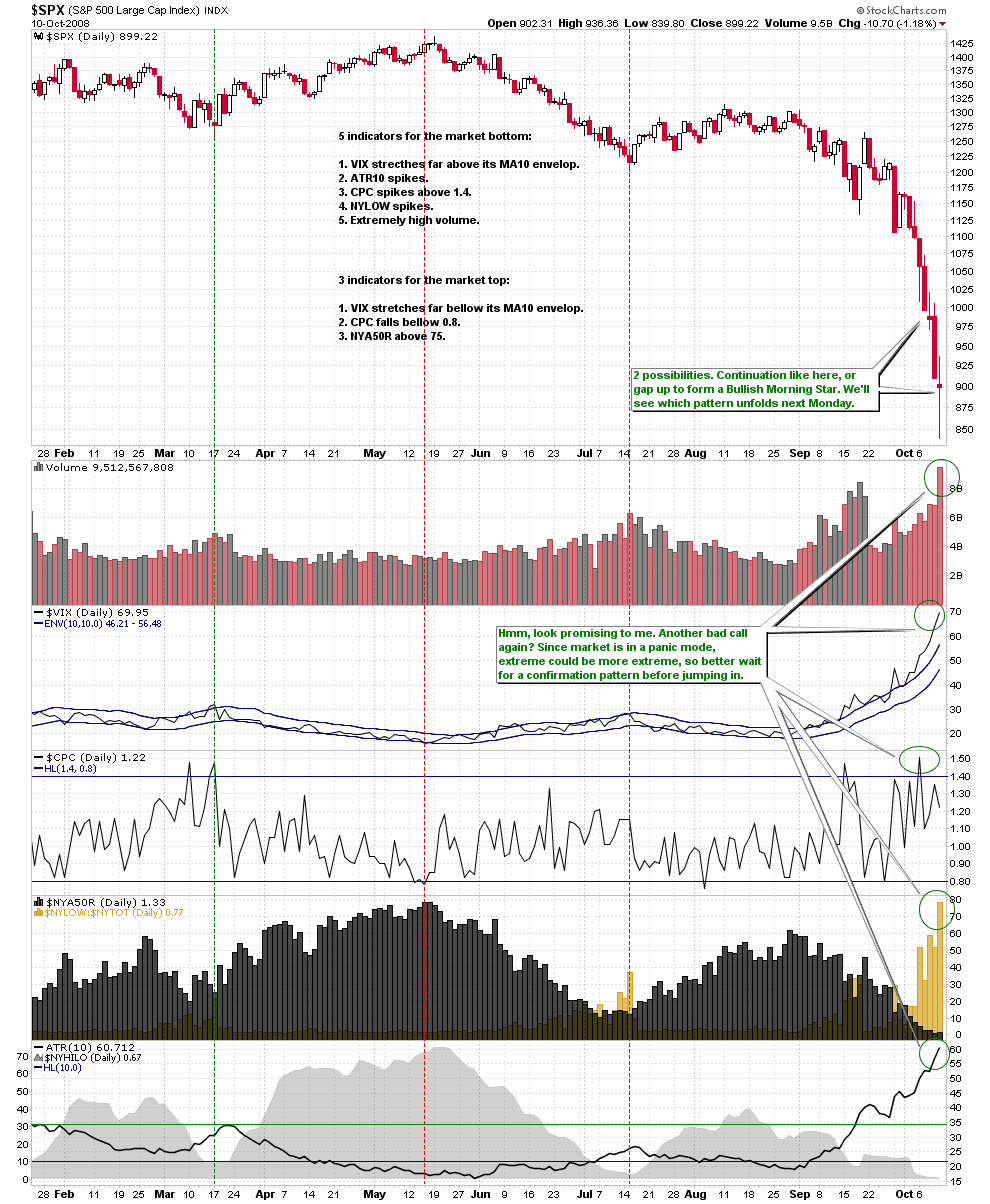
The market action on Friday looks pretty good, but it may not mean anything because the quick rally at the end of day seems like a short covering. Because of the G7 meeting in the weekend, many bears would rather not to carry short positions to Monday. Therefore, we need a follow-through on Monday. Recently the market is very panic and many TA signals on my daily watch list have been extremely oversold, while the market has not shown any sign of recovery. Again, if you insist to catch the bottom, don't open heavy positions and don't judge the bottom simply by a few indicators. At least the first step should be a close near height of the day, unlike the last week every time the bell was to ring then the market started to sold off, which indicated that people were unconfident to hold long positions overnight. If you catch the "bottom" a few days ago, this is not the time to stop loss, but don't average down either, just be patient and wait for the confirmation of the reversal.

0.0.1 Market Top/Bottomed Watch. Look at the chart again, it is still like a bottom. However it is prudent to wait for the follow-through on Monday. The best confirmation is gap up and close near high of the day, so a Bullish Morning Star pattern is formed, then the likelihood of reversal will be high.


2.3.3 NYSE Total Volume. It looks like a bottom. Again, follow-through is the key.


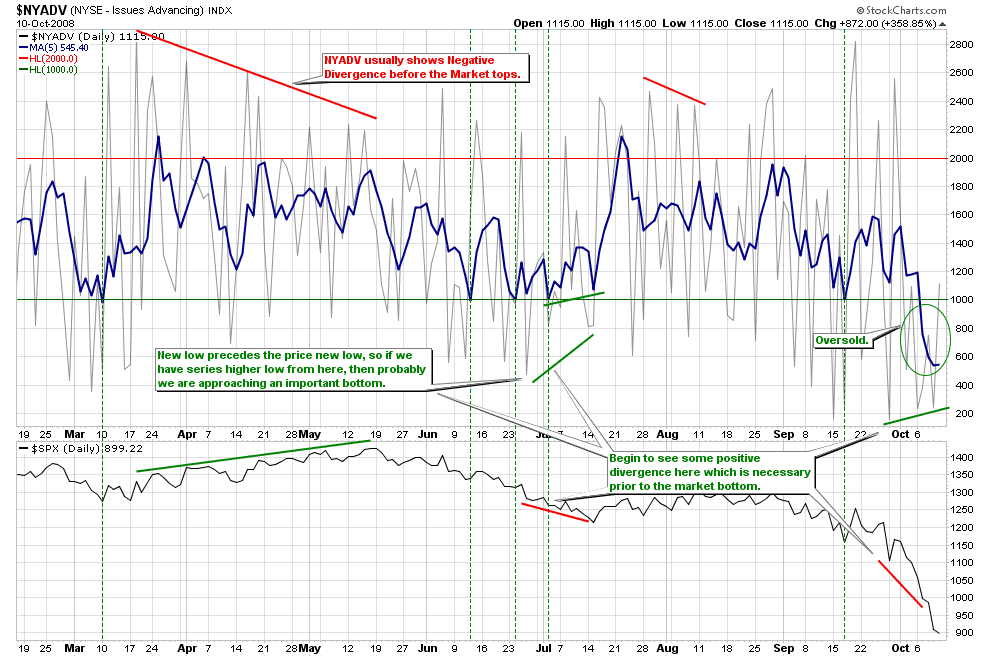
2.4.2 NYSE - Issues Advancing. NYADV is still high lows. Although the market kept dropping everyday, advancing issues didn't decrease so much, which is a good sign.


2.0.0 Volatility Index (Daily). The pattern looks like a Bearish Rising Wedge, which rallied too quickly to be sustainable. 2.0.1 Volatility Index (Weekly), on the weekly chart, this is the seventhly up week, which is the historical record.


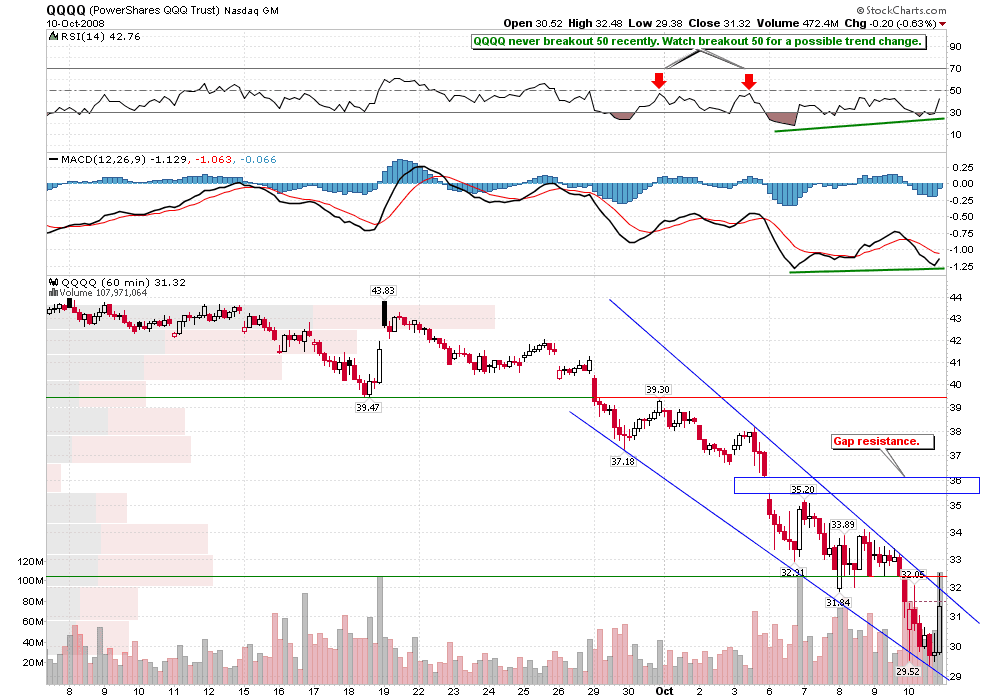
1.1.4 PowerShares QQQ Trust (QQQQ 60 min). QQQQ seems encouraging. Bullish falling wedge, and MACD and RSI show positive divergence as well. Note the RSI indicator at the top of the chart, the trend reversal won't be possible before RSI breaks above 50.


Related Posts :
  1. Worst. Week. Ever.
  2. George Soros: Global Capital Meltdown
  3. Short Squeeze Triggers Sharp Volatility in Stocks
  4. What kind of crash have we?
  5. Tony Oz Calls The Stock Market Bottom
  6. 10/09/2008 Market Recap: Is this time different?
Please Note!
This is generally never true. Before buying or selling any stock you should do your own research and reach your own conclusion. See my Disclaimer on the bottom for more information.

You are welcome to republish this article, or any portion thereof.
Please, cite the actual/original source. I would be grateful if you could link back.


Stumble Upon Toolbar Add to Technorati Favorites Bookmark and Share

Worst. Week. Ever.

From The Big Picture: Worst. Week. Ever., October 11, 2008 08:53 am

Well, if you were long, anyway. Those of you who were defensive, or in cash, or God-love-ya, short, had a pretty good week. (Feel free to hit the wish list anytime and buy yourself something nice!)

This is a headline you probably have never seen before:


I don't know if you will ever see more astonishing data for another 20 years:


Related Posts :
  1. George Soros: Global Capital Meltdown
  2. Short Squeeze Triggers Sharp Volatility in Stocks
  3. What kind of crash have we?
  4. Tony Oz Calls The Stock Market Bottom
  5. 10/10/2008 : Global Gloom!!!
Please Note!
This is generally never true. Before buying or selling any stock you should do your own research and reach your own conclusion. See my Disclaimer on the bottom for more information.

You are welcome to republish this article, or any portion thereof.
Please, cite the actual/original source. I would be grateful if you could link back.


Stumble Upon Toolbar Add to Technorati Favorites Bookmark and Share