Translate this page from English into :

Sunday, October 26, 2008

10/26/2008 - Analysis for the next week

The next monday is very difficult to be predicted because the market participants from entirely the world are becoming irrational (Trading in the panic mode, futures halted). As usually I refer to whom many peoples believe to their analysis.

The first is coming from Cobra, here is the summary:
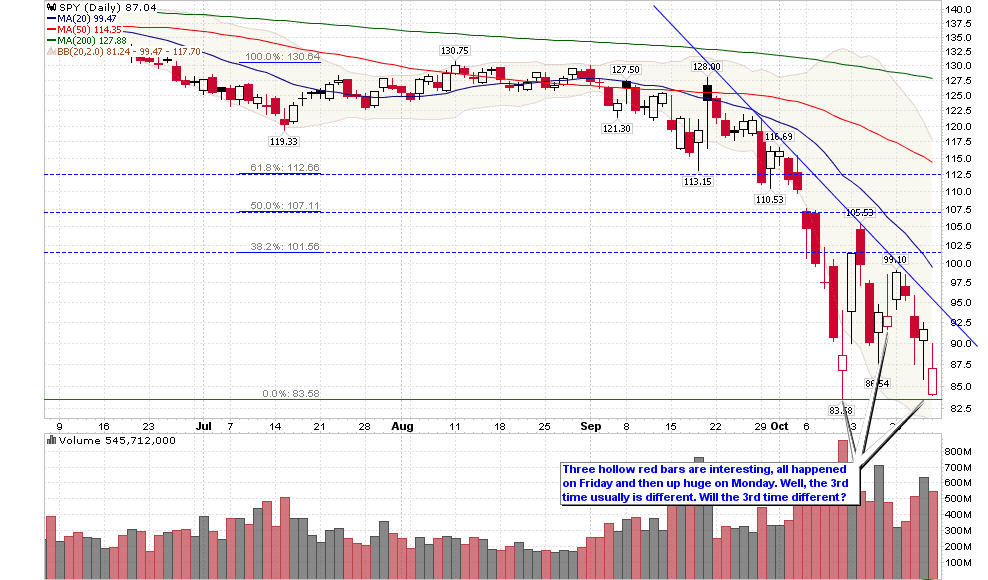
    Usually a bottom is not in place before VIX forms a reversal candle (e.g., black candle, Doji, etc), from this perspective the Friday low may not be a bottom. What about next Monday? There is a pattern recently, once it repeats the market should rise. Will be the third time different? I don't know.

    SPY Short-term Trading Signals
    Friday hollow red candle appears, then the next Monday opens high closes higher. In the past the third time is often different. So it is unknown how it goes this time.
    Click the image to enlarge

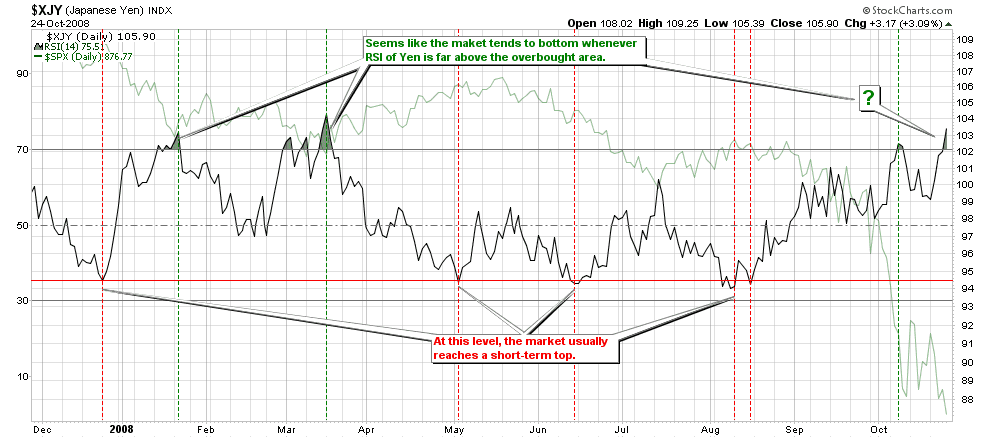
    Yen RSI and the Market Top/Bottom
    Every time the RSI of YEN reaches overbought region, the market is close to a bottom or has a big rally. Now it is overbought again, and this is obviously a good news.
    Click the image to enlarge


The second is coming from The Headline Charts, here is the summary:
    If the end of the world were around the corner, people would be buying Treasuries to the point where rates would be hitting new lows. Instead, each push lower by stocks has produced higher rates, and this is a good sign that markets are healing, and flight to safety is easing.

    I know, you worry about the health of the US government longer-term, and for many reasons. Me too. But for now, let's worry about this bear market for stocks and commodities, and look for good signs that the crisis stage of the bear has peaked. This is the best sign so far.

    Click the image to enlarge

    We've been looking for signs that we are emerging from the capital preservation stage which occurs at the end of the cycle, and to the next stage. I think this graph is missing a phase, which is the phase we are entering. I think we have now probably passed into the late contraction part of the cycle where the yield curve is very steep, and emotion settles down from panic to a level of pessimism and "why bother".

    At this stage all the money flows to fixed instruments of short maturities with very low yields, like CDs. In fact, I think we should now (or maybe early next year) expect to start seeing CD rates generally ease as banks get close to having built up their cash positions again, and don't need to attract new money as much as they did.

    Click the image to enlarge

The third is coming from Andy, Saving to invest blog, here is the summary:
    Why the dollar is rising?

    A number of analysts had predicted the continued demise of the US dollar thanks to the financial-sector bailout and weakening economy but its sharp upside has surprised many. The dollar's recent climb is part of a massive reversal of long-standing investing trends (due to the global economic slowdown) such as buying emerging-market stocks or wagering on rising commodity prices. When investors retreat from such investments, they are often selling them in exchange for US dollars. The U.S. currency remains the most popular among global institutions, accounting for 55% of the assets and liabilities they hold in foreign currencies, according to the Bank for International Settlements. It has been further boosted because banks around the world are scrambling for dollars after inter-bank borrowing between banks all but ceased to function during the past month thanks to the liquidity crunch

    After sending money overseas for years, U.S. investors now are bringing it home in a flight to safety. In July and August, the latest months for which Treasury Department data are available, U.S. investors sold $57 billion more in foreign stocks and bonds than they bought -- the largest-ever such repatriation. Dollar demand has also been reflected in the rise in purchases (and hence the price) of U.S. Treasury bonds, seen as the safest haven of all. The most recent data shows that such holdings of Treasury's increased by about $100 billion over the past four weeks. Other countries are also feeling the effects (even more than the US) and so are slashing interest rates to try and boost domestic economic activity, so the expected yield differential with the US is falling. With this trend set to continue, investors will continue to flock to the dollar.

    The US economy is likely to recover faster than other economies because unlike other central banks, the Fed more than a year ago began lowering interest rates, which punished the dollar. Now it could be a positive, as other central banks catch up. In the U.S., "a lot of the heavy lifting has already been put in the pipeline," says Stephen Jen, global head of currency strategy at Morgan Stanley, in the WSJ. "The same cannot be said of Europe." The same old reasoning still applies: The U.S. is regarded as being able to weather a recession much better than the euro zone

    As the dollar rises, US consumers are seeing some clear benefits which overall should boost spending and assist with getting the nation out the current economic slump. Benefits of the high US dollar to every day consumers include, lower oil and commodity prices, lower inflation (prices) and cheaper travel. It does hurt foreign corporate profits and exporters, but given our economy is 70% consumer driven, I think what helps consumers is much more important right now.

    Given the rapid rise in the dollar in synchronization with the escalation of the global financial meltdown and tightening credit markets, it stands to reason that as credit and stock markets stabilize so too will the dollar. This means it will give back some of its gains, but should be able to maintain current levels well into next year. If the government implements much needed long term regulatory reform and adopts a more fiscally conservative policy once the economy has recovered, then there is a chance that the US dollar could maintain its strength for a number of years to come.

The fourth is coming from Kathy Lien, here is the summary:
    The mentality in the currency and stock markets is sell now, ask questions later. The low yielding US dollar and Japanese Yen continue to be the biggest beneficiaries of risk aversion. The only thing that investors want right now are safe haven plays. The dollar’s strength will force emerging market countries to rush to prevent a flight of capital out of their currencies - more rate hikes could be likely. With deleveraging being the theme of the day, when confidence is lost, it will be difficult to recover.

    Where are the Value Points for the Currency Market?

    In the Wed edition of my Daily GFT Report and on CNBC and Bloomberg I talked about how the dollar could rise another 5%. At that time, the EUR/USD was trading at 1.2829 and the GBP/USD at 1.6236. The GBP/USD has already hit my 5 percent target and at one point this morning even became undervalued on a purchasing parity basis. Although the UK GDP report confirms that the country is headed for a recession and validates the weakness, I believe that we have seen a near term low in the currency pair.

    The EUR/USD on the other hand has only dropped 2.5 percent. The EUR/USD does not become a value play until 1.15-1.20. As for USD/JPY, it has also reached my target of 95. Although I won’t be a buyer at these levels, I won’t be a seller either. There are no rewards for heros in this type of market.

And the last is coming from Barry Ritholtz, see: 10/24/2008 Market Recap - Global Investors Retreat (Update 2)

Related Posts :
  1. 10/24/2008 Market Recap - Global Investors Retreat (Update 2)
  2. 10/23/2008 - October Blues
  3. Trading in the panic mode, futures halted
  4. Markets are in absolute freefall
  5. 10/23/2008 Market Recap-US Flat, Asian Sink
Sources :
  1. Cobra's Market View: 10/24/2008 Market Recap: Descending Triangle, October 26, 2008
  2. Headlinecharts blog: Good Signal from Rates, October 25, 2008
  3. Saving to invest blog: US Dollar Rising and Outlook, October 23, 2008
  4. Kathy Lien: Dollar Closing In on 5% Targets, Where are the Value Points?, October 24, 2008
Please Note!
This is generally never true. Before buying or selling any stock you should do your own research and reach your own conclusion. See my Disclaimer on the bottom for more information.

You are welcome to republish this article, or any portion thereof.
Please, cite the actual/original source. I would be grateful if you could link back.



Stumble Upon Toolbar Add to Technorati Favorites Bookmark and Share

Nouriel Roubini: the coming global stagnation, recession plus deflation

By Prof. Nouriel Roubini

Last January – at a time when the consensus was starting to worry about rising global inflation - I wrote a piece titled Will the U.S. Recession be Associated with Deflation or Inflation (i.e. Stagflation)? On the Risks of “Stag-deflation” rather than “Stagflation” where I argued that the US and other economies would soon have to worry about price deflation rather than price inflation.

As I put it at that time last January:
    the S-word (stagflation that implies growth recession cum high and rising inflation) has recently returned in the markets and analysts’ debate as inflation has been rising in many advanced and emerging markets economies. This rise in inflation together with the now unavoidable US recession, the risk of a recession in a number of other economies (especially in Europe) and the likelihood of a sharp global economic slowdown has lead to concerns that the risks of stagflation may be rising.

    Should we thus worry about US and global stagflation? This note will argue that such worries are not warranted as a US hard landing followed by a global economic slowdown represents a negative global demand shock that will lead to lower global growth and lower global inflation. To get stagflation one needs a large negative global supply-side shock that, as argued below, is not likely to occur in the near future. Thus the coming US recession and global economic slowdown will be accompanied by a reduction – rather than an increase – in inflationary pressures. As in 2001-2003 inflation may become the last of the worries of the Fed and one may actually start hearing again concerns about global deflation rather than inflation.

    Let me elaborate next why…

    …unlike a true negative supply side shock – that reduces growth while increasing inflation - a US recession followed by a global economic slowdown is a negative demand shock that has the effect of reducing US and global growth while at the same time reducing US and global inflationary pressures. Specifically such a negative demand shock will reduce inflation and across the world because of a variety of channels.

    First, a US hard landing will lead to a reduction in aggregate demand relative to the aggregate supply as a glut of housing, consumer durables, autos and, soon enough, other goods and service takes places. Such reduction in aggregate demand tends to reduce inflationary pressures as firms lose pricing power and then to cut prices to stave off the fall in demand and the rising stock of inventories of unsold goods. These deflationary pressures are already clear in housing where prices as falling and in the auto sector where the glut of automobiles is leading to price discounts and other price incentives. Obviously, inflation tends to fall in recession led by a fall in aggregate demand.

    Second, during US recessions you observe a significant slack in labor markets: job losses and the rise in the unemployment rate lead to a slowdown in nominal wage growth that reduces labor costs and unit labor cost, thus reducing wage and price inflationary pressured in the economy.

    Third, the same slack of aggregate demand and slack in labor markets will occur around the world as long as the negative US demand shock is transmitted – through trade, financial, exchange rate and confidence channels – to other countries leading to a slowdown in growth in other countries (the recoupling rather than decoupling phenomenon). The reduction in global aggregate demand – relative to the global supply of goods and service – will lead to a reduction in inflationary pressures.

    Fourth, during any US hard landing and global economic slowdown driven by a negative demand shock the US and global demand for oil, gas, energy and other commodities tends to fall leading to a sharp fall in the price of all commodities. A US hard landing followed by a European, Chinese and Asian slowdown will lead to a much lower demand for commodities pushing down their price. The fall in prices tends to be sharp because – in the short run – the supply of commodities tends to be inelastic; thus any fall in demand leads to a greater fall in price – given an inelastic supply curve – to clear the commodity prices. And indeed in recent weeks the rising probability of a US hard landing has already lead to a fall in such prices: for example oil prices that had flirted with a $100 a barrel level are now down to a price closer to $90; or the Baltic Dry Freight index – that measures the cost of shipping dry commodities across the globe and that had spike for most of 2007 given the high demand and the limited supply of such ships – is now sharply down by over 20% relative to its peak in the fall of 2007. Similar downward pressure in prices is now starting to show up in other commodities.

    Note that a cyclical drop in commodity prices – led by a US hard landing and global economic slowdown - does not mean that commodity prices will remained depressed over the middle term once this global growth slowdown is past. If in the medium term the supply response to high prices is modest while the medium-long term demand for commodities remains high once the US and global economy return to their potential growth rates commodity prices could indeed resume their upward trend. But in a cyclical horizon of 12 to 18 months a US hard landing and global economic slowdown would lead to a sharp fall in commodity prices. Note that even in the case of oil that is the commodity with the weakest supply response to prices – as the investments in new production in a bunch of unstable petro-states (Nigeria, Venezuela, Iran, Iraq and even Russia) are limited - a cyclical global slowdown could lead to a very sharp fall in oil prices. Indeed while oil today is closer to the $90-100 range in the last 12 months oil prices drifted downward at some point close to a $50-60 range even before a US hard landing and global slowdown had occurred. Thus, one cannot rule out that in such a hard landing scenario oil prices could drift to a price close to $60.

    The four factors discussed above suggest that – conditional on the negative global demand shock (US hard landing and global economic slowdown) materializing even the risks of stagflation-lite are exaggerated; rather US and global inflationary force would sharply diminish in this scenario and, if anything, concerns about deflation may reemerge again.

    This is not a far fetched scenario as one looks back at what happened in the 2000-2003 cycle. Until 2000 the Fed was worried about the economy overheating and rising inflation risk. But once the economy spinned into a recession in 2001 US and global inflationary pressures diminished and by 2002 the great scare became one of US and global deflation rather than inflation. Indeed the Fed aggressively cut the Fed Funds rate all the way to 1% and Ben Bernanke – then only a Fed governor – wrote speeches about using heterodox policy instruments to fight the risk of deflation once and if the Fed Funds rate were to reach its nominal floor of zero percent.

    Today, following a US hard landing and a global economic slowdown, the risks of outright deflation would be lower than in the 2001-2003 episode because of various factors: US inflation starts higher than in 2001; the Fed needs to worry about a disorderly fall of the US dollar that may increase inflationary pressures; the rise and persistence of growth rates in Chindia and other emerging market economies implies that – even if such economies likely recouple to the US hard landing – a global growth slowdown will not turn into an outright global recession that would be truly deflationary. Still, while the scenario outlined here – US recession and global slowdown – may not lead to outright deflationary pressures it would certainly lead to a slowdown of US and global inflation.

    The fact that the most likely scenario in the global economy in 2008 is one of a negative global demand shock is the one that is priced by bond markets: if investors were really worried about a rise in US and global inflation – or about true stagflationary shocks – the yield on long term government bonds would have not fallen as sharply as it has since last summer. With US 10 year Treasury yield now well below 4% and sharply falling in the last few weeks it is hard to see a bond market that is worried about global inflation or global stagflation. And while until recently commodity prices pointed to the other directions, recent weakness in oil prices, the cost of shipping commodities and the price of some other commodities also signals that commodity markets are now pricing the risk of a US recession and the risk that – with a lag – a US recession will lead to a broader global economic slowdown.

    So in conclusion “stag-deflation” (i.e. low growth or recession with falling inflation rates and possible deflationary pressures) is more likely than “stagflation” (low growth or recession with rising inflation rates) if a US hard landing materializes and leads – as likely – to a slowdown in global demand and growth.

So last January I argued that four major forces would lead to a risk of deflation (or stag-deflation where a recession would be associated with deflationary forces) rather than the inflation risk that at that time – and for most of 2008 – mainstream analysts worried about: slack in goods markets, re-coupling of the rest of the world with the US recession, slack in labor markets, and a sharp fall in commodity price following such US and global contraction would reduce inflationary forces and lead to deflationary forces in the global economy.

How have such predictions fared over time? And will the US and global economy soon face sharp deflationary pressures? The answer deflation and stag-deflation will in six months become the main concern of policy authorities. Let me now explain in more detail why…


Related Posts :
  1. Nouriel Roubini: Stay away from 'risky' assets
  2. Nouriel Roubini:"Panic" May Force Market Shutdown
  3. Nouriel Roubini: How to prevent contagion effects of the financial crisis in Hungary
  4. Warren Buffet : Buy American. I Am
  5. The Full Nouriel Roubini Horror Speech
  6. Roubini Warns of Possible Systemic Meltdown, "Severe Global Depression"
  7. Soros : Paulson's Financial-Rescue Plan Is `Ill-Conceived'
  8. Warren Buffett: We Have "Terrible, Terrible Problems"
Sources :
Please Note!
This is generally never true. Before buying or selling any stock you should do your own research and reach your own conclusion. See my Disclaimer on the bottom for more information.
You are welcome to republish this article, or any portion thereof.
Please, cite the actual/original source. I would be grateful if you could link back.


Stumble Upon Toolbar Add to Technorati Favorites Bookmark and Share

Total borrowing over the Fed's emergency lending window is around $105 bln per day

Commercial banks borrowed a record of $105.8 billion a day, on average, from the Federal Reserve's emergency lending window over the past week, according to Fed data released Thursday. Suffering from the ongoing credit crunch, banks turned to the Federal Reserve for funds, blowing through the previous borrowing record of $99.7 billion, set last week, the central bank reported.

Investment banks, meanwhile, borrowed $111 billion a day, on average, down from $131 billion a week ago.

Troubled insurer American International Group drew down another $8 billion over the past week, bringing its total borrowing to $90.3 billion. This is nearly three-quarters of the $122.8 billion loan the federal government is providing AIG. About $18 billion is being drawn from a $37.8 billion lending facility that the New York Fed provided to the world's largest insurer two weeks ago. The facility was designed to provide funding for AIG's businesses after its securities lending division ran into trouble. The company has also borrowed $72 billion of the original bridge loan of $85 billion it received from the federal government in mid-September to prevent its collapse.

On Thursday, the Fed also reduced the value of the $30 billion portfolio of mortgage securities acquired to facilitate JPMorgan's March acquisition of Bear Stearns to $26.8 billion, down from $29.5 billion the week before. The central bank revalues the portfolio every quarter. However, it plans to hold the securities for 10 years so the loss is largely just on paper.

Analysts at Bear Stearns had expected a $2 billion to $6 billion drop in the portfolio. Half the portfolio is made up of securities backed by commercial real estate loans. The other half is a mix of securities backed by prime residential mortgages, made to borrowers with good credit, and by Alt-A residential mortgages, given to those who provided little or no documentation of income and assets.

Related Posts :
  1. The worldwide is waiting for The Fed's benchmark rate decision policy
  2. US mulls buying stakes In US Insurers
  3. Fed loses 9% in Bear Stearns Portfolio
  4. AIG Exceeds Loan
Sources :
Please Note!
This is generally never true. Before buying or selling any stock you should do your own research and reach your own conclusion. See my Disclaimer on the bottom for more information.

You are welcome to republish this article, or any portion thereof.
Please, cite the actual/original source. I would be grateful if you could link back.


Stumble Upon Toolbar Add to Technorati Favorites Bookmark and Share