Translate this page from English into :

Tuesday, December 16, 2008

Apple’s share prices may back to $50

According to Douglas A. McIntyre -- an editor at 247wallst.com -- via BloggingStocks, Apple(AAPL) shares may back to $50, the level that has not been seen since 2006. Yesterday, Apple shares were traded at $94.75; we may not see the prices level anymore for along time.

According to The Journal, Goldman Sachs analyst David Bailey cut his estimate for Apple's 2009 profit, warning "some nicks have started to emerge." Mr. Bailey warned the company faces "a tougher environment" in the first two quarters of next year, when he believes consumer demand will further deteriorate.

Here is from the Wall Street Journal:
Sales of Macs in U.S. stores last month declined 1% from a year ago, while industry-wide PC sales rose 2%, according to research firm NPD Group Inc., which tracks retail sales.

NPD analyst Steve Baker blamed a 35% drop in sales of desktop Macs, noting growth in Apple's laptops still outpaced rivals.

…………

The November data indicate that falling prices for Windows-based PCs, and the rise of low-priced computers like netbooks -- mini notebooks that cost as little as $300 -- have finally tripped Apple

…………

Apple has steered away from the low-margin netbook market in favor of higher-end computers. "We don't know how to make a $500 computer that's not a piece of junk," Mr. Jobs said in October when the company reported earnings.

Apple rivals like H-P and Dell offered discounts weeks earlier than usual this holiday season, dropping some prices by as much as 50%. Mr. Munster said since last December, the average Windows PC price is down 35% to 45%; in contrast, Apple has offered only modest discounts of 5% to 10% on its PCs, analysts said.

The strategy translates to a big bite into consumers' wallets. On Amazon.com last week, an H-P Pavilion laptop with a 14.1-inch screen was marked down from $1,074 to $760. In contrast, an Apple MacBook with a 13.3-inch screen, less memory and less storage capacity was $966, just $33 below its list price.

Apple has also held the line on its desktop iMac lineup, which starts at $1,199. Meanwhile, Dell's all-in-one XPS One desktop machines start at $899.

In October, Apple lowered the price of its entry-level white MacBook laptop to $999 from $1,099 and refreshed its main MacBook line by packing higher-end features -- like an aluminum frame and better graphics performance -- into models starting at $1,299.

The withering economy has weighed heavily on PC sales. Earlier this month, research firm IDC lowered its 2009 PC growth forecast, saying revenue would fall 5.3% from this year. Earlier, IDC had estimated 4.5% revenue growth.

Piper Jaffray's Mr. Munster said he expects the company to recover in coming months, and said he is maintaining his prediction that Apple next year will increase shipments by 10%, while the rest of the industry falls 5%.

Shaw Wu, an analyst at Kaufman Brothers, expects Apple to sell 2.7 million computers in the current quarter ending in late December, a 17% increase from a year ago. He expects industry-wide PC shipments this quarter to be about 85 million.

Despite short-term weakness, analysts expect Apple's products to remain more profitable than many rivals' computers. The MacBooks are forecast to deliver close to 20% profit margins, compared with 6% or less for competitors, said Toni Sacconaghi, an analyst at Sanford Bernstein & Co.

Related Posts :
    Friedman Billings Ramsey: Apple May Cut iPhone Production by 40%
Sources :
  1. The Wall Street Journal: Apple Loses Some Shine as Mac Sales Slow, December 16, 2008
  2. BloggingStocks: Apple (AAPL): Back to $50, December 16, 2008 3:57AM
Please Note!

This is generally never true. Before buying or selling any asset you should do your own research and reach your own conclusion. See my Disclaimer on the bottom for more information.

You are welcome to republish this article, or any portion thereof.
Please, cite the actual/original source. I would be grateful if you could link back.



Stumble Upon Toolbar Add to Technorati Favorites Bookmark and Share

Bank of America’ shares could fall to $9

According to Reuters, Paul Miller of FBR (Friedman, Billings, Ramsey Group Inc) rated Bank of America (BAC) to underperformed. The Analyst said the stock could fall as low as $9. BAC's equity ratio is too low. Additionally, Miller expected that the bank will have to raise a "substantial" amount of capital, diluting existing shareholders.

Miller recommended investors to stay away from the stock until this initial raise is complete. The Bank acquired mortgage lender Countrywide in July and in September agreed to acquire Merrill Lynch (MER) has thin capital, and should cut its quarterly dividend to one cent from 32 cents to conserve its capital.

The Bank would cut up to 35,000 jobs over three years, reflecting its pending purchase of Merrill Lynch and weaker business activity. Bank of America and Merrill Lynch have received a total of $25 billion under the U.S. Treasury Department program to boost banks.

Miller estimates the bank will lose $77 billion, or 8.1 percent of its total loans, in the coming years.

Click to enlarge
Chart courtesy of Stockchart

Related Posts :
    UBS cut its price target on BAC by 48%
Sources :
    Reuters: Bank of America stock could sink to $9: analyst, December 15, 2008 11:29pm EST
Please Note!

This is generally never true. Before buying or selling any asset you should do your own research and reach your own conclusion. See my Disclaimer on the bottom for more information.

You are welcome to republish this article, or any portion thereof.
Please, cite the actual/original source. I would be grateful if you could link back.


Stumble Upon Toolbar Add to Technorati Favorites Bookmark and Share

Monday, December 15, 2008

Nouriel Roubini: U.S. and global equities could drop by another 15 to 20 %

Professor Nouriel Roubini, who predicted the global financial crisis, said in an interview with Bloomberg television on December 12, shares worldwide may fall further. “I’m still quite bearish on U.S. and global equities, they’ve fallen a lot, but they might surprise on the downside. U.S. and global equities could be 15 to 20 percent lower before they start to recover towards the end of next year,” he said.


Video courtesy of Bloomberg via Youtube

You can also download and save the video into your computer via this link.

Related Posts :
    Nouriel Roubini: How to avoid the horrors of ‘stag-deflation’
Sources :
    Bloomberg: Roubini Says U.S., Global Stocks May Drop 20% Before Recovering, December 12, 2008 11:12 EST
Please Note!

This is generally never true. Before buying or selling any asset you should do your own research and reach your own conclusion. See my Disclaimer on the bottom for more information.

You are welcome to republish this article, or any portion thereof.
Please, cite the actual/original source. I would be grateful if you could link back.


Stumble Upon Toolbar Add to Technorati Favorites Bookmark and Share

Meredith Whitney’s scary predictions

The following are the gist of the Oppenheimer & Co. analyst, Meredith Whitney, predictions via Fortune:
  1. What the federal government has done so far- with TARP, bailing out Citigroup, etc. - has stemmed the bleeding, but what it hasn't done is fundamentally alter the landscape. Yes, there's been a tremendous amount of capital has been thrown into the system, is just going to plug the holes. It's not going to create new liquidity, which is what the system so desperately needs.

  2. After we have seen TARP 1.0, TARP 2.0, and TARP 3.0, Meredith believed we will also see a 4.0, a 5.0, and so on. There has to be, because the companies cannot raise the capital they need, which means that the default provider of capital has to be the federal government. The strategy changes have not solved anything.

  3. Meredith expected all these banks to be back in the market looking for more capital. She said there will be banks getting smaller, banks going away, and banks consolidating. At the same time, though, she thought we'll see more new banks created. She has already seen more applications. And it's a great idea: We start with a clean balance sheet and make loans today with today's information. Plus, right now we've got a yield curve that's good for lending.

  4. The overall economy will be worse than people expect. The biggest issue will be consumer spending. If 2008 was characterized by the market impacting the economy, then 2009 will be about the economy impacting the market. It's already started.

Related Posts :
    Meredith Whitney: Even Stephen Hawking couldn’t turn in such a mess like the Citi’s troubles
Sources :
    Fortune via CNN Money: 8 really, really scary predictions, December 11 2008: 7:04 PM ET
Please Note!

This is generally never true. Before buying or selling any asset you should do your own research and reach your own conclusion. See my Disclaimer on the bottom for more information.

You are welcome to republish this article, or any portion thereof.
Please, cite the actual/original source. I would be grateful if you could link back.


Stumble Upon Toolbar Add to Technorati Favorites Bookmark and Share

Friday, December 12, 2008

The Stocks will be going to zero

Now "zero" ratings are proliferating. Here are the stocks which are predicted will be going to zero via Business Week:
  1. IndyMac Bank (IDMCQ)
    The trend may have started over the summer when some enterprising banking analysts predicted that shares of IndyMac Bank (IDMCQ) in Pasadena, Calif., would go to zero. Bravo to them, since the stock was recently about 4 cents a share.

  2. Nortel Networks (NT)
    RBC Capital Markets (RY) analyst Mark Sue slapped a target price of zero on telecommunications-equipment maker Nortel Networks (NT).

  3. General Motors (GM)
    Deutsche Bank analyst Rod Lache says General Motors (GM) shareholders will have worthless stock certificates within 12 months.

  4. Sirius XM (SIRI)
    Henry Blodgett thinks satellite radio provider Sirius XM (SIRI) is headed for bankruptcy. Analysts at Morningstar (MORN) say the shares of 32 of the 2,000 companies they cover are likely to become worthless.

  5. Citadel Broadcasting (CDL)
    According to Morningstar, Citadel Broadcasting (CDL), are in the media industry, where heavily indebted companies are seeing advertising revenues plunge.

  6. Mesa Air Group (MESA)
    According to Morningstar, Mesa Air Group (MESA) faces a lawsuit over its operations in Hawaii and could see lower payments from its carrier partners.

  7. Decode Genetics (DCGN)
    According to Morningstar, Decode Genetics (DCGN), which uses genealogical records from Iceland to understand genetic diseases, hasn't had any drugs approved by the Food & Drug Administration and could run out of cash.

At Morningstar, the number of companies seen as likely to go out of business has doubled in the past few weeks, and the firm expects the number to rise. Its sector analysts calculate fair value for every stock they cover based on fundamentals, says analyst Matthew Coffina, author of Morningstar's "Most Overvalued Stocks" column. Setting a value of zero "says there's a considerably better than 50% chance a stock will be worthless," he adds.

Coffina says Morningstar isn't advocating that investors sell those shares short, but it wants to warn shareholders who may be hoping for a recovery. "Even selling at 30 cents is a huge return if shares are going to zero," he says.

Sources :
    Business Week: Predicting Which Stocks Are Going to Zero, December 11, 2008, 5:00PM EST
Please Note!

This is generally never true. Before buying or selling any asset you should do your own research and reach your own conclusion. See my Disclaimer on the bottom for more information.

You are welcome to republish this article, or any portion thereof.
Please, cite the actual/original source. I would be grateful if you could link back.


Stumble Upon Toolbar Add to Technorati Favorites Bookmark and Share

Goldman Sachs cut its commodity price forecasts for 2009

According to Reuters, Goldman Sachs slashed its commodity price forecasts, citing a collapse in global economic growth and demand because of the credit crisis. After the bank predicted earlier this year oil prices will reach $200 a barrel, now it expects to see crude average $45 a barrel next year. The intensity of the global credit crunch threatens to push oil prices below $40 a barrel in the near term.

Forecasts for industrial metals aluminum and copper traded on the London Metal Exchange were cut substantially to $1,410 and $2,950 a tone next year from $2,310 and $5,230, respectively.

Meanwhile, Goldman thinks demand for agricultural products will be relatively insulated, even though it has drastically cut forecasts for corn and wheat.

"Expected challenges to acreage expansion in the upcoming planting seasons, suggests less downside from current levels and the potential for a moderate price rebound in late 2009."

Goldman expects investors looking for safety from the financial and economic crisis and a weaker dollar will boost prices of gold and silver. Gold is used by investors as a hedge against financial turbulence and as an alternative currency to the dollar.

Goldman expects economic activity to bottom in the middle of 2009 and a return to year-on-year growth in the fourth quarter of next year.

Related Posts :
    Crude oil forecast for 2009
Sources :
    Reuters: Goldman slashes 2009 commodity price forecasts, December 12, 2008 9:25am EST
Please Note!

This is generally never true. Before buying or selling any asset you should do your own research and reach your own conclusion. See my Disclaimer on the bottom for more information.

You are welcome to republish this article, or any portion thereof.
Please, cite the actual/original source. I would be grateful if you could link back.


Stumble Upon Toolbar Add to Technorati Favorites Bookmark and Share

The most illiquid assets rose 15.5% to $610bn in the third quarter

The assets at “level three”, the most illiquid and is classified as hard to value and hard to sell, rose 15.5 % to $610bn in the third quarter.

Here is from FT:
The biggest US financial institutions reported a sharp increase to $610bn in so-called hard-to-value assets during the third quarter, raising concerns about the hidden dangers on balance sheets.

So-called level-three assets, classified as hard to value and hard to sell, rose 15.5 per cent from the second quarter, according to analysis by the Market, Credit and Risk Strategies group of Standard & Poor’s.

Level-three assets have risen all year for most banks as they have found it virtually impossible to sell mortgage-backed securities and collateralised debt obligations.

“A lot of banks are saying: ‘I am going to move securities to level-three assets because I have more control over, and confidence in, the model used for their valuations’,” said Gregg Berman, head of the risk management unit at Risk Metrics.

The study is based on regulatory filings by the biggest underwriters and traders of mortgage-backed securities and CDOs. These asset classes have plunged in value amid a wave of house price falls and foreclosures and are at the centre of the crisis.

Next week, Goldman Sachs and Morgan Stanley will be the first banks to report fourth quarter results, which are likely to be scrutinised for information about their holdings of opaque assets.

Michael Thompson, managing director of MCRS, said he would be “surprised if we did not see writedowns of these level-three assets” in the fourth quarter.

Already, level-three assets are many times bigger than the market cap of the banks. The US Treasury had planned to buy these using the $700bn troubled asset relief programme but changed tack and has used some funds for capital injections.

Mr Thompson said it was hard to imagine banks would not have to take further writedowns.


Related Posts :
    Dec 2008-Bank, broker & countries default risk
Sources :
    The Financial Times: Financial groups’ problem assets hit $610bn, December 10 2008 23:32
Please Note!

This is generally never true. Before buying or selling any asset you should do your own research and reach your own conclusion. See my Disclaimer on the bottom for more information.

You are welcome to republish this article, or any portion thereof.
Please, cite the actual/original source. I would be grateful if you could link back.


Stumble Upon Toolbar Add to Technorati Favorites Bookmark and Share

Dec 2008-Bank, broker & countries default risk

From Prieur du Plessis:
Since a month ago the cost of insuring against government bankruptcy through CDSs has risen for all but two countries (Lebanon and Argentina) in Bespoke’s list of 38 countries. The table below shows the current (December 4) CDS prices, together with month-ago and start-of-year prices. Argentina, Venezuela, and Iceland have the highest default risk.

Interestingly, Germany, Japan, and France all have lower default risk than the US at the moment. It now costs $60 per year to insure $10,000 against US default for the next five years. “While this may not seem high, it was at $8 earlier in the year, and $36 one month ago,” said Bespoke.

Click to enlarge
Table courtesy of Bespoke

As shown in the table below, Ireland, Austria, Greece, and the UK have seen default risk rise the most over the last month. Notably, the US has risen by 68%.

Click to enlarge
Chart courtesy of Bespoke
From Bespoke:
As shown by table below, Morgan Stanley (MS) still has the highest default risk, followed by Goldman (GS), Citigroup (C), Merrill Lynch (MER), UBS (UBS), and Bank of America (BAC). While none of the firms below have CDS less than 100 basis points, HSBC, Deutsche Bank (DB), Wells Fargo (WFC), and JP Morgan (JPM) have the lowest default risk at the moment.

Click to enlarge
Chart courtesy of Bespoke
Related Posts :
    CDS Prices (Default Risk) for Major Banks & Brokers
Sources :
  1. Investment Postcards from Cape Town: Credit Crisis Watch, December 8, 2008
  2. Bespoke: Country Default Risk Rises Across the Board, December 04, 2008 at 12:27 PM
  3. Bespoke: Bank and Broker Default Risk, December 10, 2008 at 11:02 AM
Please Note!

This is generally never true. Before buying or selling any asset you should do your own research and reach your own conclusion. See my Disclaimer on the bottom for more information.

You are welcome to republish this article, or any portion thereof.
Please, cite the actual/original source. I would be grateful if you could link back.


Stumble Upon Toolbar Add to Technorati Favorites Bookmark and Share

Thursday, December 11, 2008

The US Unemployment rate at its highest level in 26 years

According to Citi Room, Well-paid professionals like lawyers and architects are joining the rapidly expanding unemployment rolls in New York City, according to a new unemployment study.

The report released by the Fiscal Policy Institute, shows that the effects of the financial crisis have spread well beyond Wall Street to other white-collar jobs, as well as construction, retail and service jobs. Here is the summary:
  1. The number of white-collar workers outside the financial industry receiving unemployment checks has increased by more than 40 percent and the number of college graduates collecting benefits is up by 50 percent in the city since last year.

  2. Wall Street’s cash bonuses will drop at least 50 percent to their lowest level since 2002.

  3. A report today put the national unemployment rate at its highest level in 26 years.

  4. Although the nation has been losing jobs since the start of this year, New York City’s job market remained strong into the summer, according to the report, which is based on data compiled by the federal and state Labor Departments. As recently as July, the number of new claims for unemployment benefits in the city was only about 10 percent higher than it had been a year earlier.

  5. The report estimates that job losses will average about 10,000 a month from November 2008 through the end of 2009.

  6. The number of unemployment beneficiaries who worked in professional, technical and scientific services was 6,428 in October, up 42 percent from October 2007. That total — which includes the fields of law, accounting, consulting and engineering — exceeded the 5,935 beneficiaries who worked in finance and insurance. The number of blue-collar beneficiaries was up 50 percent, driven by a jump in laid-off construction workers.

  7. The figures understate how severe the unemployment situation is because many laid-off workers have not yet started collecting checks and many others do not qualify for benefits. In October, less than one-third of the 225,000 unemployed residents of New York City were collecting benefits.

Sources :
    Citi Room @ The New York Times: Study Finds White-Collar Unemployment Spreading, December 11, 2008, 1:33 pm
Please Note!

This is generally never true. Before buying or selling any asset you should do your own research and reach your own conclusion. See my Disclaimer on the bottom for more information.

You are welcome to republish this article, or any portion thereof.
Please, cite the actual/original source. I would be grateful if you could link back.


Stumble Upon Toolbar Add to Technorati Favorites Bookmark and Share

94% probability of cutting rate to 0.25% on the next FOMC

The implied probability, using Fed Funds futures, of a rate cut to 0.25% is now at 94%, down from yesterday’s 98%. Economist forecasts, however, see the rate at 0.50%.

Click to enlarge
Source: Bloomberg via DailyFX

Related Posts :
    The Fed lowered forecast of US economic growth
Sources :
    DailyFX: Federal Reserve Has 94% Chance of Cutting to 0.25%, December 11, 2008 03:16:52 GMT
Please Note!

This is generally never true. Before buying or selling any asset you should do your own research and reach your own conclusion. See my Disclaimer on the bottom for more information.

You are welcome to republish this article, or any portion thereof.
Please, cite the actual/original source. I would be grateful if you could link back.


Stumble Upon Toolbar Add to Technorati Favorites Bookmark and Share

Top U.S. Online Video per October 2008

comScore (SCOR), a leader in measuring the digital world, today released October 2008 data from the comScore Video Metrix service, reporting that U.S. Internet users viewed 13.5 billion online videos during the month, representing an increase of 45 percent versus year ago.

Top U.S. Online Video Properties by Videos Viewed

In October, Google Sites once again ranked as the top U.S. video property with nearly 5.4 billion videos viewed (representing a 40 percent share of all videos viewed), with YouTube.com accounting for more than 98 percent of all videos viewed at the property. Fox Interactive Media ranked second with 520 million videos (3.8 percent), followed by Yahoo! Sites with 363 million (2.7 percent), and Viacom Digital with 305 million (2.3 percent). Hulu, a joint venture of NBC and Fox featuring full-length broadcast TV programs, ranked sixth with 235 million videos viewed (1.7 percent).


Top U.S. Online Video Properties by Unique Viewers

More than 147 million U.S. Internet users watched an average of 92 videos per viewer in October. Google Sites attracted a record 100 million online video viewers, or more than two out of every three Internet users who watched video during the month. Fox Interactive ranked second with 60.8 million viewers, followed by Yahoo! Sites (45.2 million) and Microsoft Sites (30.7 million).


Other notable findings from October 2008 include:
  • 77 percent of the total U.S. Internet audience viewed online video.
  • The average online video viewer watched 274 minutes of video.
  • More than 80 percent of the 18-34 year olds watched online video, higher than any other age segment. The average 18-34 year old online video viewer watched 4.8 hours of video during the month, also ranking above all other age segments.
  • 99.5 million viewers watched 5.3 billion videos on YouTube.com (53.2 videos per viewer).
  • 51.2 million viewers watched 520 million videos on MySpace.com (8.0 videos per viewer).
  • The duration of the average online video was 3.0 minutes.
  • The duration of the average online video viewed at Hulu was 11.6 minutes, higher than any other video property in the top ten.


Sources :
    comScore: YouTube Attracts 100 Million U.S. Online Video Viewers in October 2008, December 9, 2008
Please Note!

This is generally never true. Before buying or selling any asset you should do your own research and reach your own conclusion. See my Disclaimer on the bottom for more information.

You are welcome to republish this article, or any portion thereof.
Please, cite the actual/original source. I would be grateful if you could link back.

Stumble Upon Toolbar Add to Technorati Favorites Bookmark and Share

Korea cut rate by 100bps; Taiwan cut rate by 75bps

The Bank of Korea’s cut its interest rate by 100bps to 3% on Thursday, it was the fourth times in two months. The bank’s governor, Lee Seong-tae, said South Korea was “on the verge of an emergency situation that may need more drastic policy”.

Central banks around the world have delivered a cascade of cuts as the speed of the economic slowdown — and outright recession in the United States, Canada, Japan and much of Europe — becomes apparent.

In Taiwan, the central bank also cut its main rate by 75bps to 2%, it was the fifth such move in two months. The rate cut, which was announced after the close of the market, was the biggest in 26 years

Related Posts :
    Souht Korea Cuts Rates for Third Time in a Month
Sources :
    The New York Times: South Korea Cuts Interest Rate to Record 3 Percent, December 11, 2008
Please Note!

This is generally never true. Before buying or selling any asset you should do your own research and reach your own conclusion. See my Disclaimer on the bottom for more information.

You are welcome to republish this article, or any portion thereof.
Please, cite the actual/original source. I would be grateful if you could link back.

Stumble Upon Toolbar Add to Technorati Favorites Bookmark and Share

Switzerland National Bank (SNB) cut rate by 50bps

The Switzerland National Bank (SNB) cut its interest rate by 50bps on recession fears, it’s for the fourth time since last October. The SNB stated, "By further lowering the Libor target range, the SNB aims to reduce the risk of deterioration in the situation, and thus supporting economic activity".

The SNB also has cut its target range for the 3 months Libor by 50 bps to 0.00-1.00%. Here is from DailyFX:
The SNB has cut its target range for the 3 months Libor by 50 bps to 0.00-1.00%. The move was widely expected and brings the mid point of the range to just 0.5%, very close to zero. The central bank has reacted swiftly and decisively to the threat of a protracted economy slowdown and we could well see rates go down to zero next year and the SNB resorting to quantitative easing.

In addition, The SNB in its monetary policy assessment said the central bank will continue to provide the CHF money market with a generous and flexible to supply of liquidity and take all necessary steps to gradually bring the Libor down to the middle of the target range.

The bank said the global economic outlook has sharply deteriorated over the past few months with economic activity declining in both the U.S. and Europe and slowing down considerably in Asia. At the same time the situation on international financial markets has worsed further and the SNB now predicts Swiss economic growth of -0.5% and -1.0% in 2009 and 2010 respectively.

Average inflation is seen at 0.9% next year and 0.5% in 2010. This "improvement in the inflation outlook has provided room for maneuver, which the SNB is decisively using".

The bank said the renewed cut in the Libor target range is aimed at reducing the risk of a deterioration in the situation and thus "supporting economic activity" and that it will "implement further measures should the situation so require".

Meanwhile, Swiss Franc (CHF) dipped after SNB cut rates by 50 bp, which was widely expected, leaving the 3-month Libor target rate at 0.00-1.00%. The SNB cited deterioration in the intonation environment, citing a decline in the U.S. and European economies, which are strongly impacting the Swiss economy.

Related Posts :
    Swiss cut its interest rate by 1%
Sources :
    DailyFX: Swiss National Bank Cuts 50bp as Policymakers Lower Forecasts for Growth and Inflation (Update), December 11, 2008 08:12:44 GMT
Please Note!

This is generally never true. Before buying or selling any asset you should do your own research and reach your own conclusion. See my Disclaimer on the bottom for more information.

You are welcome to republish this article, or any portion thereof.
Please, cite the actual/original source. I would be grateful if you could link back.


Stumble Upon Toolbar Add to Technorati Favorites Bookmark and Share

Global hedge-fund lost $64 billion in November

According to Eurekahedge Pte via Bloomberg, The global hedge-fund industry lost $64 billion of assets in November after lost $100 billion in October. The Number consists of:
  • $18 billion net loss, contributed by market declines
  • $46 billion of investor redemptions
Hedge-fund industry assets shrank by 13% to $1.65 trillion in October from its peak at $1.9 trillion in June.

George Soros on November 13 said, "Hedge funds grew to approximately $2 trillion of capital which at times controlled as much as $10 trillion or more in assets. But the bubble has now burst and hedge funds will be decimated. I would guess that the amount of money they manage will shrink by between 50% and 75%".

Related Posts :
    George Soros: 50–75 % of hedge funds will disappear in the coming months (Update 1)
Sources :
  1. Bloomberg: Hedge Funds Shrink by $64 Billion, Eurekahedge Says (Update2), December 10, 2008 23:22 EST
  2. PI Online: Alternatives briefs: Soros says hedge funds forgot ‘cardinal rule’, November 24, 2008, 12:01 AM ET
Please Note!

This is generally never true. Before buying or selling any asset you should do your own research and reach your own conclusion. See my Disclaimer on the bottom for more information.

You are welcome to republish this article, or any portion thereof.
Please, cite the actual/original source. I would be grateful if you could link back.


Stumble Upon Toolbar Add to Technorati Favorites Bookmark and Share

China’s market was shocked by deflation

China’s market was shocked by a new threat, deflation. After the PPI announcement on December 9, China’s A Shares opened lower.

PPI rose 2 % from a year earlier in November, the lowest increase since 2.2 per cent in January 2007, decelerating sharply from 6.6% in October and the lowest rise since April 2006. The Data signaling the economy may be headed toward deflation.

According to Ma Qing, an analyst with research firm CEB Monitor Group in Beijing, inflation in China would likely be negative 1.5 per cent in the coming months, while HSBC chief China economist Qu Hongbin yesterday reversed his forecast for China's CPI outlook next year to a decline of 0.2 per cent from a 2.5 per cent increase.

China's growth is expected by the World Bank to slide in 2009 to 7.5 percent, below a level of 8 percent widely regarded as the minimum needed to absorb millions of people entering the work force each year. It expanded 11.9 percent in 2007.

Chinese Academy of Social Sciences released a report entitled, “Economic Blue Book”, on December 2. In the report, it predicted that China would maintain its GDP growth at 9% in 2009 and CPI will continue down 4% at the same time that China's exports in October before the actual growth rate fell sharply; exports contribution to the GDP growth will drop.

Wang Tongsan of Chinese Academy of Social Sciences said that the Chinese economy is an existence of the possibility of deflation, but very small, should be around 3%. It can not completely rule out the possibility of deflation, but very small. Because of two factors:
  1. China’s proactive fiscal policy and moderate monetary policy, such a policy is certainly the direction of prices.

  2. A factor in the long run, it is necessary to straighten out the pricing mechanism, in particular some of the resources of public goods and the value of the mechanism of administrative factors.

As a matter of major macro-control policies, resources and product pricing mechanism for the formation, in 2009 there was an increase of the price, do not rule out the possibility of deflation.

Wang Tongsan said on stagflation, if it is defined as high inflation and economic recession, negative growth, China is no possibility. Now as China's CPI showed a downward trend, CPI has reached 4%, so there is no inflation. With regard to lag, even as China's economy is now the most pessimistic forecast is 7%, 6% had not. If such a situation, this is also a relatively low growth rate. So, I think, be it a strict definition of stagflation, or the other, China will not appear stagflation.

Via Bespoke:
As recently as August, PPI data from China showed that inflation was running at a rate of 10.1% year over year (y/y). Since then, however, pricing power in China has collapsed as evidenced by last night's release of the November PPI, which showed that prices are now up by just 2.0% y/y. At this rate, it won't be long before we start seeing minus signs.

China is no stranger to deflation; consumer prices fell 0.8 percent in 2002, 1.4 percent in 1999 and 0.8 percent in 1998. But more is at stake for the money market this time. The rapid growth of the banking system, reforms like the introduction of interest rate derivatives and rising debt issuance have lifted trading volume in the interbank bond repurchase market more than fivefold since 2002. Bill market trading over the past month suggests that banks have actively started preparing for the possibility of deflation.

China didn't resort to zero rates during its previous periods of deflation, and after the announcement this month of a nearly $600 billion economic stimulus package for the next two years, it is clearly counting on fiscal policy to support growth.

The commercial banks' benchmark one-year deposit rate is now at 3.60 percent. A cut to 1.98 percent, the low end of a forecast from the Bank of China for the end of 2009, would bring it down to its level in 2002, when China last experienced deflation.

ETFs/Stocks :
    iShares FTSE/Xinhua China 25 ETF        FXI  $31.24
    ProShares UltraSh FTSE/Xinhua China 25 FXP $32.73
Related Posts :
  1. Nouriel Roubini: The Rising Risk of a Hard Landing in China
  2. China’s economic indicators are showing an accelerated decline
Sources :
  1. News.cn: Academy of Social Sciences forecast: GDP growth in 2009 China will continue to 9% CPI down, December 2, 2008 16:58:25
  2. Reuters: WRAPUP 1-Deflation risks in China, Japan as demand slumps, December 10, 2008 5:01 am EST
  3. The Australian Business with WSJ: China's deflation fears increase as CPI pace slows, December 11, 2008
  4. The International Herald Tribune: Deflation looms as new threat to China, November 20, 2008
  5. CNBC: China A-shares end morning lower after PPI data; airlines, banks up - UPDATE, December 9, 2008
  6. CNBC: China Nov PPI up 2 pct year-on-year; steep drop from October rise UPDATE 2, December 9, 2008
  7. Bespoke: Deflation Coming in China?, December 10, 2008 at 03:07 PM
Please Note!

This is generally never true. Before buying or selling any asset you should do your own research and reach your own conclusion. See my Disclaimer on the bottom for more information.

You are welcome to republish this article, or any portion thereof.
Please, cite the actual/original source. I would be grateful if you could link back.


Stumble Upon Toolbar Add to Technorati Favorites Bookmark and Share

Wednesday, December 10, 2008

The S&P may plunge another 55% to 400 by 2014

According to Bloomberg, Russell Napier, the author of “Anatomy of the Bear" and an Institutional Investor’s top-ranked Asia strategist from 1997-1999, today said, The S&P may plunge another 55 percent to 400 by 2014. Before the trough in 2014, investors are likely to see a so- called bear market rally for the next two years as central bank actions delay the onset of deflation.

His analysis was based on The Q ratio, developed in 1969 by Nobel Prize-winning economist James Tobin. The Q ratio on U.S. equities has dropped to 0.7 from a peak of 2.9 in 1999, and reaching 0.3 has always signaled the end of a bear market.

The Q ratio for U.S. equities has fluctuated between 0.3 and 3 in the past 130 years. At the end of the four largest U.S. bear markets in 1921, 1932, 1949 and 1982, the Q ratio fell to 0.3 or lower, and history is likely to repeat.

The government’s efforts will eventually fail as ballooning government debt devalues the dollar, causes investors to flee U.S. assets and takes the S&P 500 to its eventual bottom in 2014, Napier said.

He said, the ratio shows the Standard & Poor’s 500 Index is still too expensive relative to the cost of replacing assets, while the 39 percent drop in the index this year pushed equity prices below replacement cost, history suggests the ratio must sink further as deflation sets in.

With deflation, the value of assets falls and the value of debt stays up, then equity get crushed. The results are always horrific. Bear markets always end for exactly the same reason, and that is the market begins to price in deflation.

Related Posts :
    Warren Buffet of Russia: "for the time being the best thing is to sit and wait"
Sources :
    Bloomberg: Q Ratio Signals ‘Horrific’ Market Bottom, CLSA Says (Update4), December 10, 2008 16:15 EST
Please Note!

This is generally never true. Before buying or selling any asset you should do your own research and reach your own conclusion. See my Disclaimer on the bottom for more information.

You are welcome to republish this article, or any portion thereof.
Please, cite the actual/original source. I would be grateful if you could link back.


Stumble Upon Toolbar Add to Technorati Favorites Bookmark and Share

2008 Dec 10-Upgrade/Downgrade

  1. American Express(AXP) was downgraded by BAC to sell, target $13

    Via Reuters:
    Citigroup and Bank of America initiated coverage of American Express Co (AXP) with "sell" ratings, partly due to a slowdown in consumer and corporate spending.

    Significant consumer and corporate spending slowdown, the accelerated loan book growth over the past few years and geographic and demographic risks embedded in current receivables will hurt the company's near-term prospects, Bank of America said.

    Upcoming funding and liquidity obligations needing to be addressed in a stressed capital markets environment will also negatively impact the prospects, it added.

    Citigroup said credit will deteriorate at a faster rate at American Express than at its peers due to its more aggressive growth in 2006-2007.

    Citigroup also started coverage of the credit card sector with a cautious view and said the group faces negative headwinds from weakening credit, a difficult funding environment and the potential for greater regulatory pressure.

    "The powerful combination of rising unemployment and weak housing should drive charge-offs above historical peak levels," Citigroup analyst Donald Fandetti said in a note dated Dec. 9.

    Also, weak fourth-quarter results and new restrictive industry rules by the U.S. Federal Reserve coming as early as Thursday next week will be the key negative catalysts in the short-term, Fandetti wrote.

    The brokerage started Capital One Financial Corp (COF) with a "hold" rating, saying the company has the best relative funding position.

    It also initiated Discover Financial Services Inc (DFS) with "hold."

    Shares of American Express were down 8 percent at $21.37, while those of Capital One were down 3 percent at $31.86.

    Discover Financial shares were down 2 percent at $10.12 Wednesday morning on the New York Stock Exchange.

  2. Citigroup downgrades Sina(SINA), target $30

    Via Barron's:
    Citigroup’s Jason Brueschke today cut his rating on Sina (SINA) to Hold from Buy, slicing his target on the stock to $30, from $40, to bring his stance in line with “our broader negative 2009 sector outlook for the advertising market.”

    “Failing corporate profitability and consumer sentiment, not simply headline GDP growth, are keys to advertising spend in 2009,” he writes. Brueschke says Q4 will likely be strong for the China-based Web portal, but that the first half of 2009, and especially Q1, will be a challenge, with advertisers delaying commitments, making shorter commitments, and making smaller commitments, increasing earnings risks.

Related Posts :
    The current credit-card business is another version of subprime lending
Sources :
  1. Reuters: UPDATE 1-Citi, BofA initiate American Express with sell, December 10, 2008 12:54pm EST
  2. Barron's: Sina: Citi Downgrades; Sees Growth Slowdown In ‘09, December 10, 2008, 1:51 pm
Please Note!

This is generally never true. Before buying or selling any asset you should do your own research and reach your own conclusion. See my Disclaimer on the bottom for more information.

You are welcome to republish this article, or any portion thereof.
Please, cite the actual/original source. I would be grateful if you could link back.


Stumble Upon Toolbar Add to Technorati Favorites Bookmark and Share

The 3-month Treasury bills were traded in negative yield

Chart courtesy of ChartMechanic

The 3-month Treasury bills were traded in negative yield yesterday. The Yield fell to between negative 0.1% and 0.2%. However, none couldn't confirm if trades were executed at these levels. By afternoon trade, the yield moved back into positive territory to 0.04%. The Negative yield reflects that market is hunger for safety.

According to Kathy Lien, A forex Analyst, the only reason why anyone would buy Treasury bills at negative real return is if they believe that recession will deepen, driving bond prices higher and yields further below zero.

From her experience, the bond markets tend to have it right which suggests that we may see further losses in the currency and equity markets this week. The only thing that could help would be a bailout for the automakers and even then, the positive impact on investor sentiment may be limited.

Related Posts :
    The 3-month treasury bill’s yield at the lowest level since Lehman collapsed
Sources :
  1. Wallstreet Pit: What Zero Yield in Treasury Bills Signal for Currencies, December 9, 2008
  2. The Wall Street Journal: T-Bill Yields Fall to Historic Lows, December 9, 2008
Please Note!

This is generally never true. Before buying or selling any asset you should do your own research and reach your own conclusion. See my Disclaimer on the bottom for more information.

You are welcome to republish this article, or any portion thereof.
Please, cite the actual/original source. I would be grateful if you could link back.


Stumble Upon Toolbar Add to Technorati Favorites Bookmark and Share

Tuesday, December 9, 2008

Canada unexpectedly cut its interest rate by 75 bps to 1.5%

The Bank of Canada surprised markets Tuesday with a deeper-than-expected 75bps cut to its benchmark-lending rate, to 1.5% a 50-year low, as it warned that Canada is entering a recession and global economic conditions are deteriorating at a deeper rate than anticipated. Canada has lowered its key lending rate by a combined 150bps in the span of two months. The last time the bank's key lending rate was this low was in July, 1958.

The Bank of Canada projected core inflation would remain below 2% in both 2009 and 2010. The Bank of Canada sets its benchmark rate to meet a 2% inflation target.

Here is from the New York Times:
The lack of a mortgage and banking crisis in Canada had shielded the country somewhat from the economic downturn. But a dramatic drop in exports to the United States, particularly of automobiles and auto parts, combined with a collapse in energy and commodity prices has brought an end to the country’s isolation.

“While Canada’s economy evolved largely as expected during the summer and early autumn, it is now entering a recession as a result of the weakness in global economic activity,” the Bank of Canada said in its announcement. “The recent declines in terms of trade, real income growth and confidence are prompting more cautious behavior by households and businesses.”

The central bank’s level of concern was highlighted by the extent of Tuesday’s rate cut. Most economists had anticipated half a percentage point.

The announcement may further inflame an economic debate that has created political turmoil in Canada. The Conservative government of Prime Minister Stephen Harper shut down Parliament last week to avoid a vote of no-confidence in an economic program it announced in late November.


Sources :
  1. The Financial Post: Bank of Canada cuts rates to 50-year low, December 9, 2008
  2. The New York Times: Bank of Canada Cuts Rate to 50-Year Low , December 9, 2008
Please Note!

This is generally never true. Before buying or selling any asset you should do your own research and reach your own conclusion. See my Disclaimer on the bottom for more information.

You are welcome to republish this article, or any portion thereof.
Please, cite the actual/original source. I would be grateful if you could link back.


Stumble Upon Toolbar Add to Technorati Favorites Bookmark and Share

IATA forecasts the global airline industry will severe a far smaller loss in 2009

The International Air Transport Association (IATA) forecasts the industry will lose $2.5 billion in 2009, compared to the $4.1 billion loss predicted in early September. Reducing the industry losses outlook was based on rapidly the recent oil prices decline. The global airline industry is likely to see a far smaller loss next year.

Here is from Aviationweek today:
The global airline industry is likely to see a far smaller loss next year than it predicted just three months ago, mainly due to a remarkable turnaround in the fortunes of U.S. airlines that will be only partly offset by a worsening outlook for European and Asia-Pacific carriers.

The International Air Transport Association (IATA) forecasts the industry will lose $2.5 billion in 2009, compared to the $4.1 billion loss predicted in early September. Where IATA earlier saw North American carriers losing $4 billion in 2009, the group now predicts a $300 million profit. The reverse is true for European and Asia-Pacific carriers; in September IATA forecast essentially flat growth in 2009, and now it sees losses of around $1 billion for each region. Latin American carriers are expected to record losses of $200 million, the same as Middle East airlines.

IATA bases its new outlook on oil prices averaging US$60 per barrel in 2009, producing a total industry bill of $142 billion. As for 2008, IATA also adjusted its forecast slightly. It now sees an industry loss of $5 billion, compared to the $5.2 billion loss predicted earlier. However, the picture varies so much from region to region that it is “increasingly difficult to talk about what’s happening in the industry overall,” said IATA Chief Economist Brian Pearce.

The big swings in the latest forecast, of course, are due to the rapidly changing fuel price and demand outlooks. As fuel dipped, U.S. carriers have found that their drastic capacity cuts have set them up very well for the demand drop. The others have yet to make such severe capacity cuts. Most non-U.S. regions have a major wave of reductions ahead of them, Pearce believes. Both Europe and Asia-Pacific carriers have slowed growth plans, but have yet to see a decrease, he said.

Another factor is that airlines in other regions generally have stronger fuel hedge positions. While this put the U.S. carriers at a disadvantage when fuel soared to record levels earlier this year, it also means they will reap the rewards of lower fuel prices more quickly than European and Asia-Pacific airlines.

These other regions will not reap the full benefit of lower fuel prices until 2010, said Pearce. This lag explains why while jet fuel spot prices will be down about 40% next year, the effective price after hedging will be more like 10%-15% lower.

The prediction of a slight profit for North American airlines aligns with recent commentary from U.S. airline executives and analysts. North American airlines were in many regards fortunate, Pearce point out, because they didn’t choose to hedge less than their European counterparts, and the capacity cuts were made for a reason that no longer applies. Given the deteriorating demand environment, these moves “were fantastic strategy in hindsight,” Pearce said.

While the situation is looking better on the cost front, the revenue outlook has worsened dramatically with the realization the global recession will be more extensive than previously realized. In fact, Pearce said this recession will be worse than those in both 1991 and 2001. Airlines, like other sectors, “are not looking at a quick turnaround,” and any “robust recovery” is now expected to be in 2011 at the earliest.

The airline revenue outlook for a two-year period appears to be the worst in the post-World War II period, IATA says. A 6.5% decline in revenue for 2009 would be equivalent to the drop following the 9/11 terrorist attacks, and worse in percentage terms than in the previous two economic recessions.

The revenue loss for 2009 is expected to be $35 billion, which would outweigh the $32 billion drop in fuel costs forecast next year. For 2010, IATA sees revenue down $3 billion compared to a fuel cost drop of $17 billion. Revenues are expected to rise by $48 billion in 2011, and fuel costs will increase by $29 billion. Yields will also be down this year, by about 3%. The cost of travel from a consumer perspective will be about 5% lower, Pearce believes.

Passenger traffic is likely to be down 3% in 2009, following a 2% drop in 2008. All regions will be affected, including Latin America, which has so far resisted the traffic weakness seen in North America. Traffic within this region – as distinct from intra-region travel – has stayed fairly strong, as it has in other areas like the Middle East and China.

Sources :
    Aviationweek: IATA Predicts Smaller Global Loss, Profits, December 9, 2008
Please Note!

This is generally never true. Before buying or selling any asset you should do your own research and reach your own conclusion. See my Disclaimer on the bottom for more information.

You are welcome to republish this article, or any portion thereof.
Please, cite the actual/original source. I would be grateful if you could link back.


Stumble Upon Toolbar Add to Technorati Favorites Bookmark and Share

Crude oil forecast for 2009

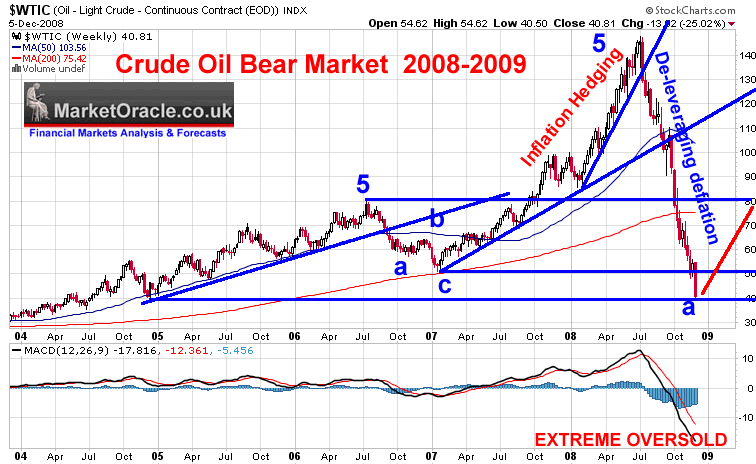
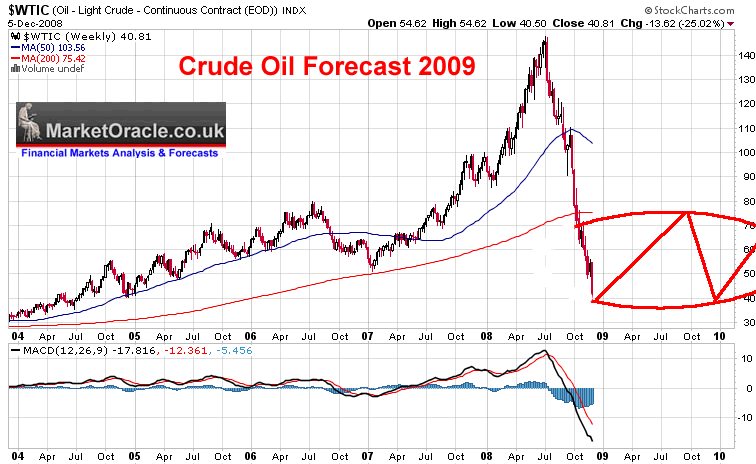
After plunge about 70% since its recent peak at $147 due to deflation, Oil prices remains to need finding its bottom. It will take much time for crude oil to formulate a bottom that is expected will form a very volatile double or even triple bottom pattern.

Nadeem Walayat, A contributor to Market oracle, wrote, “However the long-term trend for crude oil remains higher, when I mean long-term I am looking at well beyond the next 12 months towards 5 to 10 years, when I would not be surprised given the peak oil fundamentals that we will actually be visiting the $200 crude targets that were loudly pronounced during mid 2008 as being imminent when crude oil was trading at $147. This scenarios should not be surprising given that the US Dollar bull market remains in tact that will continue to bear down on all commodities during 2009, but more on the dollar in my next (fourth) US Dollar bull market update.”

Click the images to enlarge

Charts courtesy of Market Oracle

ETFs/Stocks :
    Ultra DJ-AIG Crude Oil ETF          UCO
    UltraShort DJ-AIG Crude Oil ETF SCO
    ProShares Ultra Oil & Gas ETF DIG
    ProShares UltraShort Oil & Gas ETF DUG
Related Posts :
    Merril Lynch: Oil prices could fall to $25
Sources :
    Market Oracle: Crude Oil Forecast 2009- Time to Buy?
Please Note!

This is generally never true. Before buying or selling any asset you should do your own research and reach your own conclusion. See my Disclaimer on the bottom for more information.

You are welcome to republish this article, or any portion thereof.
Please, cite the actual/original source. I would be grateful if you could link back.


Stumble Upon Toolbar Add to Technorati Favorites Bookmark and Share

borrowing in the world debt securities market plunged 77% in the Q3 of 2008

The Bank for International Settlements (BIS) said on December 7, that borrowing in the world debt securities market plunged 77% to $247 billion in the third quarter of 2008 compared with the second quarter, amid the continued turmoil in financial markets.

The decline is "well beyond normal seasonal patterns" and resulted in the lowest level of net issuance since the third quarter of 2005.

Here is from FinFacts:
Net issuance of bonds and notes decreased to $247 billion, down substantially from $1,086 billion in the second quarter. The decline was well in excess of normal seasonal patterns, and resulted in the lowest level of net issuance since the third quarter of 2005.

Money market borrowing also stagnated, with net issuance falling into negative territory in the third quarter. By currency of denomination, the largest decrease in bond and note issuance came from the euro-denominated segment, followed by the dollar-denominated segment, while the breakdown by nationality of issuers indicates that the largest contraction in net issuance came from US borrowers, down from $308 billion in the second quarter to $46 billion in the third quarter.

Outstanding claims in the international banking market diminished sharply during the second quarter of 2008 . BIS reporting banks' international claims fell by an unprecedented $1.1 trillion, with sizeable declines recorded across claims in most currencies of denomination. While a significant decrease in interbank claims (-$812 billion) accounted for most of that decline, international claims on non-banks also fell for the first time since 1998, mainly vis-à-vis the United States, the United Kingdom and Japan. At the same time, residents of emerging markets and many central banks around the world reduced their placements of funds with BIS reporting banks.

The BIS said market developments over the period under review went through four more or less distinct stages. Stage one, which led into the Lehman bankruptcy in mid-September, was marked by the takeover by the US authorities of the government-sponsored housing finance agencies Fannie Mae and Freddie Mac. Stage two encompassed the immediate implications of the Lehman bankruptcy and the crisis of confidence it triggered. Stage three, starting in late September, was characterised by fast-paced and increasingly broad policy actions, as the response to the crisis evolved from case by case reactions to a more international, system-wide approach. In the fourth stage, from mid-October, pricing patterns were increasingly dominated by recession fears, while markets continued to struggle with the uncertainties surrounding the large number of newly announced policy initiatives.


Related Posts :
    BIS warns global lending collapse, ZIRP & monetary stimulus may come at a cost
Sources :
  1. FinFacts: Bank for International Settlements says world debt borrowings plunged sharply in Q3 2008, December 8, 2008 9:06:41 AM
  2. The Wallstreet Journal: World Debt Borrowings Fall 77%, December 7, 2008, 8:39 P.M. ET
Please Note!

This is generally never true. Before buying or selling any asset you should do your own research and reach your own conclusion. See my Disclaimer on the bottom for more information.

You are welcome to republish this article, or any portion thereof.
Please, cite the actual/original source. I would be grateful if you could link back.


Stumble Upon Toolbar Add to Technorati Favorites Bookmark and Share

BIS warns global lending collapse, ZIRP & monetary stimulus may come at a cost

According to the Telegraph, Bank for International Settlements (BIS) warns cross-border loans worldwide fell by $1.1 trillion (£740bn) in the first half of the year, reflecting the scramble by the financial industry to cut leverage by pulling credit lines and slashing risky exposure.

Foreign lending by UK banks fell by a staggering $884bn, equal to 81% of the entire contraction in international lending.

London as the epicenter of Europe's structured credit industry, has suffered a dramatic collapse and facing a double blow since worldwide issuance of bonds and securities has also gone into freefall, plummeting 77% from over a trillion dollars to $247bn in the third quarter.

In its quarterly report, the BIS warned the US Federal Reserve, the Bank of England and other central banks that near-zero interest rates and emergency monetary stimulus may come at a cost.

By opening the cash spigot, the authorities risk displacing the money markets and may "discourage banks from lending to other banks".

The money markets are a crucial lubricant for the financial system, but they cannot function if rates fall too low. The sector can wither away, as Japan discovered during its "Lost Decade".

The BIS also hinted that the European Central Bank and Sweden's Riksbank may have blundered by raising rates this year to contain the oil shock. It said short-term energy spikes have no lasting effect on inflation or wage deals.

"Evidence suggests an absence of strong second-round effects on inflation. The temporary inflationary impulse will soon drop out," it said.

Related Posts :
    Banks ignore Gordon Brown’s request to cut its borrowing cost
Sources :
    Telegraph: BIS warns of collapse in global lending, December 9, 2008 8:53AM GMT
Please Note!

This is generally never true. Before buying or selling any asset you should do your own research and reach your own conclusion. See my Disclaimer on the bottom for more information.

You are welcome to republish this article, or any portion thereof.
Please, cite the actual/original source. I would be grateful if you could link back.


Stumble Upon Toolbar Add to Technorati Favorites Bookmark and Share

Japan sank more deeply into recession rather than initially thought

Japan revised its 3rd Quarter GDP today. The number is bigger than expected and signs that Japan’s economy as the second largest economy in the world, sank more deeply into recession rather than initially thought.

Here is from IHT:
Gross domestic product contracted 0.5 percent in July-September, far more than the preliminary figure of a 0.1 percent decrease and economists' median forecast of a 0.2 percent fall. Japan's economy shrank at an annual rate of 1.8 percent in the quarter, three times faster than the contraction in the U.S. economy in the same period.

"The revision was bigger than expected. Given further weakness in exports and capital spending since October, the economy's contraction will deepen in the fourth quarter," said Tatsushi Shikano, senior economist at Mitsubishi UFJ Securities. "The Japanese economy will likely shrink in the financial year to March."

The revision was mainly due to a markdown in inventory and government spending.

The export-driven economy now looks likely to keep contracting at least until the first quarter of next year, which would mark unprecedented four straight quarters of decline, as leading Japanese manufacturers cut outputs sharply to deal with slump in global demand.

The euro zone and the United States are also in recession and growth is slowing in big emerging markets, such as China, boding ill for big Japanese exporters like Toyota and Sony.

Capital spending, a key driver of growth until recently, was revised downward slightly to a 2.0 percent contraction, from 1.7 percent, a change not large enough to affect the overall growth rate.

The meltdown of global financial markets since mid-September has shattered hopes for a short and shallow recession in Japan. The previous record was three quarters in a row, as in the last contraction seven years ago in the wake of the dotcom bust.

While the weakness until the third quarter largely stemmed from high oil prices, the economy is expected to bear the full brunt of the global downturn in the fourth quarter and beyond.

Recent data showed that Japanese companies are curtailing production at an unprecedented pace as demand plunges not just in the United States, the world's biggest economy, and Europe but also in emerging nations that had until recently weathered the global financial storm.

A sharp appreciation in the yen since October is also hurting exporters, as a higher yen cuts overseas earnings in yen terms and also limits their competitiveness.

The downturn was much more severe than previously thought, said Susumu Kato, chief economist at Calyon. "We've been expecting a 0.4 percent contraction in fiscal 2008/09 but that now needs to be revised down. It's hard to see at this point how the economy will return to a recovery."

Japanese consumption should benefit from sharp drops in oil and other raw material prices but economists say it will take time before such positive effects are felt.

Economists say the closely watched "tankan" corporate survey by the Bank of Japan due next Monday will show a plunge in Japanese corporate sentiment.

Some analysts speculate the Bank of Japan will cut interest rates again by the end of the current business year next March, after trimming its key rate to 0.30 percent from 0.50 percent in October. However, derivative contracts are pricing in less than 30 percent chance of another 0.20 percentage point cut by then.

Related Posts :
    Japan deepens into unprecedented recession
Sources :
    The International Herald Tribune: Japan revises 3rd quarter GDP downward, December 9, 2008
Please Note!

This is generally never true. Before buying or selling any asset you should do your own research and reach your own conclusion. See my Disclaimer on the bottom for more information.

You are welcome to republish this article, or any portion thereof.
Please, cite the actual/original source. I would be grateful if you could link back.


Stumble Upon Toolbar Add to Technorati Favorites Bookmark and Share

S&P downgrades Russia’s rating


Cite capital outflows, 'rapid depletion' of foreign currency reserves;
Report and analysis by Ellen Pinchuk of Bloomberg News.
Video courtesy of Bloomberg via Clip Syndicate

Due to warning of the "rapid depletion" of Russia's massive reserves, Standard & Poor's has lowered Russia's long and short-term sovereign foreign currency credit ratings from BBB+/A-2 to BBB/A-3 with a negative outlook.

Here is from Novosti, the Russian News & Information Agency on December 8:
Standard & Poor's has lowered Russia's long and short-term sovereign foreign currency credit ratings from BBB+/A-2 to BBB/A-3 with a negative outlook, the international rating agency said on Monday.

The long-term local currency rating was also lowered to BBB+ from A-, while the short-term local currency rating was affirmed at A-2, S&P said.

"The lowering of the ratings on Russia reflects risks associated with the sharp reversal in external portfolio and other investment flows, which has increased the cost and difficulty of meeting the country's external financing needs," Standard & Poor's credit analyst Frank Gill said.

Since August 2008, Russia's international reserves, which hold gold and foreign currency, have plunged from $583 billion to $455 billion, amid the financial crisis.

"Pressures on the financial account stem from corporations prepaying or hedging foreign exchange borrowing, from banks refinancing their foreign currency obligations domestically with public sector banks, and from resident capital flight, while the central bank tries to offset intensifying pressures on the nominal exchange rate," S&P said.
Redemption profile as % of total liabilities on the r.h. scale
Source: company data, Dealogic, Cbonds, Raiffeisen RESEARCH
Via RZB

ETFs/Stocks :
    Market Vector Russia ETF Trust  RSX  14.55  +1.17 (8.74%)
Related Posts :
    Russia will likely face a very hard landing
Sources :
  1. Novosti: S&P downgrades Russia's rating to BBB/A-3, outlook negative, December 8, 2008 15:57
  2. RZB: S&P downgrades rating of Russian Standard Bank, November 19, 2008
  3. The Wallstreet Journal: S&P Downgrades Russia, Citing Falling Reserves, December 9, 2008
Please Note!

This is generally never true. Before buying or selling any asset you should do your own research and reach your own conclusion. See my Disclaimer on the bottom for more information.

You are welcome to republish this article, or any portion thereof.
Please, cite the actual/original source. I would be grateful if you could link back.


Stumble Upon Toolbar Add to Technorati Favorites Bookmark and Share

FedEx (FDX) cut its profit outlook for fiscal year (FY) 2009

FedEx (FDX) expected to report a better than expected second quarter profit result, but cut its profit outlook for fiscal year (FY) 2009 as oil prices decline. Here is from Reuters:
The package delivery company's earnings warning came minutes after trucking and logistics company Con-way Inc (CNW) cut its full-year 2008 earnings outlook.

Memphis-based FedEx estimated earnings of $1.58 per share for its fiscal 2009 second quarter ending November 30. Analysts had expected earnings of $1.51, according to Reuters Estimates.

The company is due to report the results on December 18.

But Fedex also sharply lowered its previously announced fiscal 2009 earnings forecast, to a range of $3.50 to $4.75 per share, from $4.75 to $5.25, as "significantly weaker macroeconomic conditions are expected to offset the benefits from lower fuel prices and the announced departure of DHL from the U.S. domestic package market."

Deutsche Post AG (DPWGn.DE) unit DHL said last month it would halt its U.S. domestic service as of January 30, with the loss of 9,500 jobs, citing a slowing U.S. economy and an uphill struggle against local behemoths FedEx and United Parcel Service Inc (UPS.N: Quote, Profile, Research, Stock Buzz).

Both UPS and FedEx are considered bellwethers of U.S. economic activity.

FedEx said it has lowered its target for capital expenditures for fiscal 2009 to $2.5 billion from a previously stated figure of $3.0 billion.

Separately, trucking firm Con-way said it was cutting its full-year earnings outlook to a range of $2.20 to $2.35 a share, from a previously announced target of $2.60 to $2.80. The previous target already had been reduced in October from a range of $3.00 to $3.40.

"With three weeks remaining to the end of the year, the company is maintaining a relatively wide range in guidance, due to turbulent market conditions and lack of reliable visibility into an economy which continues to deteriorate," San Mateo, California-based Con-way said in a statement.

Con-way is regarded by analysts as one of the better performing less-than-truckload operators, which consolidate smaller loads into a single truck.

In extended trading, FedEx's stock fell $8.43, or more than 11 percent, to $66.00 after closing up 72 cents at $74.43 on the New York Stock Exchange.

In after-hours trading, UPS shares were down nearly 5 percent, or $2.65, at $55.97, while Con-way stock slid less than 1 percent to $25.60.


Related Posts :
    RIMM cut its third-quarter profit outlook
Sources :
    Reuters: FedEx slashes outlook, shares fall 11 percent, December 8, 2008 5:58pm EST
Please Note!

This is generally never true. Before buying or selling any asset you should do your own research and reach your own conclusion. See my Disclaimer on the bottom for more information.

You are welcome to republish this article, or any portion thereof.
Please, cite the actual/original source. I would be grateful if you could link back.


Stumble Upon Toolbar Add to Technorati Favorites Bookmark and Share

Friday, December 5, 2008

Banks ignore Gordon Brown’s request to cut its borrowing cost

Even BOE has aggressively cut its interest rate in the two consecutive months by 140bps on November 6 and 100bps yesterday to 2%, as low as at anytime in its 300 years history. But banks as lenders are still not willing to cut its borrowing cost.

British Prime Minister, Gordon Brown, intensively urges banks to cut its borrowing cost but the Gordon Brown’s request is ignored by banks.

Here is from Telegraph:
In lowering rates again following last month's dramatic 1.5 percentage point reduction, the Bank of England itself hinted that base rate cuts were not enough to stop the economy sliding into a prolonged recession. The Bank of England will reduce interest rates even further as the economic downturn continues to bite.

Willem Buiter, of the London School of Economics, a former member of the Bank's Monetary Policy Committee, on Thursday called on the Bank to reduce rates to zero immediately, saying there was little point in "keeping its powder dry."

Roger Bootle, an economic adviser to the accountants Deloitte, said the Bank must cut rates "as far as it can", adding: "It won't be long before interest rates are reduced to 1 per cent, and they may ultimately have to fall all the way to zero."

The Bank is also now considering radical plans to pump cash directly into the economy – the nuclear option for when interest rate cuts fail.

The Government has begun considering contingency plans to nationalize the banking system if lending conditions do not improve soon.

As known, the main problem of the current credit market is evaporating credit confidence that was due to higher risk of credit default. Accordingly, even though the benchmark rate is dramatically reduced to zero percent as Willem Buiter and Roger Bootle saying, I think it would not directly impact on the easing credit tightened. Even, if the government really nationalizes the banking system.

The Government should restore credit confidence by regulating credit market as George Soros proposing on the current financial system reformation along with the bailout moves. If we look back in the past, when economy was very well, credit trust was high and default risk was very low and controllable. How much central banks set interest rate, lenders remained willing to lend, even lenders were totally private holding.

Related Posts :
    ECB, BOE & Sweden cut rate; French unveiled a €26bn stimulus packages
Sources :
    Telegraph: Banks under pressure to cut borrowing costs after rate cut, December 5, 2008 7:54AM GMT
Please Note!

This is generally never true. Before buying or selling any asset you should do your own research and reach your own conclusion. See my Disclaimer on the bottom for more information.

You are welcome to republish this article, or any portion thereof.
Please, cite the actual/original source. I would be grateful if you could link back.


Stumble Upon Toolbar Add to Technorati Favorites Bookmark and Share