Translate this page from English into :

Tuesday, November 11, 2008

China's Stimulus Plan is not actually adding a new spending

By Barry Ritholtz
The Big Picture
November 11th, 2008, 7:19AM

Paraphrasing Nixon, have the Chinese become Keynesians now, too?

I don’t believe so.

China’s proposed $586 billion dollar stimulus plan sure generated a lot of excitement this past weekend. It was amusing to watch the SPX futures tick up on this supposed new program. Especially when we compare it with the $170 billion in tax rebates this summer — The Economic Stimulus Act of 2008 — which was only 1% of GDP of the US, versus about 18% of China’s GDP.

But is China’s plan really a new stimulus? The short answer is no, and it took the market about half a day to figure this out yesterday.

Why? Compare China — a country with a centrally planned economy, carefully managed by a communist regime — with the United States. The US has a $14 trillion economy, of which about $3 trillion is government spending (military, entitlements, discretionary). Any new stimulus plan — be it tax rebates, direct spending on public works programs, or aid to the auto industry — is essentially new spending that didn’t previously exist.

When $3 trillion becomes $3.17 trillion, it is significant. It is as if the US is adding more pieces to the economic chess board.

China, on the other hand, is merely moving resources from one region to another. They are not creating more economic activity, putting cash in the hands of consumers, or even increasing their infrastructure plans.
“Bullishness in Asia on Monday was tempered by questions about how much of China’s plan is actually new — or is simply a repackaging of past commitments, such as the rebuilding effort following the Sichuan earthquake. Investors appeared to question estimates that Beijing would spend another 6% to 7% of its gross domestic product in each year of the plan, as the raw numbers of the plan would suggest. . .

Beijing may be prepared to add extra stimulus. A Beijing think tank, the China Academy of Social Sciences, said Monday it has submitted a report to economic policy makers outlining ways for the government to offset stock-market panic. One suggestion is to deploy as much as $115 billion to buy shares in the stock market’s 50 biggest companies if the Shanghai Composite Index slips to 1500. The market remains 64% below last year’s close.

The package didn’t address one big question about China’s economic-policy plans: whether it will stoke its own domestic demand by letting the yuan rise, or act defensively to let the currency fall to relieve pressure on its own exporters.”
On their economic chess board, all they are doing is moving pieces about. But they are not actually adding anything to the board.

This Chinese economic stimulus plan is a contradiction in terms.
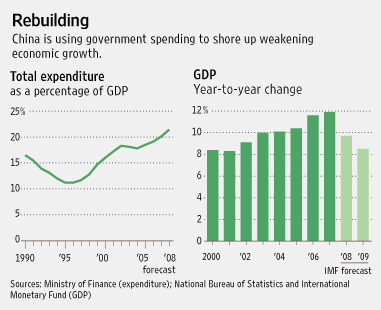

Chart courtesy of WSJ


ETFs/Stocks :
    iShares FTSE/Xinhua China 25 Index ETF     FXI  $25.05  -1.56 (-5.86%)
    UltraShort FTSE/Xinhua China 25 Proshares FXP $76.66 +7.16 (+10.30%)
Related Posts :
Sources :Please Note!

This is generally never true. Before buying or selling any asset you should do your own research and reach your own conclusion. See my Disclaimer on the bottom for more information.

You are welcome to republish this article, or any portion thereof.
Please, cite the actual/original source. I would be grateful if you could link back.



Stumble Upon Toolbar Add to Technorati Favorites Bookmark and Share

Meredith Whitney expects banks will need more government aid

The Financial Times
November 10, 2008

Meredith Whitney, the Citi Killer and one of the first analysts to predict in 2007 that banks would face enormous write-downs and balance sheet problems as a result of the housing downturn, expects the US government to have to take further measures to back the banking system, “either by raising capital for these banks or do a stimulus program directly to the consumer”.

She finds it hard to see how a new US administration under president-elect Barack Obama will be able to “rerail the economy after it’s been derailed.” She says the economic crisis is not just Wall Street’s issue; Washington was also involved.

Click the Financial Times' report video

Sources :Please Note!

This is generally never true. Before buying or selling any asset you should do your own research and reach your own conclusion. See my Disclaimer on the bottom for more information.

You are welcome to republish this article, or any portion thereof.
Please, cite the actual/original source. I would be grateful if you could link back.


Stumble Upon Toolbar Add to Technorati Favorites Bookmark and Share

Even its $36.9 bln endowment won't protect Harvard

A student graduating from Harvard's Business School holds a U.S. flag with
a dollar bill tied to it during the 357th Commencement Exercises at
Harvard University in Cambridge, Massachusetts June 5, 2008.
REUTERS/Brian Snyder

Harvard University would also be feeling the pinch due to financial crisis.

From The Wall Street Journal:
    Harvard's endowment, which stood at $36.9 billion in June, has had stellar performance, returning an annualized 14% over the last decade. In fact, its returns had been so lush and its size so large that the Cambridge, Mass., school has drawn unflattering attention from Congress for hoarding its riches. Amid such pressure, Harvard and other wealthy schools have been increasing financial aid.

    Ms. Drew Gilpin Faust, Harvard University's president, noted that Moody's Investors Service, the bond rater, is projecting a 30% decline in the value of endowments this fiscal year. Earnings from Harvard's endowment, Ms. Faust said, provide about a third of the school's $3.5 billion budget.

    She said the school was assessing all of its capital spending plans, including "the phasing and development" of its massive plan to expand its campus in Boston's Allston neighborhood, which has been described by the school as a multibillion-dollar build-out that will take 50 years.

    Ms. Faust said the school remained committed to its new, sweetened financial-aid awards, which make the school tuition free to families with under $60,000 and extend assistance to families making up to $180,000. She also said the school wants to keep tuition increases modest because families are facing financial strains.

Sources :Please Note!

This is generally never true. Before buying or selling any asset you should do your own research and reach your own conclusion. See my Disclaimer on the bottom for more information.

You are welcome to republish this article, or any portion thereof.
Please, cite the actual/original source. I would be grateful if you could link back.


Stumble Upon Toolbar Add to Technorati Favorites Bookmark and Share

Is Mexico the next crisis?

The Huffington Post
By Diane Francis
November 11, 2008 11:49 AM EST

NAFTA's weakest member, Mexico, is fighting a desperate battle against narcos. The cartels have murdered 4,000 mayors, police, army and others in the past year and on Nov. 4 election day they sent a terrible warning to the country.

This may become President-elect Barack Obama's first test and crisis. The day of Barack Obama's landmark election, Mexico's second-highest official in charge of other key drug interdiction officials died in a fiery jet crash during rushhour in downtown Mexico. Fourteen died in total and 40 were injured on the ground.
The government is saying very little and the investigation is being conducted in the U.S. too, but the facts have frightening implications for all three NAFTA partners. Some 40 million Mexican-Americans also live in the U.S. and are gravely concerned how this crisis is handled.

Here's excerpts from my National Post blog:
    "There was no press attention in Canada, and hardly any in the U.S., about the crash carrying Interior Secretary Juan Camilo Mouriño, along with key drug interdiction officials. Another passenger was former Assistant Attorney-General José Luis Santiago Vasconcelos who had a multi-million dollar price put on his head by the cartels because of his work against the drug trade during the Administration of Vicente Fox.

    "It appears to be a message that the drug cartels will stop at nothing as they continue to corrupt and ruin the country as they did in Colombia. Mexico's stock market and currency fell calamitously and the implications for the U.S. are obvious in the form of violence along its border, increased illegal immigration and a continuing flow of illicit narcotics.

    Unchecked, Mexico could descend into a kleptocracy.

    "The plane's black box is being examined in the United States, not Mexico, and reports are that one of its engines fell off as the jet approached Mexico City's airport. The crash site could not have been more high profile and created a firebomb in the heart of the city, fuelling speculation that the pilot was on a suicide mission. He also reported no problems to the tower as they approached the airport.

    "The tragedy plunges the government of President Felipe Calderon into a crisis. Already, there are problems with declining oil income, and revenues for the government from oil, as well as the drug war."

    "Rosanna Fuentes-Berain who is a prominent Mexican author and newspaper editor, said in an interview with me: "The Calderon Presidency will be tested by how he reacts to an unfortunate event that will take at least a month for experts to establish if indeed it was an accident or an intentional attack."

    "In a country where, in the current year, 4,000 people have been murdered, it is not irrational to think that this could be an escalation precisely because Calderon has fought so courageously against drug traffickers that operate as almost a parallel state."

    "Transparency and scientific evidence beyond any reasonable doubt are to be at the heart of how this case is presented to the citizens. Mexicans have very low levels of confidence in their politicians. This is a society that has had more than its share of lies coming from politicians."

    "The crash is more worrisome considering that the plane was under the protection of the Armed Forces, but it is widely known that there has been penetration of the military by the cartelistas. Not surprisingly, the peso and Mexican stock markets tumbled in part because of the American downturn, but also undoubtedly due to worries about the stability of NAFTA's southernmost partner."


ETFs/Stocks :
    iShares MSCI Mexico Inv. Mt. Idx. ETF EWW  30.04  -0.76 (-2.47%)
Related Posts :
Sources :Please Note!

This is generally never true. Before buying or selling any asset you should do your own research and reach your own conclusion. See my Disclaimer on the bottom for more information.

You are welcome to republish this article, or any portion thereof.
Please, cite the actual/original source. I would be grateful if you could link back.


Stumble Upon Toolbar Add to Technorati Favorites Bookmark and Share

[Video] Where is the Bottom for Oil?

Bloomberg Video
November 11, 2008 08:40 am EST

China Stimulus and Oil Prices - Analysis and Discussion with Antoine Halff of Newedge USA; Oil Price Down 58% from High, a Dramatic Drop But Still High Historically


ETFs/Stocks :
    Ultra Oil & Gas ProShares           DIG  $30.95  -2.92 (-8.62%)
    ProShares UltraShort Oil & Gas ETF DUG $40.29 +3.22 (+8.69%)
    United States Oil Fund LP ETF USO $48.58 -2.65 (-5.17%)
Related Posts :
Sources :Please Note!

This is generally never true. Before buying or selling any asset you should do your own research and reach your own conclusion. See my Disclaimer on the bottom for more information.

You are welcome to republish this article, or any portion thereof.
Please, cite the actual/original source. I would be grateful if you could link back.


Stumble Upon Toolbar Add to Technorati Favorites Bookmark and Share

Bank of Korea buys banks bond through repurchase agreement

XinHua,
November 11, 2008 22:22

SEOUL, Nov. 11 (Xinhua) -- South Korea's central bank said Tuesday that it signed a 63-day repurchasing agreement to buy 1 trillion won (755.9 million U.S. dollars) worth of bank and other special bonds.

Out of the total amount of purchase, the bank bonds accounted for 756.4 billion won (571.7 million U.S. dollars) while the rest was other special debts, according to the Bank of Korea.

The interest rate ranged from 4.51 percent to 4.72 percent, the BOK added.

The auction followed the BOK decision in late October to include bank bonds and some special debts as collateral for its open market operations in an effort to ease a credit crunch sparked by global financial turmoil.

This was the first time for the South Korean central banks to include bank bonds in is repurchase agreement transaction.


Related Posts :
Sources :Please Note!

This is generally never true. Before buying or selling any asset you should do your own research and reach your own conclusion. See my Disclaimer on the bottom for more information.

You are welcome to republish this article, or any portion thereof.
Please, cite the actual/original source. I would be grateful if you could link back.


Stumble Upon Toolbar Add to Technorati Favorites Bookmark and Share

2008/11/11-Fitch Cuts Ratings On Harley-Davidson, Financing Arm

Marketwatch Pulse,
November 11, 2008

Fitch Ratings on Tuesday downgraded Harley-Davidson Inc. and its financing arm because of declining sales and weaker margins. Fitch lowered the issuer default rating of Harley-Davidson and Harley-Davidson Financial Services to A from A+. The outlook is negative.

Copyright © 2008 MarketWatch, Inc.

Sources :Please Note!

This is generally never true. Before buying or selling any asset you should do your own research and reach your own conclusion. See my Disclaimer on the bottom for more information.

You are welcome to republish this article, or any portion thereof.
Please, cite the actual/original source. I would be grateful if you could link back.


Stumble Upon Toolbar Add to Technorati Favorites Bookmark and Share

China announced monthly trade surplus of $35.2 bln in October

Visit the A exhibition hall of China Import and Export Fair in Guangzhou,
capital of south China's Guangdong Province on Nov. 3, 2008. (Xinhua Photo)

XinHua,
November 11, 2008

China's General Administration of Customs on Tuesday announced a record monthly trade surplus of 35.2 billion U.S. dollars in October.

It was the fourth consecutive monthly rise since July. Total foreign trade rose 17.6 percent from the same month last year to 221.4 billion U.S. dollars in October, according to the Customs website.

Though exports growth further slowed to 19.2 percent from 21.5 percent in September, which might have led to smaller trade surplus, the trade gap continued to widen on sharply declining imports.

China's exports reached 128.3 billion U.S. dollars, while its imports registered 93.1 billion U.S. dollars in October.

"Export growth is slightly higher than expected," said Asian Development Bank (ADB) economist Zhuang Jian. "But the impact of reduced demand from the European and American markets remains, and will continue to damage exports. The situation might be more severe next year."

Exports to the United States rose 11.4 percent to 212.8 billion U.S. dollars in the first 10 months, an acceleration of 0.2 percentage points from the first three quarters.

Exports to the European Union gained 24.5 percent to 246.7 billion U.S. dollars year on year, down 1.1 percentage points than the first nine months.

The growth of China's imports slowed much faster than expected, indicating a serious lack of domestic demand, Zhuang said.

Affected by the global economic slowdown, imports growth dropped from 33.7 percent in July gradually to 15.6 percent in October.

The decline in imports is not only caused by the slackening domestic demand, but also triggered by the fall in exports.

As a large proportion of China's imports come from the demand for resources and materials needed to produce finished export products, the decrease in exports has also pulled down imports, said Zhuang.

ETFs/Stocks :
    iShares FTSE/Xinhua China 25 Index ETF  FXI  $25.23  -1.38 (-5.19%)
    UltraShort FTSE/Xinhua China 25 Proshares FXP $76.02 +6.52 (+9.38%)
Related Posts :
Sources :Please Note!

This is generally never true. Before buying or selling any asset you should do your own research and reach your own conclusion. See my Disclaimer on the bottom for more information.

You are welcome to republish this article, or any portion thereof.
Please, cite the actual/original source. I would be grateful if you could link back.


Stumble Upon Toolbar Add to Technorati Favorites Bookmark and Share

S&P cuts South Africa outlook to negative on growth & current account

MoneyWeb,
November 11, 2008

S&P points to concerns about a large current account deficit and slowing world growth.

Standard & Poor's cut the outlook for South African ratings to negative from stable on Tuesday on concerns about a large current account deficit and slowing world growth.

The revision follows a similar move by Fitch on Monday, which was criticised by the country's Treasury.

"The outlook revision reflects pressures on South Africa's balance of payments, which increase the risk of further currency depreciation and a sharper-than-anticipated correction in the current account deficit...," S&P credit analyst Remy Walters said in a statement.

The ratings agency affirmed South Africa's "BBB+/A-2" foreign currency and "A+/A-1" local currency ratings.

It said local banks had limited exposure to the global financial crisis and should cope with an increase in bad debts as households struggle to cope with high interest rates and inflation.

But the economy would feel the impact of the global slowdown.

The rand had depreciated sharply this year and net portfolio flows were likely to remain negative, putting further pressure on the currency.

This would add to inflationary pressures and delay an expected easing in monetary policy at a time when economic growth was easing, S&P said.

The rand has weakened by around 30 percent against the dollar in 2008, stung by global risk aversion, a recent dip in commodity prices and concern about the financing of a currenct account deficit that stood at 7.3 percent of GDP last year.

The central bank highlighted the weak rand as a major threat to the inflation outlook. Analysts warn the rand could delay rate cuts, widely expected in 2009.

S&P said part of the necessary adjustment in the balance of payments was a larger-than-expected correction in domestic demand, including through the delaying of public sector investments, which could lead to a longer period of slower growth.

"The negative outlook reflects the increasing weight of short-term macroeconomic risks to our base case," Salters said, adding an orderly balance of payments correction and continued prudent fiscal policy.


ETFs/Stocks :
    iShares MSCI South Africa Index ETF  EZA  31.68  -1.57 (-4.72%)
Related Posts :
Sources :Please Note!

This is generally never true. Before buying or selling any asset you should do your own research and reach your own conclusion. See my Disclaimer on the bottom for more information.

You are welcome to republish this article, or any portion thereof.
Please, cite the actual/original source. I would be grateful if you could link back.


Stumble Upon Toolbar Add to Technorati Favorites Bookmark and Share

S&P: Some $2.1T of European company and bank debt matures in the next 3 years

Reuters,
November 11, 2008

Some $2.1 trillion of European company and bank debt matures in the next three years, raising "substantial refinancing risk", Standard & Poor's said on Tuesday.

With new bond issues at a virtual standstill after the bankruptcy of Lehman Brothers, fears have intensified that companies will be unable to raise fresh debt to pay off maturing bonds, potentially pushing them into default.

"Funding pressures in Europe have escalated sharply since September as stress in the global financial system accelerated," S&P analysts said in a note.

"Given the soaring cost of capital the sizeable pipeline of debt coming due suggests substantial refinancing risk."

The credit-ratings agency said euro-denominated senior bank debt was being offered at spreads near 225 basis points over swaps, almost 10 times wider than levels before August 2007.

The financial sector makes up 72% of maturing debt over the next three years rated by S&P -- but recent government rescue packages should help mitigate those refinancing pressures, S&P said.

Just in the remainder of 2008, $206 billion of European debt will mature, including $181 billion in the financial sector.

Within non-financials, capital-intensive sectors such as telecommunications and utilities have around $113 billion and $79 billion worth of debt respectively due to mature in 2009 through to the end of 2011, S&P said.

In the fourth quarter, those sectors face an additional $8.6 and $4.1 billion respectively of maturing debt.

Other sectors with the heaviest redemption profiles include healthcare at $48 billion; metals, mining and steel at $32 billion; and transportation at $28 billion.

"The vast majority of debt (90%) maturing in Europe is investment grade, which traditionally would temper refunding risk, but poses greater challenges than normal in the current environment," S&P said.

The biggest refunding risks come in 2009, when $801 billion of debt matures, split between $576.8 billion of financial debt and $172.6 billion of non-financial debt, the vast majority of which is investment-grade. Another $51.6 billion of debt matures in 2009 that is not rated by S&P.

Germany Most Exposed to Financials

Germany has the most maturing financial debt in 2009 to 2011 at 40% of the total, largely due to its exceptionally large covered bond market.

Covered bonds are backed by assets that remain on the borrower's balance sheet and are therefore perceived as less risky. But even this market has suffered in the deepening credit crisis with scant new issues and wider spreads.

After Germany, Sweden, the Netherlands, France, Italy, Spain and the United Kingdom have the most financial debt maturing. Together, they account for about 85% of total financial exposure in Europe, S&P said.

For non-financial debt maturing in 2009 to 2011, France is most exposed at 26%, followed by the United Kingdom, Germany, the Netherlands and Italy. The five make up about 80% of total exposure.

Following is a table, based on data from S&P as at Oct. 22, on bond refinancings due in Europe from now until end-2011.

Related Posts :
Sources :Please Note!

This is generally never true. Before buying or selling any asset you should do your own research and reach your own conclusion. See my Disclaimer on the bottom for more information.

You are welcome to republish this article, or any portion thereof.
Please, cite the actual/original source. I would be grateful if you could link back.


Stumble Upon Toolbar Add to Technorati Favorites Bookmark and Share

Starbucks profit plunges 97% due to a sharp economic downturn

On Monday, the Starbucks (SBUX) reported that net income had dropped 97 percent due to a sharp economic downturn, where there are only fewer people are in the mood to indulge.

Starbucks reported a modest profit of $5.4 million, or a penny a share, compared with $158.5 million, or 21 cents a share, in the period a year ago. Revenue rose 3 percent, to $2.5 billion, up slightly from $2.4 billion a year ago. The company's operating expenses rose because of higher payroll, higher rents and inventory write-downs, while operating profit margins shrank to 0.6 percent, from 10.2 percent in the year-ago period. It blamed weak traffic in its American stores, the source of 88 percent of its revenue.

Down more than 56 percent already this year, shares of Starbucks fell 2.75 percent Monday in after-hours trading, to $9.92.

They said they had identified the macroeconomic storm early and taken action - announcing 600 store closures over the summer and cutting expenses.

The company's chief executive, Howard Schultz, said Starbucks was also reacting to economic conditions by introducing new marketing programs that reward loyal customers, like a new Gold Card that costs $25 and entitles buyers to 10 percent discounts and free wireless Internet access in stores.

"In this environment, the rules of engagement no longer apply," Schultz said in the call. "We are keenly aware of the importance of value to our customers."

The company plans to end fiscal 2009 with 225 fewer company-owned stores than at the beginning of the year.

Internationally, Starbucks is planning to open about 700 new stores in the fiscal year ahead, but two-thirds of those will be licensed cafés that are run by other companies, like supermarkets and bookstores.

Many Starbucks watchers say that the company has a resiliency with its core customers that it can build on in the months and years ahead.

Related Posts :
Sources :Please Note!

This is generally never true. Before buying or selling any asset you should do your own research and reach your own conclusion. See my Disclaimer on the bottom for more information.

You are welcome to republish this article, or any portion thereof.
Please, cite the actual/original source. I would be grateful if you could link back.


Stumble Upon Toolbar Add to Technorati Favorites Bookmark and Share

2008/11/11-FBR downgraded Alcoa

Marketwatch Pulse
November 11, 2008

LONDON -- Alcoa (AA) was downgraded to market perform from outperform by Friedman, Billings, Ramsey and the aluminum giant's price target was cut to $10 from $20. The rating change reflects "the combination of production curtailments announced yesterday after the market closed and a lower aluminum price outlook."

Copyright © 2008 MarketWatch, Inc.

Sources :Please Note!

This is generally never true. Before buying or selling any asset you should do your own research and reach your own conclusion. See my Disclaimer on the bottom for more information.

You are welcome to republish this article, or any portion thereof.
Please, cite the actual/original source. I would be grateful if you could link back.


Stumble Upon Toolbar Add to Technorati Favorites Bookmark and Share

[Video] Brown Calls For Global Coordination On Stimulus; Recession Thrusts Tax Cuts

Bloomberg Video
November 11, 2008 04:51 am EST

Brown calls for global coordination on stimulus; Recession thrusts tax cuts into spotlight in Britain; Report and analysis by Steven Bell of GLC LTD.


Related Posts :
Sources :Please Note!

This is generally never true. Before buying or selling any asset you should do your own research and reach your own conclusion. See my Disclaimer on the bottom for more information.

You are welcome to republish this article, or any portion thereof.
Please, cite the actual/original source. I would be grateful if you could link back.


Stumble Upon Toolbar Add to Technorati Favorites Bookmark and Share

AmEx Gets Access to Bailout Fund

American Express and MasterCard credit cards are shown
in Washington June 25, 2008. REUTERS/Jim Bourg (UNITED STATES)

Every company is willing to be a bank because they can access loan directly to the Fed. After the investment and local banks, the three big auto makers, AIG and Ambac. Now, American Express Co. (AXP) won fast approval to become a bank-holding company, helping the credit-card giant gain access to a chunk of the $700 billion in federal funds being pumped into financial firms. But The Wall Street Journal reported today that it isn't clear whether American Express applied for financial aid provided through TARP. We also still wait for the six big brokers which asking for the government bailout.

The move shows how quickly financial-services firms that have long relied on the capital markets are racing to shore up their funding sources as the credit crisis drags on and economic turmoil spreads around the world.

The specter of a steep recession has fueled investor worries about AmEx's financial position; even though its two bank units already have access to the Federal Reserve's discount window. Last month, the New York Company said it could keep itself going for at least a year if it were shut out of the credit markets.

American Express has total consolidated assets of about $127 billion and two bank units: American Express Centurion Bank, which operated as an industrial loan company under Federal Deposit Insurance Corp. supervision, and American Express Bank, which was regulated by the Office of Thrift Supervision. Each has assets of about $25 billion and deposits of about $7.2 billion, the Fed said. Centurion is being converted to a bank, according to the Fed order.

Banks, thrifts and bank-holding companies have a Nov. 14 deadline to apply for a capital infusion from the government. Fed officials are reviewing applications from a small number of other firms, including GMAC LLC, the auto and home lender.


Related Posts :
Sources :Please Note!

This is generally never true. Before buying or selling any asset you should do your own research and reach your own conclusion. See my Disclaimer on the bottom for more information.

You are welcome to republish this article, or any portion thereof.
Please, cite the actual/original source. I would be grateful if you could link back.


Stumble Upon Toolbar Add to Technorati Favorites Bookmark and Share

[Video] Russian Stock Indices; Russian Banks; Uralkali Downgraded By Credit Suisse

Bloomberg Video
November 11, 2008 02:36 am EST

Uralkali downgraded by Credit Suisse, Citigroup after flood probe; Putin meets with oil industry leaders to dicuss windfall profit tax, interfax; Report and analysis by Ellen Pinchuk of Bloomberg News.


ETFs/Stocks :
    Market Vector Russia ETF Trust  RSX  $17.88
Related Posts :
Sources :Please Note!

This is generally never true. Before buying or selling any asset you should do your own research and reach your own conclusion. See my Disclaimer on the bottom for more information.

You are welcome to republish this article, or any portion thereof.
Please, cite the actual/original source. I would be grateful if you could link back.


Stumble Upon Toolbar Add to Technorati Favorites Bookmark and Share

Fitch downgraded 17 Emerging Markets, including Russia, South Korea, South Africa and Malaysia

Global woes raise and continue spreading

After yesterday Merril Lynch consider Australia is the most vulnerable to economic crisis and Switzerland at the second rank. Today, Fitch Ratings lowered the outlooks of South Korea and three other emerging countries to "negative" from "stable" and cut the sovereign ratings of four others, see also the yesterday news. The Rating reflects higher risks to creditworthiness stemming from the global financial crisis and economic slowdown.

The outlooks on the long-term foreign currency ratings for South Korea, Mexico, Russia and South Africa, were revised down to "negative" from "stable," Fitch, one of the three major international credit ratings agencies, said in a release. A negative outlook means there is a greater chance of the actual credit rating being downgraded.

Outlooks on Chile and Malaysia, meanwhile, were lowered to "stable" from "positive," the agency said.

South Korea's A+ rating is four notches below Fitch's highest of AAA and six notches above "speculative" grade, generally regarded as "junk."

Russia, Mexico and South Africa are all rated BBB+, three levels above "speculative." Chile is at A, and Malaysia is at A-.

Fitch said the action followed a global review of the ratings of 17 major emerging market economies carried out "in response to the profound deterioration in the global economic and financial outlook."

Bulgaria, Kazakhstan, Hungary and Romania had their credit ratings downgraded by Fitch.

Brazil, China, India, Peru, Poland, Taiwan and Thailand had their ratings affirmed.

The agency said that contagion from the global financial crisis in advanced economies "triggered extreme volatility in emerging market asset prices" and caused "liquidity strains."

Foreign investors have fled emerging markets in droves during the crisis, cashing out of stock markets and sending funds back to their home economies and currencies.

In South Korea's case, Fitch expressed concerns that government support for the country's banks amid the credit crisis could undermine its external credit and foreign exchange reserve position.

South Korean banks and companies have struggled to secure U.S. dollars needed to meet foreign currency debt obligations as international lending has dried up amid the global credit crunch.

For Malaysia, Fitch said it considered the likely impact on the country's balance of payments from lower oil and other commodity prices along with weaker demand for electronics exports.

"Malaysia is one of Asia's more open economies and the region's only significant net oil exporter," Fitch said.


ETFs/Stocks :
    UltraShort MSCI Emerging Markets (ETF)  EEV  $82.65
Related Posts :
Sources :Please Note!

This is generally never true. Before buying or selling any asset you should do your own research and reach your own conclusion. See my Disclaimer on the bottom for more information.

You are welcome to republish this article, or any portion thereof.
Please, cite the actual/original source. I would be grateful if you could link back.


Stumble Upon Toolbar Add to Technorati Favorites Bookmark and Share