The Big Picture
November 11th, 2008, 7:19AM
Paraphrasing Nixon, have the Chinese become Keynesians now, too?
I don’t believe so.
China’s proposed $586 billion dollar stimulus plan sure generated a lot of excitement this past weekend. It was amusing to watch the SPX futures tick up on this supposed new program. Especially when we compare it with the $170 billion in tax rebates this summer — The Economic Stimulus Act of 2008 — which was only 1% of GDP of the US, versus about 18% of China’s GDP.
But is China’s plan really a new stimulus? The short answer is no, and it took the market about half a day to figure this out yesterday.
Why? Compare China — a country with a centrally planned economy, carefully managed by a communist regime — with the United States. The US has a $14 trillion economy, of which about $3 trillion is government spending (military, entitlements, discretionary). Any new stimulus plan — be it tax rebates, direct spending on public works programs, or aid to the auto industry — is essentially new spending that didn’t previously exist.
When $3 trillion becomes $3.17 trillion, it is significant. It is as if the US is adding more pieces to the economic chess board.
China, on the other hand, is merely moving resources from one region to another. They are not creating more economic activity, putting cash in the hands of consumers, or even increasing their infrastructure plans.
“Bullishness in Asia on Monday was tempered by questions about how much of China’s plan is actually new — or is simply a repackaging of past commitments, such as the rebuilding effort following the Sichuan earthquake. Investors appeared to question estimates that Beijing would spend another 6% to 7% of its gross domestic product in each year of the plan, as the raw numbers of the plan would suggest. . .On their economic chess board, all they are doing is moving pieces about. But they are not actually adding anything to the board.
Beijing may be prepared to add extra stimulus. A Beijing think tank, the China Academy of Social Sciences, said Monday it has submitted a report to economic policy makers outlining ways for the government to offset stock-market panic. One suggestion is to deploy as much as $115 billion to buy shares in the stock market’s 50 biggest companies if the Shanghai Composite Index slips to 1500. The market remains 64% below last year’s close.
The package didn’t address one big question about China’s economic-policy plans: whether it will stoke its own domestic demand by letting the yuan rise, or act defensively to let the currency fall to relieve pressure on its own exporters.”
This Chinese economic stimulus plan is a contradiction in terms.
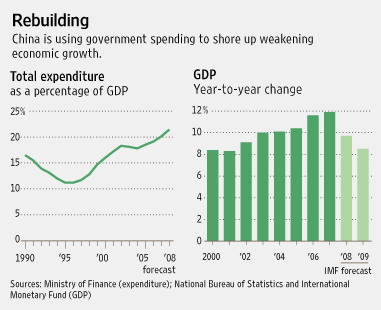
Chart courtesy of WSJ
ETFs/Stocks :
iShares FTSE/Xinhua China 25 Index ETF FXI $25.05 -1.56 (-5.86%)Related Posts :
UltraShort FTSE/Xinhua China 25 Proshares FXP $76.66 +7.16 (+10.30%)
Sources :
- The Big Picture: China’s Stimulus Plan Is No Such Thing
This is generally never true. Before buying or selling any asset you should do your own research and reach your own conclusion. See my Disclaimer on the bottom for more information.
You are welcome to republish this article, or any portion thereof.
Please, cite the actual/original source. I would be grateful if you could link back.





No comments:
Post a Comment