Translate this page from English into :

Wednesday, October 15, 2008

The Market Has Almost Wiped Out the Gains From Monday's Historic Rally(Update 2)

U.S. stocks headed sharply lower Wednesday after a round of data showed more weakness in the U.S. economy and surprising resilience in inflation.


Retail sales dropped by the most since August 2005 as consumers cut spending on cars, furniture, electronics, clothing and sporting goods. Americans are even eating out less and only spending on the necessities - health care and gas.

Core producer prices increased but headline prices declined. Headline numbers have become just as important as the core numbers, which means that the data today gives the Federal Reserve an excuse to continue cutting interest rates.

Interest rates at 1 percent before the end of the year is a very real possibility. Given the way the futures markets are trading, there is a decent chance that we will see the Dow test 9000 today. This will weigh on USD/JPY and other carry trades. Over the past few weeks, the equity market has been sell-off positive for the dollar but negative for the Japanese Yen.


The gloom was pervasive Wednesday. In a speech, Federal Reserve Chairman Ben Bernanke said credit markets will take time to unfreeze and called for action on the "too-big-to-fail" problem involving U.S. financial institutions. The Fed's Beige Book survey of economic conditions suggests a difficult path for the rest of the year. Earlier, San Francisco Fed President Yellen said the U.S. economy is in a recession.

From Bloomberg: S&P Reviews $280.1 Billion of Alt-A Mortgage Debt
    Standard & Poor's said it may downgrade $280.1 billion of Alt-A mortgage securities, the most that the ratings company has identified in a single announcement for bonds backed by the loans.

    The debt may be cut in part because S&P has boosted estimates for losses on each foreclosure on Alt-A loans with at least five years of fixed rates to 40 percent, from 35 percent.

    "There has been a persistent rise in the level of delinquencies among the Alt-A mortgage loans supporting these transactions," S&P analysts Scott Davey and Ernestine Warner said in the statement.
As inflationary as government efforts are, further writedowns and more financial bankruptcies might be coming.

Tomorrow is very critical because the market may test the last Friday low. Whether the mid-term bullish trend will be killed, in some extent, depends on whether the Friday low still holds tomorrow. For people who are desperate to cut losses, you may want to wait to know if that low is broken.
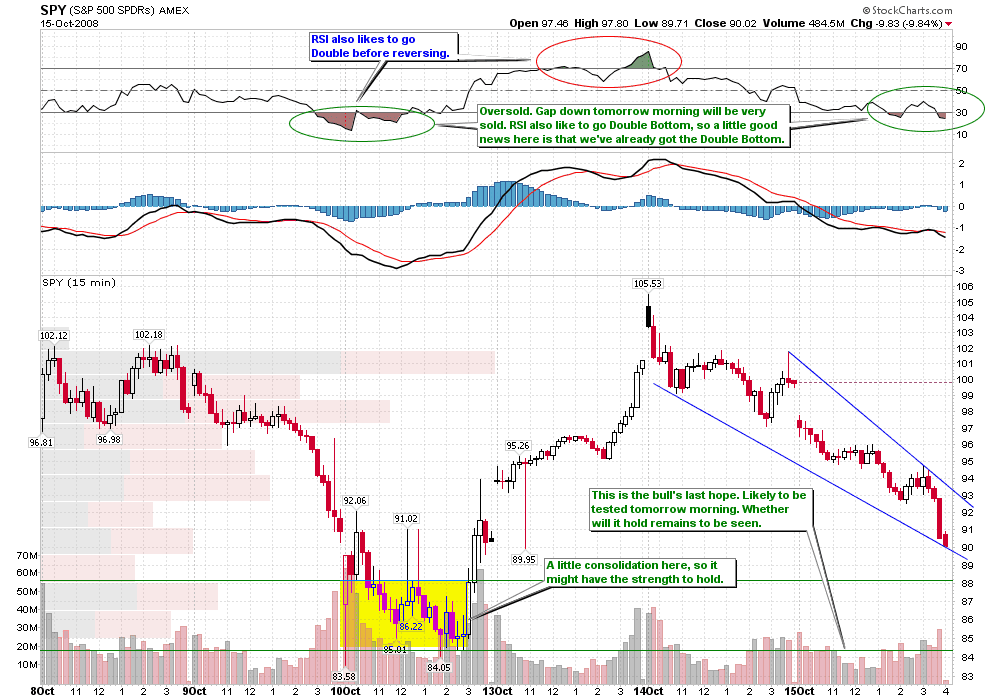
Chart Courtesy of Cobra's Market View

The level that the market will test tomorrow is a consolidation region on last Friday, which has a strength and could hold. Additionally RSI at the top of the chart has oversold, if the market gaps down at open it will be deeply oversold. On the chart, the oversold of RSI on the 15-min chart, specially if RSI forms a double bottom, is quite accurate. Today RSI has formed a double bottom, therefore the market might hold there. Good luck, bulls!


Sources:
  1. EconompicData: Retail Stores Slump (September), October 15, 2008 06:01 am
  2. EconompicData: PPI: Year over Year Inflation; Month over Month Deflation, October 15, 2008 05:44 am
  3. Credit Writedowns: Writedown news: 15 Oct 2008
  4. Calculated Risk: S&P may downgrade $280 billion of Alt-A, October 15, 2008 05:26 pm
  5. Kathy Lien: Weak Consumer Spending = Negative GDP, October 15 2008
  6. Naked Capitalism: Dow Falls 730 on Deteriorating Fundamentals, Evidence Rescue Efforts Not Taking Hold (Updated), October 15, 2008 05:04 pm
  7. Cobra's Market View: 10/15/2008 Market Recap: Testing Low
Related Posts :
  1. The Full Nouriel Roubini Horror Speech
  2. But What About The Next $750 Billion Of Writedowns?
  3. Earnings Season Could Bring Back Recession Fears
  4. The Global Money Printing Probably Would Succeed Averting A "Mynsky Meltdown"
Please Note!
This is generally never true. Before buying or selling any stock you should do your own research and reach your own conclusion. See my Disclaimer on the bottom for more information.

You are welcome to republish this article, or any portion thereof.
Please, cite the actual/original source. I would be grateful if you could link back.



Stumble Upon Toolbar Add to Technorati Favorites Bookmark and Share

The Full Nouriel Roubini Horror Speech


From ClusterStock: The Compleat Nouriel Roubini, October 14, 2008 10:02 am

Never heard the full Nouriel Roubini horror speech? Well, now's a good a time as any. Some highlights from Nouriel's excellent opus on Bloomberg TV today (click for video):

  • The $250 billion bank recapitalization is only the beginning. The government will soon have to re-up (because it hasn't dealt with the huge writedown problem), and it will eventually have to take a much more active role in bank management. Otherwise, we'll just have a plague of zombie banks, like Japan.

  • House prices will fall 40%, worse than the Great Depression. (Sounds horrifying, but we're more than halfway there).

  • Worst recession in 40 years, now projected to last 18-24 months.

  • Stock market rally will sputter

  • Economy is "really tanking"

  • Total bank losses from crap debt will be "closer to $3 trillion" (up from previous estimate of $1-$2 trillion). This compares to about $650 billion of writeoffs so far.

  • Our new $1 trillion annual deficits will likely cause Russia, China, and the other countries who are funding our spending spree to say, hey, wait a minute, why are we funding this banana republic. Raise our interest rate or we're history.
If you've never seen the Nouriel show, definitely watch the video (15 minutes).

Related Posts :
  1. But What About The Next $750 Billion Of Writedowns?
  2. The Global Money Printing Probably Would Succeed Averting A "Mynsky Meltdown"
Please Note!
This is generally never true. Before buying or selling any stock you should do your own research and reach your own conclusion. See my Disclaimer on the bottom for more information.

You are welcome to republish this article, or any portion thereof.
Please, cite the actual/original source. I would be grateful if you could link back.


Stumble Upon Toolbar Add to Technorati Favorites Bookmark and Share

But What About The Next $750 Billion Of Writedowns?


From ClusterStock: But What About The Next $750 Billion Of Writedowns?, October 14, 2008 9:08 am

We like the new bailout. We think it will ease the credit crisis and get banks lending to each other again (if not to consumers). The Treasury is finally focusing on the equity side of the balance sheet: The taxpayers' money will go farther here and address the major problem--insolvency. Equity injections will also allow taxpayers to participate in the upside when (if) bank stocks recover. The preferred stock structure makes sense, as does the "callable" feature in which banks can buy out the security in three years.

All that said, we still have one big question: What about future writedowns?

A key component of successful financial system bailouts in the past has been forced asset writedowns, in which the government makes banks reduce the carrying value of this assets to nuclear-winter levels before the government injects new equity. This move does several important things:
  • It removes the fear that banks and bank investors will be hammered by future writedowns
  • It turns the banks' attention 100% to putting the new equity to work
  • It attracts private capital (because investors won't worry about getting sandbagged)
  • It eliminates the death-by-a-thousand-cuts scenario that killed Japan.
To put some numbers on this: So far, US financial institutions have taken about $650 billion in asset writedowns. Nouriel Roubini and others have put the total expected writedowns at $1-$2 trillion. This suggests that banks still have $350 billion-$1.350 trillion in losses to take. Losses in this range could wipe out common shareholders, the government, and the financial institutions....unless the banks can easily raise additional equity to offset the losses.

The government may be hoping that 1) the writedowns are done, or 2) the banks can just slowly write off the rest of their crap assets against earnings over the next several years (thanks to the elimination of mark-to-market accounting). Given the magnitude of the projected losses, this seems like wishful thinking.

Alternatively, the government may plan to just keep injecting more and more capital until the writedowns are finally done. If this is the plan, however, other private-market investors are unlikely to follow suit.

So we have one remaining and important question for Messrs. Paulson and Bernanke: What about the future writedowns?


Related Posts :
  1. The Global Money Printing Probably Would Succeed Averting A "Mynsky Meltdown"
  2. U.S. Investing $250 Billion in Banks
Please Note!
This is generally never true. Before buying or selling any stock you should do your own research and reach your own conclusion. See my Disclaimer on the bottom for more information.

You are welcome to republish this article, or any portion thereof.
Please, cite the actual/original source. I would be grateful if you could link back.


Stumble Upon Toolbar Add to Technorati Favorites Bookmark and Share

Earnings Season Could Bring Back Recession Fears

Historical Bull and Bear Markets for the Dow: 1900-Present
Table Courtesy of Bespoke Investment Group


With the third quarter earnings season in full swing, the latest correction in the stock market is partially attributed to the fears of a recession. Former US Fed Chairman Paul Volcker said on Tuesday that there is a risk of a considerable recession in the US and Europe. We find the debate of a recession quite interesting because talking about whether a recession is here or not is just a matter of semantics. Everyone from individuals to corporations large and small is already acting like a recession is here. In fact, not many people would argue that the US economy is in the worst shape since the Great Depression. Over the past 50 years, there have been 6 times that the US economy has fallen into a recession and to be compared to the Depression at a time when we have yet to see two consecutive months of negative GDP growth indicates the potential of addition weakness for the US economy. So far, third quarter earnings have been soft, forcing many companies like Pepsi to cut jobs. In the second quarter, many multinational US corporations benefited from positive currency translations. The dollar’s weakness boosted their overseas earnings helping to contribute to the company’s profitability in the second quarter. However the 15 percent rally in the US dollar over the past 3 months will erase any positive currency contributions, increasing the chances of earnings reports missing expectations. This is part of the reason why rating downgrades by Standard and Poors has hit a 6 year high. Taking a step back, it would be surprising if the credit crisis and the meltdown in stocks did not lead to a major slowdown in the global economy. With retirement accounts falling as much as 40 percent in value over the past month, individual and corporations will become increasingly frugal especially going into this holiday shopping season which could lead to more troubling times for the US economy. Recessions fears are real and will remain for some time.

The price action in the equity markets today may continue to be the classic “buy the rumor, sell the news” reaction to the Treasury’s Recapitalization plan. This morning, Treasury Secretary Paulson announced a $250B program that would inject half of that amount into 8 of the country’s largest financial institutions and leave the other available to any bank or bank holding company that needs it. The US government has taken an equity stake in the banks and will be privy to dividend payments on their preferred stock. Based upon the tone of Paulson’s press conference, he was extremely reluctant to resort to this option but unfortunately, he felt that to not do so would leave US citizens and businesses “without access to financing,” which is “totally unacceptable.” The FDIC announced that they were guaranteeing all deposits regardless of size in non-interest bearing accounts through 2009. This means that all checking accounts that do not pay interest are covered in case the bank fails but there is still a $250k limit on interest bearing or savings accounts. In taking these actions, the US government has basically pledged to prevent another major bankruptcy and even if a bank of any size fails, consumers are protected as long as their money is held in a non-interest bearing account.

A number of important US data are due for release tomorrow including retail sales, producer prices, Empire manufacturing, business inventories and the Fed’s Beige Book report. Both ICSC and SpendingPulse have reported a decline in consumer spending so we expect retail sales to be weak. Import prices also took a big tumble, which should lead to softer producer prices. Overall we expect most of the economic data to be dollar bearish. The same is true for the Fed’s Beige Book report as the US economy weakens and inflation eases.


Source:
Related Posts :
  1. The Global Money Printing Probably Would Succeed Averting A "Mynsky Meltdown"
  2. U.S. Investing $250 Billion in Banks
Please Note!
This is generally never true. Before buying or selling any stock you should do your own research and reach your own conclusion. See my Disclaimer on the bottom for more information.

You are welcome to republish this article, or any portion thereof.
Please, cite the actual/original source. I would be grateful if you could link back.


Stumble Upon Toolbar Add to Technorati Favorites Bookmark and Share

The Global Money Printing Probably Would Succeed Averting A "Mynsky Meltdown"

The U.S. government will soon write checks for $250 billion to shore up the balance sheets of nine banks - Goldman Sachs, Morgan Stanley, J.P. Morgan Chase, Bank of America Corp, Citigroup, Wells Fargo, Bank of New York Mellon, and State Street Corp - as other industries begin lining up to claim their fair share of the newly expanded government largess.

The $250 billion equates to more than a thousand dollars from every U.S. taxpayer.

For the moment at least, it seems that policymakers have succeeded in averting a "Mynsky Meltdown" after having clearly experienced a "Mynsky Moment".

What could go wrong? George Magnus explains:
    Even if a financial meltdown is averted, we should be under no illusion that the deleveraging in the financial and household sectors will stop. As a result, four big battlegrounds remain.

    First, there is a high possibility of further bouts of financial stress and failures. Money markets are still broken and recovery will take time.

    Second, illiquidity, a preference for cash-type instruments, even over government bonds, and a considerably ex­panded supply of government bonds raise the threat of an untimely increase in bond yields.

    Third, the global recession that has started may yet turn out to be sharper than expected – and certainly longer. This will bring sustained, and some new, credit risks.

    Fourth, much slower growth and the risk of some home-made financial crises in emerging markets warrant close scrutiny.

It seems that almost all of these are sure to happen.

As unthinkable as the prospect might be, what central banks and governments are now doing could well be the "new normal" for some time to come.

Source :
Related Posts :
  1. Iceland Meltdowns
  2. U.S. Investing $250 Billion in Banks
Please Note!
This is generally never true. Before buying or selling any stock you should do your own research and reach your own conclusion. See my Disclaimer on the bottom for more information.

You are welcome to republish this article, or any portion thereof.
Please, cite the actual/original source. I would be grateful if you could link back.


Stumble Upon Toolbar Add to Technorati Favorites Bookmark and Share

Iceland Meltdowns

From Maoxian - Trade in Salted Fish Products Remains Brisk, October 15, 2008 10:31 am :
    Icelandic Stocks Drop 77% as Trading Resumes After 3-Day Halt

      "The global financial crises sparked the collapse this month of Kaupthing Bank hf, Glitnir Bank hf and Landsbanki Islands hf with debts equivalent to as much as 12 times the size of Iceland’s economy. The three banks accounted for about 76 percent of the OMX Iceland 15 Index’s value prior to the nationalization. Trading in Icelandic stocks was halted since Oct. 9 after the OMX Iceland 15 lost 30 percent in nine days as the country’s financial system collapsed."

    Setting the price of the nationalized banks at zero in the index, eh? Back to basics, which in Iceland’s case means salted fish products.


From The Financial Ninja - Iceland Melts, 77% Single Day Drop, October 14, 2008 10:00 am :


    Although I don’t know for certain, I’m going to guess that a 77% single day drop for an entire index is the largest single day drop for an index ever anywhere…

    Looks like Iceland just melted.

    So if you thought 8% - 10% down days were bad, you ain't seen nothing yet.

    Icelandic Stocks Drop 77% as Trading Resumes After 3-Day Halt: “Iceland's benchmark stock index plunged 77 percent, the biggest decline on record, as trading resumed after a three-day suspension and the nationalization of the country's largest banks.

    Kaupthing Bank hf, Glitnir Bank hf and Landsbanki Islands hf collapsed this month with debts equivalent to as much as 12 times the size of Iceland's economy. The three banks accounted for about 76 percent of the ICEX 15 Index's value prior to the nationalization.

    The OMX Iceland 15 Index fell 2,317.23, or 77 percent, to 687.39 as of 11:48 a.m. local time. Five of the 13 other stocks in the index didn't trade, while the five that did account for about 7.1 percent of the index's value.

    Trading was halted since Oct. 9 after the measure lost 30 percent in nine days as the country's financial system collapsed. Iceland's delegation started talks in Moscow today to secure an emergency loan of as much as 4 billion euros ($5.47 billion) from Russia.

    The country should seek aid from the IMF and later apply for European Union membership and adopt the euro, Foreign Minister Ingibjorg Solrun Gisladottir wrote in Morgunbladid on Oct. 13.

Related Posts :
  1. The Stunning Collapse of Iceland
  2. Economist Irving Fischer Talking Stocks From 1929
  3. George Soros: Global Capital Meltdown
Please Note!
This is generally never true. Before buying or selling any stock you should do your own research and reach your own conclusion. See my Disclaimer on the bottom for more information.

You are welcome to republish this article, or any portion thereof.
Please, cite the actual/original source. I would be grateful if you could link back.


Stumble Upon Toolbar Add to Technorati Favorites Bookmark and Share