Translate this page from English into :

Thursday, October 2, 2008

"If We Don't Do This, We Won't Have An Economy On Monday"


By Henry Blodget, ClusterStock, Oct 2, 2008 5:52 AM

Joe Nocera and the NYT crew tell the story of the 36 hours that almost killed Morgan Stanley (MS) and Goldman Sachs (GS) and shut down the credit markets, prompting Ben Bernanke and Hank Paulson to pull the trigger on their bailout plan.

The story reads like John Kenneth Galbraith's "The Great Crash," which chronicled the hour to hour events of 1929. Of course, in this case, it isn't over yet.


Related Posts :
  1. Warren Buffett: We Have "Terrible, Terrible Problems"
  2. The Mother Bubble
  3. Senate Passes $700 Bn Bailout!
  4. Front Page Crash Coverage
Please Note!
This is generally never true. Before buying or selling any stock you should do your own research and reach your own conclusion. See my Disclaimer on the bottom for more information.

You are welcome to republish this article, or any portion thereof.
Please, cite the actual/original source. I would be grateful if you could link back.



Stumble Upon Toolbar Add to Technorati Favorites Bookmark and Share

Corporate Debt Spreads Continue Spike

From Econompic Data, Oct 2, 2008 10:01 am


Related Posts :

European's Banks Leverage

Please Note!
This is generally never true. Before buying or selling any stock you should do your own research and reach your own conclusion. See my Disclaimer on the bottom for more information.

You are welcome to republish this article, or any portion thereof.
Please, cite the actual/original source. I would be grateful if you could link back.


Stumble Upon Toolbar Add to Technorati Favorites Bookmark and Share

European's Banks Leverage

From Econompic Data (Greed is Global), Oct 1, 2008 3:45 am

Per Infectious Greed:
    Europeans banks have long been gaming their regulators, having far less than the actual capital reserves that they needed given their balance sheets. AIG filled the hole, selling credit defaults swaps to European banks via which they could tell regulators that they were adequately covered -- at triple-A, no less -- while carrying less cash than required.
How large scale was this "gaming"? According to AIG, about $379 Billion of their $527 Billion default swap portfolio:
    "represents derivatives written for financial institutions, principally in Europe, for the purpose of providing them with regulatory capital relief rather than risk mitigation."
According to analysis done by CEPS, banks were levered as much as 60x. The biggest culprits? UBS, ING, Barclays, and Deutsche bank.


Remember these names and let the write-downs continue...

Related Posts :

Why Europe's Banks are in Trouble?

Please Note!
This is generally never true. Before buying or selling any stock you should do your own research and reach your own conclusion. See my Disclaimer on the bottom for more information.

You are welcome to republish this article, or any portion thereof.
Please, cite the actual/original source. I would be grateful if you could link back.


Stumble Upon Toolbar Add to Technorati Favorites Bookmark and Share

The Inventory of The SPDR Gold Shares ETF (GLD) Hit A New All-Time High

From The Mess That Greenspan Made (Uhhh... Japan... comin' through), Oct 2, 2008 06:03 am


The inventory at the SPDR Gold Shares ETF (NYSE:Arca:GLD) hit a new all-time high the other day at 755 tonnes and, in the process, came even closer to Japan, a country that currently holds the #7 spot in the World Gold Council's World Gold Holdings.


IMAGEIt's funny to see the gold price about 15 percent lower than the peak earlier this year while the inventory is about 15 percent higher.

It's even funnier to see that you can't buy the stuff in many coin shops - I see California Numismatic Investments has replaced all of the "N/A" entries with the much more meaningful "Out of Stock" in the "Sell" column on their bullion page.

Here's what the wold gold order now looks like - Japan's days at number 7 are numbered.


IMAGEMark Haynes was heard to say on CNBC the other day something like, "I'd go out and buy some gold coins right now and bury them in my backyard, but the coin shops are all out". Then he went on to chuckle in a manner that, at first sounded condescending, but, as it continued, had a distinct sense of helplessness.

Related Posts :
  1. The Fed Looks at Cutting Rates
  2. Inflation, Deflation, Money Velocity and Gold
Please Note!
This is generally never true. Before buying or selling any stock you should do your own research and reach your own conclusion. See my Disclaimer on the bottom for more information.

You are welcome to republish this article, or any portion thereof.
Please, cite the actual/original source. I would be grateful if you could link back.


Stumble Upon Toolbar Add to Technorati Favorites Bookmark and Share

Fed Loses $6Billion


From The Financial Ninja, Oct 2, 2008 8:19 am

“This exercise illustrates the difficulties in measuring fair value. It will be interesting to see how and whether the Fed chooses to apply fair-value accounting principles.” –Bank of America report

Fed May Lose $6 Billion on Bear's Assets, Bank of America Says: “The U.S. Federal Reserve may lose as much as $6 billion on a portfolio of mortgage-backed assets it took over from Bear Stearns Cos., according to Bank of America Corp. analysts.

The Fed will today announce its quarterly estimate of the fair value of Maiden Lane LLC's $30 billion of holdings that JPMorgan Chase & Co. considered too risky when it acquired Bear Stearns in March, Bank of America analysts Jeffrey Rosenberg and Hans Mikkelsen wrote in a client note. The central bank valued the assets at $29 billion as of June 30, according to the report.”

So, what do you REALLY think the odds are of the TAXPAYER making money off the bailout bill that the senate just passed? If the Fed can lose $6 billion on $30 billion… how much do you think Paulson can lose on $700 billion that can be indefinitely recycled?

“About half the portfolio is backed by commercial mortgages and half by residential loans. About 80 percent of those are so- called Alt-A mortgages, a step higher than subprime in terms of quality, with the remainder prime mortgages, Bank of America estimates.”

The Bear portfolio is actually far more conservative and of far higher quality than the TOXIC JUNK that Paulson intends to purchase. Naturally, only the worst paper will be sold to him by the banks.

The US taxpayer will end up being the proud bagholder all of the worst securitized paper in the world.

“The valuation of the $12 billion of Alt-A mortgages varies by as much as $5.4 billion depending on whether the analysts use estimates that Goldman Sachs Group Inc., Lehman Brothers Holdings Inc. or Morgan Stanley apply to their own portfolios, the analysts wrote.”

That is one hell of a range on $12 billion. Imagine the random fun an army of accountants could have with a $700 billion portfolio of this stuff? I can’t wait for the Fed itself to dispense with fair value accounting…

Just to add insult to injury, the senate managed to sneak into the bailout all sorts of random and insulting things...

The people get SHAFTED. AGAIN.

via Calculated Risk (Curious About Wooden Arrows for Children?) and Naked Capitalism (More on the Oinking Bailout Bill):

"SEC. 503. EXEMPTION FROM EXCISE TAX FOR CERTAIN WOODEN ARROWS DESIGNED FOR USE BY CHILDREN.

(a) IN GENERAL.—Paragraph (2) of section 4161(b) is amended by redesignating subparagraph (B) as sub301 paragraph (C) and by inserting after subparagraph (A) the following new subparagraph:

(B) EXEMPTION FOR CERTAIN WOODEN ARROW SHAFTS.—Subparagraph (A) shall not apply to any shaft consisting of all natural wood with no laminations or artificial means of enhancing the spine of such shaft (whether sold separately or incorporated as part of a finished or unfinished product) of a type used in the manufacture of any arrow which after its assembly—
(i) measures 5⁄16 of an inch or less in diameter, and
(ii) is not suitable for use with a bow described in paragraph (1)(A).

(b) EFFECTIVE DATE.—The amendments made by this section shall apply to shafts first sold after the date of enactment of this Act."

The Fed loses about $6 billion. The Senate passes the worst bailout bill ever and the people get shafted again.

Just another day in Amerika.


Related Posts :
  1. Naked CDS betting?
  2. The Fed Looks at Cutting Rates
  3. Senate Passes $700 Bn Bailout!
Please Note!
This is generally never true. Before buying or selling any stock you should do your own research and reach your own conclusion. See my Disclaimer on the bottom for more information.

You are welcome to republish this article, or any portion thereof.
Please, cite the actual/original source. I would be grateful if you could link back.

Stumble Upon Toolbar Add to Technorati Favorites Bookmark and Share

Naked CDS betting?

From Angry Bear, Oct 2, 2008 5:02 am

lifted from comments by run75441

Anyone looking at the CDS and the "naked" CDS portion of the Derivative Market? It was said that AIG had $400 billion CDS outstanding, which is why the Fed determined they could not let it go under. It was also said speculators led to AIG's inability to raise capital in the market place due to the number of "naked" CDS betting on its default. Apparently, there is a way to look up the CDS market and lenders use it.

It would be an interesting topic and very germaine to today's economic issues as it is estimated to be a CDS market of ~$62 trillion of the ~$600 trillion Derivative market globally. It is my understanding that this is the link between the banks and why there has been and still could be many failures to come.

( Any Wall Street analysts in among readers, preferably clothed?...rdan, not run)

Related Posts :
  1. The Fed Looks at Cutting Rates
  2. The Mother Bubble
  3. Senate Passes $700 Bn Bailout!
Please Note!
This is generally never true. Before buying or selling any stock you should do your own research and reach your own conclusion. See my Disclaimer on the bottom for more information.

You are welcome to republish this article, or any portion thereof.
Please, cite the actual/original source. I would be grateful if you could link back.


Stumble Upon Toolbar Add to Technorati Favorites Bookmark and Share

The Fed Looks at Cutting Rates


By Douglas A. McIntyre is an editor at 247wallst.com, Oct 2nd 2008 9:05AM

What if the economic bailout package is not enough to free the locked-up credit markets? Big banks may sell bad assets to The Treasury Department, but will they loan that money to the man in the street or small businesses?

If the Paulson plan is not effective, the number of arrows in the federal government's quiver drops substantially.

The Fed has tried to save the economy with a number of rate cuts. Many analysts have thought the agency would not cut again before the election, but those many analysts could be wrong.

According to The Wall Street Journal, "Federal Reserve officials are weighing further interest-rate cuts, even if Congress passes a $700 billion rescue plan, in the face of a deteriorating economic outlook and severely strained financial conditions."

The Fed had better hurry along. On Wednesday, reported car sales figures were down over 30% for September for many auto companies. The major excuse for the problem was not gas prices, it was the inability of people to get car loans. There is absolutely no evidence that the housing or mortgage markets are getting better. Default rates on credit cards are rising. Retail sales this holiday season are likely to be pathetic.

The economy is at the stage when it is time to pull out all the stops. The window to save the consumer may close in the next week or so. That may mix metaphors a bit, but that makes it no less true.

Related Posts :
  1. The Mother Bubble
  2. Why Europe's Banks are in Trouble?
  3. Senate Passes $700 Bn Bailout!
Please Note!
This is generally never true. Before buying or selling any stock you should do your own research and reach your own conclusion. See my Disclaimer on the bottom for more information.

You are welcome to republish this article, or any portion thereof.
Please, cite the actual/original source. I would be grateful if you could link back.


Stumble Upon Toolbar Add to Technorati Favorites Bookmark and Share

The Mother Bubble

From Jesse's Café Américain


The US Long Bond.

Or as the New York bondtraders used to say, "Big Daddy."

A picture or two are worth a thousand words.

It can go on indefinitely right?

Don't most man-made things continue on endlessly in this world even when they stop making sense?

Special thanks to Brian at ContraryInvestor.com


Primary bagholders. We'd like to think the Brits are acting as agents for others.

Related Posts :
  1. Why Europe's Banks are in Trouble?
  2. 10/01/2008 Market Recap: Breadth still oversold
  3. Senate Passes $700 Bn Bailout!
Please Note!
This is generally never true. Before buying or selling any stock you should do your own research and reach your own conclusion. See my Disclaimer on the bottom for more information.

You are welcome to republish this article, or any portion thereof.
Please, cite the actual/original source. I would be grateful if you could link back.


Stumble Upon Toolbar Add to Technorati Favorites Bookmark and Share

Why Europe's Banks are in Trouble?

From Jesse's Café Américain


Here is an eye opening set of data by way of Paul Kedrosky at Infectious Greed and the sibylline Yves Smith at Naked Capitalism :

The European banks were levered up like the wilder investment banks on Wall Street.
    Figure 1. Leverage Ratio of Financial Institutions
    Banks
    Leverage Ratio (Total Assets/Equity )
    June 30, 08
    2007
    UBS
    46.9
    63.9
    ING Group
    48.8
    35.3
    HSBC Holding
    20.1
    18.4
    Barclays Bank
    61.3
    52.7
    BBV Argentaria
    20.1
    18.6
    Deutsche Bank
    52.5
    Fortis
    33.3
    26.4
    KBC
    24.4
    20.5
    Llyod's TSB
    34.1
    31.0
    RBS
    18.8
    21.8
    Credit Agricole
    40.5
    34.8
    BNP Paribas
    36.1
    31.5
    Credit Suisse
    33.4
    31.5
    Source : Own calculations based on balance sheet data

    But the AIG case shows the importance of another link across financial markets, namely massive regulatory arbitrage. The K-10 annex of AIG’s last annual report reveals that AIG had written coverage for over US$ 300 billion of credit insurance for European banks. The comment by AIG itself on these positions is: “…. for the purpose of providing them with regulatory capital relief rather than risk mitigation in exchange for a minimum guaranteed fee”. AIG thus helped to organise regulatory arbitrage on a gigantic scale. A formal default of AIG would have had a devastating impact on banks in Europe. This explains why AIG’s problems had sent shock waves through the share prices of European banks. For the time being the US Treasury has saved, inter alia, the European banking system, but given that AIG is to be liquidated European banks now have to scramble to find other ways of obtaining the ‘regulatory capital relief’ they appear to need urgently.
No wonder the European banks are scrambling so hard for liquidity. And a good part of that demand is for dollars given the markdowns they are being forced to take on their dollar assets being held for customers.

Europe seems to be much further behind the curve in dealing with its problems than the US, as bad as both of them are.

We wonder now how much of the pressure on the Congress is coming not only from Wall Street but also from Europe. This also helps one to understand Section 112 in the plan that calls for Treasury payments to non-US banks.

When push comes to shove, it appears that even Willem Buiter is not completely above the fray, and talking his figurative book:
    Those whom the gods would destroy, they first make mad. The US House of Representatives has voted to reject the Emergency Economic Stabilization Act - the $700bn Treasury-funded facility for purchasing and managing toxic assets held by the US banking system.
    Opposition to the proposal came from two different sources. A few remaining libertarians and believers in unfettered free enterprise voted against. Even when they recognise the risk that a calamitous collapse in economic activity may result, they view this as a form of creative destruction that is an integral part of a Darwinian market economy... Those who genuinely hold these views are mad, but honest and principled. I wish them a good depression...

    A larger body of nay-voters consists of populist rabble-rousers or, worse, politicians who know better but follow the whims, fancies and passions of their constituents, even when this means that before long the real economy risks falling off a cliff...

    Sorry for the delay Willem. The bailout check for your banks is in the mail.

    "Hundreds of billions of dollars are going to bail out foreign investors. They know it, they demanded it, and the bill has been carefully written to make sure that can happen." - Brad Sherman , D-California"

Related Posts :
  1. 10/01/2008 Market Recap: Breadth still oversold
  2. Senate Passes $700 Bn Bailout!
  3. VIX 20 Year History
Please Note!
This is generally never true. Before buying or selling any stock you should do your own research and reach your own conclusion. See my Disclaimer on the bottom for more information.

You are welcome to republish this article, or any portion thereof.
Please, cite the actual/original source. I would be grateful if you could link back.


Stumble Upon Toolbar Add to Technorati Favorites Bookmark and Share

10/01/2008 Market Recap: Breadth still oversold

From Cobra's Market View :

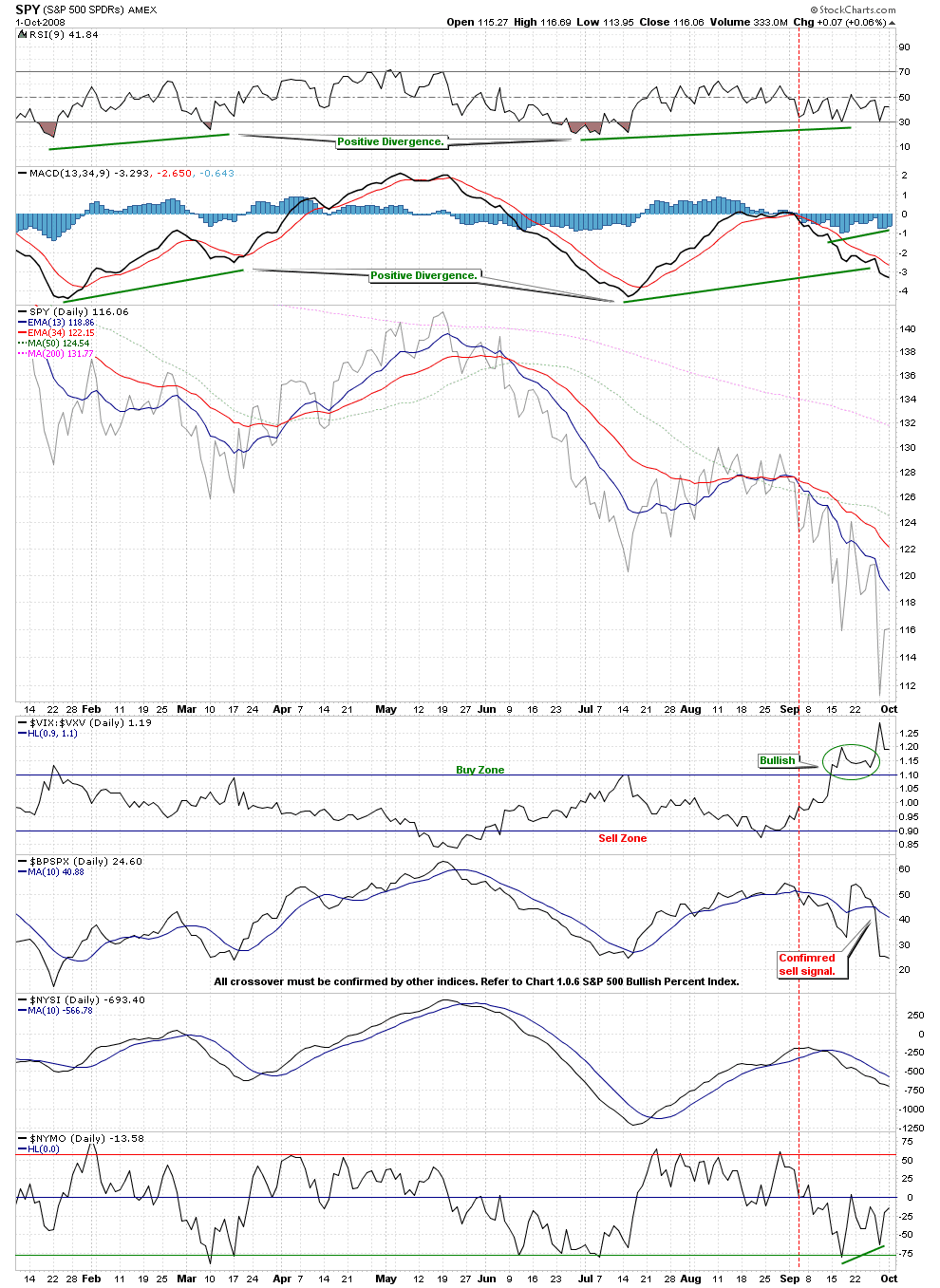
From the perspective of the technical analysis, the market is bullish over the near term and the intermediate term.

Here is why the mid-term outlook is bullish: 0.0.3 SPY Mid-term Trading Signals, VIX:VXV is above 1.1, which means the mid-term (90 days) volatility is lower than the current level and thus the probability of mid-term rally is relatively high.


Here is why the short-term outlook is bullish too: 2.4.3 Breadth Oversold/Overbought Watch, RHNYA and NYA50R are still oversold, which means the probability of short-term bounce is very high.


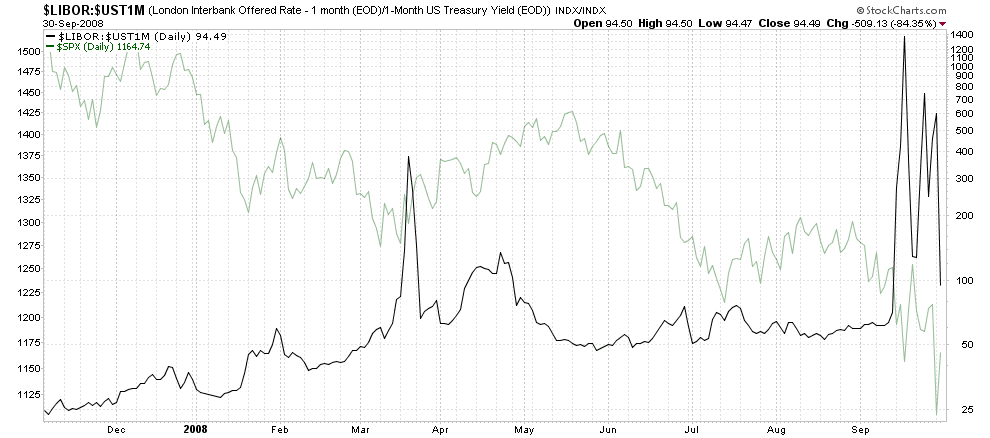
3.0.2 Credit Risk Watch. StockCharts does not provide 3-month LIBOR so I use 1-month LIBOR instead. You don't need to comprehend the meaning of LIBOR. On the following chart, every time when the black curve is at a very high level the stock market denoted by the green curve will drop down. Now the black curve starts to drop down, which means the credit crisis is getting somewhat relieved.


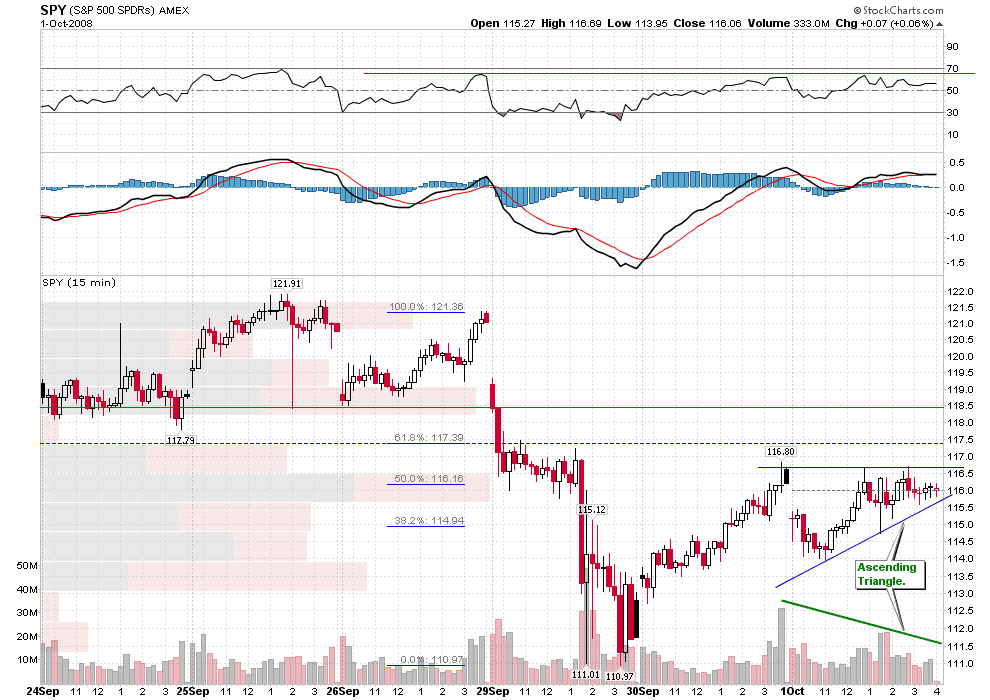
Tomorrow, the probability of rising is high.

1.0.4 S&P 500 SPDRs (SPY 15 min), 1.2.4 Diamonds (DIA 15 min), Ascending Triangle, relatively high probability of breakout at the upside.


1.1.7 TRINQ Trading Setup, TRINQ is above 2.0 today, which means QQQQ will probably rise tomorrow. So far the success rate of this setup is 83%.

Related Posts :
  1. Senate Passes $700 Bn Bailout!
  2. VIX 20 Year History
Please Note!
This is generally never true. Before buying or selling any stock you should do your own research and reach your own conclusion. See my Disclaimer on the bottom for more information.

You are welcome to republish this article, or any portion thereof.
Please, cite the actual/original source. I would be grateful if you could link back.


Stumble Upon Toolbar Add to Technorati Favorites Bookmark and Share