FN Arena News on July 23, wrote:
US based market trader Dennis Gartman highlighted this week a report from US FoodIndustryNews.com. It noted that VeraSun Energy, one of the country's largest ethanol producers, had delayed the opening of three new ethanol plants because of "volatility in the market". Citigroup has recently predicted that up to three-quarters of US ethanol plants would have to shut down as profits were turning to losses on the price of corn.
Gartman also notes that a dozen or more ethanol and other bio-diesel plants have declared bankruptcy in recent months not just because of input prices, but because they can't find financing. The ramifications of the credit crunch have seeped beyond the financial sector into all corners of industry, and have not left the alternative fuel market unscathed. Moreover, the cost of building a new bio-fuel plant has skyrocketed along with everything else. Mr Jerry Taylor of the Cato Institute noted:
"I think the ethanol industry as a whole will have to re-examine its entire financial model and determine how it can make money. Many of these [ethanol] plants never met the objectives that they were designed and built to achieve."
It is actually a lot cheaper to make ethanol from sugar cane. Sugar, unlike corn, has not been on a one-way price trajectory. However the sugar market in the US is tightly controlled, and the government puts a US54c per gallon tariff on imported ethanol. Brazil is the world's major sugar source, and its ethanol industry has also been booming. And as corn ethanol has become ridiculously expensive, it has actually become a cheaper alternative for US oil refiners to pay the tariff and use Brazilian sugar ethanol instead.
While Darin Newsom, analyst with DTN in Omaha, on July 24, noted that the seemingly relentless drive in commodities - crude oil and corn have doubled in the past year - was built largely on robust demand for raw materials, especially in fast-growing economies in China and the Middle East.
A weakening U.S. greenback fed that demand by making dollar-denominated commodities cheaper to overseas buyers.
But with record energy prices and soaring costs for other commodities, "a lot of that demand has died out," Newsom said.
Rick Schwarck, CEO of Absolute Energy LLC, on January 8, said that the price of corn and soybeans is closely linked with the price of crude oil. “If oil goes down to $100 a barrel, ethanol goes down and plants shutter. More corn is released back into the market place and prices go down,” Schwarck says. “If it goes to $200 a barrel, plants that have gone off line would come back, demand [for corn] would go up, and the price of corn would go up.”
The Organization for Competitive Markets (OCM) on July 22, said that Monsanto's market power is driving up seed prices and devastating farmers and their communities. "Monsanto's market power has been quietly accruing over several years and has now begun materially impacting price," said Keith Mudd, OCM's board president. "The lack of competition and innovation in the marketplace has reduced farmers' choices and enabled Monsanto to raise prices unencumbered."
Even the list price on seed corn will topple the $300 per bag barrier starting this fall, up about $95 to $100 per bag, or 35 percent on average, according to Monsanto(MON) officials who met with DTN and Progressive Farmer editors this week. For 2009, 76 percent of the company's corn sales will be triple stack, 'so we think we can get the pricing right to show farmers the benefits,' John Jansen, Monsanto's corn traits lead. 'We can pass the red-faced test from the Panhandle of Texas to McLean County, Ill.'
"If and when the ethanol boom subsides, Monsanto will not lower its prices, farmers will be forced into bankruptcy, and the lack of an effective remedy for antitrust in crop seed will be a substantial cause," Said Fred Stokes, executive director, OCM.
Related Posts :World Food Shortage and the Ethanol BubblePlease Note!
This is generally never true. Before buying or selling any stock you should do your own research and reach your own conclusion. See my Disclaimer on the bottom for more information.
You are welcome to republish this article, or any portion thereof.
Please, cite the actual/original source. I would be grateful if you could link back.



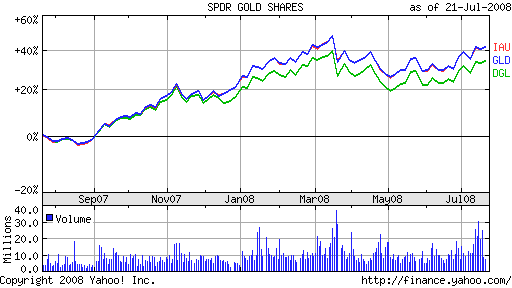
 Gold bullion holdings in the world’s largest gold exchange traded fund (ETF), SPDR Gold Shares (GLD), reported a net inflow of five tons for the second quarter, making for a total of 948 tons.