Translate this page from English into :

Friday, October 24, 2008

Nouriel Roubini: Stay away from 'risky' assets

From Nouriel Roubini's Global EconoMonitor:


New York University Professor Nouriel Roubini talks with Bloomberg's Guadalupe Barriviera in Madrid about the outlook for the U.S. economy and financial markets, efforts by policy makers to stabilize credit markets and Roubini's investment advice.

According to Bloomberg, New York University Professor Nouriel Roubini said curbs placed on U.S. futures trading today shows his prediction that markets will be shut down amid panic selling is coming true.

``This morning, even before the markets in the U.S. opened, the S&P futures fell by more than their daily limit,'' resulting in curbs on futures trading, Roubini told a conference in Madrid today. ``What I said yesterday has already started.''

Roubini said yesterday that policy makers may need to shut down financial markets for a week or two as investors dump assets. Trading in futures on the Standard & Poor's 500 Index and the Dow Jones Industrial Average was limited today after declines of more than 6 percent. Trading of U.S. stocks would be suspended for an hour should the Dow Jones Industrial Average decline 1,100 points to 7,591.25.

``Things are getting worse, they are not getting better,'' Roubini said. There's an increased risk of a ``multi-year economic stagnation'' in the U.S. and ``we have a whole set of emerging market economies in trouble. Even a few of them going bust may cause systemic trouble.''

Russia's RTS exchange today stopped trading after stocks slumped more than 10 percent. Europe's Dow Jones Stoxx 600 Index slid 8.5 percent. The MSCI World index of global stocks has lost 45 percent this year as the fallout from the U.S. housing crisis toppled banks from Seattle to Paris.

Great Depression

Still, Roubini said he doesn't expect the economic consequences of the current crisis to be as severe as the Great Depression. ``During the Great Depression, output in the U.S. fell by more than 20 percent, I don't believe that's going to be the case,'' he said.

In July 2006, Roubini predicted the financial crisis. In February this year he forecast a ``catastrophic'' meltdown that central bankers would fail to prevent, leading to the bankruptcy of large banks exposed to mortgages and a ``sharp drop'' in equities.

Roubini said that the European Central Bank should provide ``much more monetary easing'' and governments around the world must put together a massive fiscal stimulus package after action so far failed to halt the stock-market rout. The U.S. bank bail- out plan will likely require between $600 billion and $700 billion, he said.

Roubini, a former senior adviser to the U.S. Treasury Department, said earlier this month that the world's biggest economy will suffer its worst recession in 40 years.


Related Posts :
  1. Nouriel Roubini:"Panic" May Force Market Shutdown
  2. 10/22/2008 - Nouriel Roubini on CNBC this morning
Sources :
Please Note!
This is generally never true. Before buying or selling any stock you should do your own research and reach your own conclusion. See my Disclaimer on the bottom for more information.

You are welcome to republish this article, or any portion thereof.
Please, cite the actual/original source. I would be grateful if you could link back.


Stumble Upon Toolbar Add to Technorati Favorites Bookmark and Share

The top 10 Benjamin Graham value plays

Here are the current holdings of the 10-stock Graham portfolio:
  1. JAKKS Pacific (NASDAQ: JAKK)
  2. Men's Wearhouse (NYSE: MW)
  3. Ashland Inc. (NYSE: ASH)
  4. Movado Group (NYSE: MOV)
  5. Mueller Industries (NYSE: MLI)
  6. Scholastic Corporation (NASDAQ: SCHL)
  7. Ceradyne, Inc. (NASDAQ: CRDN)
  8. Columbia Sportswear (NASDAQ: COLM)
  9. Reliance Steel & Aluminum (NYSE: RS)
  10. Carlisle Companies (NYSE: CSL)

As you can see, the portfolio has a pretty diverse mix, with holdings that range from basic materials firms to aerospace & defense companies to retailers.

The 2008 year has, so far, been one of the Graham strategy's best -- and that's saying something. The portfolio is up more than 23% this year, during a period while the S&P had fallen 17.8%. The model's continued strength, both over the long term and through this difficult 2008, is a testament to the enduring greatness of Graham.

Related Posts :
Source :
Please Note!
This is generally never true. Before buying or selling any stock you should do your own research and reach your own conclusion. See my Disclaimer on the bottom for more information.

You are welcome to republish this article, or any portion thereof.
Please, cite the actual/original source. I would be grateful if you could link back.


Stumble Upon Toolbar Add to Technorati Favorites Bookmark and Share

10/24/2008 - Upgrade & Downgrade

From Standard & Poor's Equity Research:
    Western Digital Corp. (WDC)

    Needham upgrades to strong buy from buy

    Western Digital (WDC) posted fiscal first quarter results. Needham analyst Richard Kugele says the company's $2.1 billion in revenue and 93 cents non-GAAP EPS compare to his $2.08 billion and 84 cents estimates. He says Western Digital conservatively forecasted muted demand; he takes it further and assumes no material improvement through fiscal 2009 (June), with an even weaker fiscal 2010. Kugele says he's now comfortable with his estimates for first time in six months; nevertheless, Western Digital was trading (pre-open Oct. 24) at book value, $1 above tangible book, and materially below historical trough valuations of 0.5x sales, at a whopping 4.2x even his lowered $3.10 (from $3.29) fiscal 2009 EPS estimate. He has a $22 12-month price target on the stock.

    Netgear, Inc. (NTGR)

    Wedbush Morgan cuts target

    Wedbush Morgan analyst Rohit Chopra says Netgear Netgear (NTGR) posted mixed third quarter results and issued lower-than-expected guidance as economy takes its toll on business. He notes the company's 19 cents third quarter EPS missed his 24 cents estimate, due to a revenue shortfall, forex losses from a stronger U.S. dollar, and higher taxes. Chopra says weak retail and service provider channels caused the revenue shortfall. He cut his 2008 estimates to $1.18 EPS on $739.2 million in revenue from $1.41 and $770.4 million, respectively. Chopra sees some support for the stock coming from a 6 million-share buyback. He kept his hold rating on the stock, but lowered his $13 price target to $12, based on P/E analysis.

    Juniper Networks, Inc. (JNPR)

    Stifel cuts target

    Stifel analyst Sanjiv Wadhwani says Juniper Networks (JNPR) posted solid third quarter results but gave cautious fourth quarter guidance due to the macro environment. He notes that Juniper's $947 million in revenue and 32 cents non-GAAP EPS beat his $930 million and 29 cents estimates. Wadhwani says Juniper management is emphatic that they haven't seen slowdown in business but rather the overall macro environment, and its desire to get the right cost structure for the company in case customers slow purchases was a factor that led to its lower guidance. Wadhwani says fourth quarter revenues are expected at $921-$971 million; the low end assumes a material slowdown in the company's business. EPS is seen at 30-33 cents. The analyst cut his $25 price target to $23, but kept his buy rating on the shares.


Related Posts :
  1. 10/23/2008 - Upgrade & Downgrade (Update 2)
  2. 10/22/2008 - Upgrade & Downgrade (Update 1)
Sources :
Please Note!
This is generally never true. Before buying or selling any stock you should do your own research and reach your own conclusion. See my Disclaimer on the bottom for more information.

You are welcome to republish this article, or any portion thereof.
Please, cite the actual/original source. I would be grateful if you could link back.


Stumble Upon Toolbar Add to Technorati Favorites Bookmark and Share

Rumors: The Fed is visiting some midwest hedge fund

From Self-evident.org:
    How big is Citadel?

    I wish I could tell you. It is not a public company, so they do not report their financial data to the SEC. All I can find is the blurb on their Web site:

      In 1990, one year after graduation, Griffin launched Citadel with $4.6 million in investment capital. Today, Citadel deploys more than $20 billion across multiple investment strategies.

      While initially focusing on U.S. convertibles, Citadel soon expanded into other markets, including European convertibles and merger arbitrage. As Citadel’s investment focus expanded, so too did the team, as Citadel attracted top talent from around the world.

      By 1998, Citadel had grown to more than $1 billion in investment capital, deployed globally through a variety of quantitative, event-driven, and fundamental approaches.

      Today, Citadel has expanded further, having built market-making and hedge fund administration businesses, as well as a business that deploys capital with unaffiliated managers. Citadel’s broad array of businesses and global footprint put it at the center of the capital markets, and redefining what it means to be a leader in alternative investments.

    Apparently, there are rumors that the Fed is visiting some midwest hedge fund today.

    Citadel is denying these rumors.

      "Categorically false. We continue to do business as usual around the globe,” Citadel spokeswoman Katie Spring said.

    She added that the fund continues to hold 30 percent of its assets in cash. Rumors that Citadel was lobbying for access to the Fed’s discount window were also false, she said.

    Why would the Fed be paying a visit to a hedge fund? Hedge funds are not banks. The Fed does not regulate them. The Fed could make loans to a hedge fund, or maybe force a shotgun marriage to a real bank (facilitated by some FedLube™).

    So, what, we start monetizing hedge fund losses now? Honestly, I do not get it. $20 billion just does not sound like all that much. Well, unless it is levered up…

Related Posts :
  1. 10/23/2008 - October Blues
  2. Trading in the panic mode, futures halted
Sources :
Please Note!
This is generally never true. Before buying or selling any stock you should do your own research and reach your own conclusion. See my Disclaimer on the bottom for more information.

You are welcome to republish this article, or any portion thereof.
Please, cite the actual/original source. I would be grateful if you could link back.


Stumble Upon Toolbar Add to Technorati Favorites Bookmark and Share

10/24/2008 - October Blues

On this day back in 1929, the market started to crash, thanks to a wave of panic selling on the NYSE. October 24, 1929, known as Black Thursday, marked the first day of panic selling that ultimately led to...you know....five days later.
Photo courtesy of ClusterStocks

October 24, 1929 - a date to remember
Photo courtesy of Telegraph.co.uk

From Floyd Norris:
    Here are some October performances, through a few minutes ago. In each case, I took a major index from the country in question. All figures are in U.S. dollars.

    U.S., down 26%
    Canada. down 37%
    Mexico, down 44%
    Argentina, down 43%
    Brazil, down 48%
    Chile, down 30%
    Peru, down 42%

    Britain, down 31%
    Germany, down 35%
    France, down 31%
    Switzerland, down 20%
    Italy, down 30%
    Ireland, down 35%
    Iceland, down 83%
    Netherlands, down 35%
    Belgium, down 37%
    Denmark, down 35%
    Finland, down 26%
    Greece, down 45%
    Poland, down 46%
    Czech Republic, down 45%
    Russia, down 53%
    Hungary, down 50%
    Lithuania, down 37%
    Turkey, down 50%
    South Africa, down 42%
    Israel, down 22%

    Japan, down 23%
    Hong Kong, down 30%
    China, down 21%
    Taiwan, down 23%
    South Korea, down 46%
    Australia, down 34%
    New Zealand, down 25%
    India, down 36%
    Singapore, down 35%

    The variance is not that great, with the exception of poor Iceland. And remember that prices were way down from last year before October began.

    You will note that the United States is among the best performers. Don’t you feel better now?

    Spain, down 33%

Traders in Frankfurt. (Kai Pfaffenbach/Reuters)

Related Posts :
  1. Trading in the panic mode, futures halted
  2. Markets are in absolute freefall
  3. 10/23/2008 Market Recap-US Flat, Asian Sink
Sources :
Please Note!
This is generally never true. Before buying or selling any stock you should do your own research and reach your own conclusion. See my Disclaimer on the bottom for more information.

You are welcome to republish this article, or any portion thereof.
Please, cite the actual/original source. I would be grateful if you could link back.


Stumble Upon Toolbar Add to Technorati Favorites Bookmark and Share

Trading in the panic mode, futures halted

From The Financial Post:
    American stock futures trading was halted on Friday morning following deep declines on the Dow Jones Industrial Average and Standard & Poor's 500 indices as global stock markets plunged.

    Futures contracts fell more than 6% triggering a "limit down" suspension of selling on either index, as S&P 500 futures sank to 855.20, according to Bloomberg News. Nasdaq futures were also halted. (see the futures here: Markets are in absolute freefall)

    All three contracts lost the maximum amount permissible before the start of futures trading in the United States.

    Normal trading will resume when both exchanges open at 9:30 a.m. EST, however, if the Dow falls below 1,100 points before 2 p.m. EST, the benchmark index will suspend trading, Bloomberg reported.

    A plunge of that scale would prompt a one-hour halt. If stocks fall to that level between 2 p.m. and 2:30 p.m. trades would be stopped for 30 minutes. If the index dips 1,100 points after 2:30 p.m. EST, there would be no halt.

Image courtesy of Bespoke Investment Group (Click to enlarge)

Related Posts :
  1. The Treasury to announce the second round banks injection as soon as today
  2. Markets are in absolute freefall
  3. Swiss banking collapse is going to be one bigest domino to fall
  4. 10/23/2008 Market Recap-US Flat, Asian Sink
Sources :
Please Note!
This is generally never true. Before buying or selling any stock you should do your own research and reach your own conclusion. See my Disclaimer on the bottom for more information.

You are welcome to republish this article, or any portion thereof.
Please, cite the actual/original source. I would be grateful if you could link back.


Stumble Upon Toolbar Add to Technorati Favorites Bookmark and Share

The Treasury to announce the second round banks injection as soon as today

Henry Paulson, U.S. treasury secretary, addresses the National Committee on U.S.-China Relations Annual Gala in New York, Oct. 21, 2008. Photographer: Jin Lee/Bloomberg News

From Bloomberg:
    Treasury Secretary Henry Paulson is preparing to take stakes in a number of regional U.S. banks as he seeks to halt the freeze of credit to businesses and households. The plans may announce as soon as today. The purchases would be the second round in a $250 billion program to inject capital into financial companies, after an initial $125 billion was allocated to nine of the largest banks.

    The decision to buy stakes in more lenders comes after some of the mid-sized American financial institutions report mounting losses.

    National City Corp., Ohio's largest lender, Oct. 21 posted a wider third-quarter net loss widened to $729 million, from $19 million a year earlier.

    SunTrust Banks Inc., Georgia's largest lender, posted a 26 percent decline in third-quarter profit yesterday. The bank's board authorized the sale of $1.6 billion to $4.9 billion in preferred shares to the U.S. Treasury.

    Paulson's focus on injecting funds into banks is a shift away from his initial emphasis on unclogging balance sheets by purchasing troubled mortgage-backed assets from financial institutions. Last week, the Treasury agreed to take stakes in nine firms including Citigroup Inc., Morgan Stanley and Bank of America Corp.

Related Posts :
  1. Markets are in absolute freefall
  2. Swiss banking collapse is going to be one bigest domino to fall
  3. 10/23/2008 Market Recap-US Flat, Asian Sink
Sources :
Please Note!
This is generally never true. Before buying or selling any stock you should do your own research and reach your own conclusion. See my Disclaimer on the bottom for more information.

You are welcome to republish this article, or any portion thereof.
Please, cite the actual/original source. I would be grateful if you could link back.


Stumble Upon Toolbar Add to Technorati Favorites Bookmark and Share

Markets are in absolute freefall

From Credit Writedowns:

The news on markets around the world is particularly dire this morning. Despite a late day rally in the U.S., markets in Asia and Europe are down as much as 9 and 10% and S&P Futures are 60 limit down. This is going to be a very ugly day with market breakers likely to be tested and the Dow breaking through 2002 lows easily at the open.

As I had said I was getting bullish on particular sectors like energy and consumer staples, I deserve a big slap upside the head because all sectors are going to be hit today. While this certainly increases the bargains available for value investors, which is what I want, it is also certain to scare the bejesus out of most retail investors and I foresee some very heavy panic selling.

The crux of the matter is the dollar because this is the only thing that is now rising (except the yen). Gold is down over 3%, Brent crude is down over 6%, WTI crude is down 3%, agricultural commodities are down, and all currencies are getting killed against the dollar excep the Yen, which is absolutely exploding to the upside at 92 yen to the dollar.

The Danish are actually raising interest rates to defend their currency and the British Pound is down the most since 1971 in a single day -- and that's when we started having floating currencies. The Euro is down the most in a single day since 1999 - when it was created. This is absolute chaos. I have to repeat -- absolute chaos. God help us.


Related Posts :
  1. Swiss banking collapse is going to be one bigest domino to fall
  2. 10/23/2008 Market Recap-US Flat, Asian Sink
Sources :
Please Note!
This is generally never true. Before buying or selling any stock you should do your own research and reach your own conclusion. See my Disclaimer on the bottom for more information.

You are welcome to republish this article, or any portion thereof.
Please, cite the actual/original source. I would be grateful if you could link back.


Stumble Upon Toolbar Add to Technorati Favorites Bookmark and Share

Swiss banking collapse is going to be one biggest domino to fall

From Kathy Lien:
    What people are not talking about is how close Switzerland came to collapsing. After Iceland, no other country has a greater share of its GDP dependent on banking. Remember what happened to huge production companies, Ford, GM and GE, when their finance arms took over for the production sectors of their businesses as the generators of profit. When the securitized paper market crashed, these once strong industrial production companies crashed with them. Well, on a much larger scale, that’s what is happenning to Switzerland.

    Banking had become the main engine of profit generation as the country’s industrial production shrank. International banking is now collapsing, so a country that lives by the bank, will die by the bank.

    What’s really scary is that Switzerland is said to be holding over a third of the world’s private bank deposits. Just this week, Switzerland, seeing its yields rising to dangerous levels, was forced to engage in currency swaps with the ECB. A collapse of the Swiss banking system, once the safest place in the world to deposit money, will spell big trouble. If one believes in the domino theory, a Swiss banking collapse is going to be one bigass domino to fall. The falling of smaller dominos, like Argentina, Iceland, Hungrey, and Lituania, are, or may be, a foregone conclusion.

    One cancerous problem the Swiss banking system has is Phil Gramm. Senator Gramm, as you remember, had the Glass-Steagall Act repealed while his wife sat on the board of ENRON, He opened the doors of US banks so that they were able to engage in risky derivative products, like “enhanced yield” money market SIVs and CDOs. Seventy-percent of those CDOs were exported abroad, where Gramm, now the Vice Chairman of UBS, could use them to destroy his own Swiss bank.

    http://www.france24.com/en/20081020-ecb-launches-first-euro-swiss-franc-swap-operation

    — blackswan —


Related Posts :
  1. Denmark unexpectedly raised the benchmark lending rate by 50 bp to boost Krone
  2. China cuts its housing lending rates and taxes
  3. Sweden guarantees $200 billion in bank loans, Oil Heads Toward $50, India Lowers Key Rate for the First Time Since 2004
  4. 10/22/2008 Market opened by fears (Update 2): Hungary raises the benchmark rate by 3% points to boost its currency
Sources :
Please Note!
This is generally never true. Before buying or selling any stock you should do your own research and reach your own conclusion. See my Disclaimer on the bottom for more information.

You are welcome to republish this article, or any portion thereof.
Please, cite the actual/original source. I would be grateful if you could link back.


Stumble Upon Toolbar Add to Technorati Favorites Bookmark and Share

Fed loses 9% in Bear Stearns Portfolio

From CNBC:
    The value of the Bear Stearns' portfolio held by the Federal Reserve hase declined 9% to $26.8 billion from $29.5 billion last quarter, the Fed said.

    The portfolio is now valued at $2 billion less than initial loan to JPMorgan Chase earlier this year.

    The Fed balance sheet was unchanged in the latest week at $1.7 trillion. Commercial bank borrowing from Fed discount window rose by $5.7 billion, to $107.5 billion.

    Investment bank borrowing from Fed discount window fell by $31.4 billioin, to $102.4 billion, in the latest week.

    Banks borrowed $107.9 billion from the Fed to purchase commercial paper from money markets, down $14.9 billion in latest week.

    AIG borrowing from the Fed rose to $90.3 billion from $82.9 billion last week.

Related Posts :
  1. AIG Exceeds Loan
  2. Greenspan: Incredible Testimony!
Sources :
Please Note!
This is generally never true. Before buying or selling any stock you should do your own research and reach your own conclusion. See my Disclaimer on the bottom for more information.

You are welcome to republish this article, or any portion thereof.
Please, cite the actual/original source. I would be grateful if you could link back.


Stumble Upon Toolbar Add to Technorati Favorites Bookmark and Share

10/23/2008 Market Recap-US Flat, Asian Sink

Chart courtesy of http://finance.google.com

Wall Street closing mixed on Thursday after investors wrestled with their fears about the economy but also looked for bargains after two days of selling. While the Dow Jones industrials and Standard & Poor's 500 index rose sharply, a downdraft in tech stocks left the Nasdaq composite index with a loss. Lossing the technology sector is caused by disappointed Amazon's forecast, following downbeat reports from eBay Inc. and Texas Instruments Inc. We go through earnings season earnings that are basically not great

The credit markets again showed signs of easing after locking up when Lehman Brothers Holdings Inc. declared bankruptcy in mid-September.

An auction of $988 million in debt from failed bank Washington Mutual Inc. fetched a substantially higher price than was seen for a similar auction of Lehman Brothers debt earlier in the month. The sale priced $988 million of WaMu debt at 57 cents for every $1 of debt sold compared with the 8.625 cents on the dollar that a $4.92 billion sale of Lehman debt garnered.

Besides indicating greater confidence in WaMu's debt, the auction also indicated some investors are becoming more willing to wade into risky debt following a range of coordinated moves by governments around the world to build confidence in the credit markets.

But a significant improvement in credit markets, which is expected to help revive lending to businesses and consumers, will take time, although there are signs of gradual easing. The rate on three-month loans in dollars - known as the London Interbank Offered Rate, or Libor - was unchanged at 3.54 percent. The rate fell to that level on Wednesday and is the lowest since Sept. 24.

And while demand for short-term Treasury bills rose, yields are well above where they were last week. The three-month bill, regarded as the safest assets around, yielded 0.94 percent, down from 1.01 percent late Wednesday. Last week the yield was at 0.20 percent, indicating investors were willing to trade the slimmest of returns for a safe place to keep their money.

The dollar was mixed against other currencies after jumping to multiyear highs Wednesday, while gold prices fell. According to Kathy Lien's article, she wrote:
    In the face of today’s 200 point positive and negative swings in the Dow, it could be argued that the US dollar has been relatively stable if you only look at the daily change of the 3 major currency pairs. The EUR/USD rallied 100 pips, the GBP/USD was unchanged while USD/JPY fell 75 pips. This compares to multi hundred pip moves for all 3 currency pairs on Wednesday.
    .............
    Although it may be very tempting to say that the dollar has hit a top, especially against the Euro, in order for this EUR/USD rally to be real and for investors to be convinced to stop selling higher yielding currencies, we need to see stabilization in the financial markets and a return of confidence.
Chart courtesy of http://money.aol.com

Asian stocks tumbled for a third day Friday on growing alarm that a global recession will eat into corporate profits. Shares of Sony sank more than 14 percent after it slashed its earnings forecast for the fiscal year.

Asian markets seemed to shrug off a rebound Thursday in European markets and on Wall Street.Japan's Nikkei 225 stock average slid 9.6 percent to 7,649, its first close below 8,000 since May 2003. For the week, the Nikkei lost 12 percent.

The dollar fell as low as 94.75 yen, the lowest since August 1995. A strong yen erodes Japanese exporters' earnings.Dollar-selling seems unstoppable. Investors continue to dump the dollar due to ongoing worries over the slowing U.S. economy.

From Cobra's Market View:
    The rally at the end of trading hours shows that big money was defending the last Thursday low, nothing else. Tomorrow there is a way to see whether the market is willing to rise and how strong the strength is. As shown in the following chart, 3 steps are needed for mid-term trend reversal:

    1. We need an up day tomorrow, since SPX has never gone up for 2 days in a row since Oct, if tomorrow SPX rises, it will be a milestone.

    2. it won't look good if the Monday high cannot be taken out should the market goes up tomorrow, because Tuesday and Wednesday the market was down, Thursday and Friday (suppose it will rise) the market was/will be up, if the rally cannot recover the loss in the previous two days, it means the upward strength is weaker than the downward strength.

    3. The further confirmation is that Oct 14th high is taken out in order to form a real higher high, then the trend is confirmed to be reversed.

    After all, it seems quite tough to reach all three, and it's too early to relax and rise the up trend.

    Click to enlarge

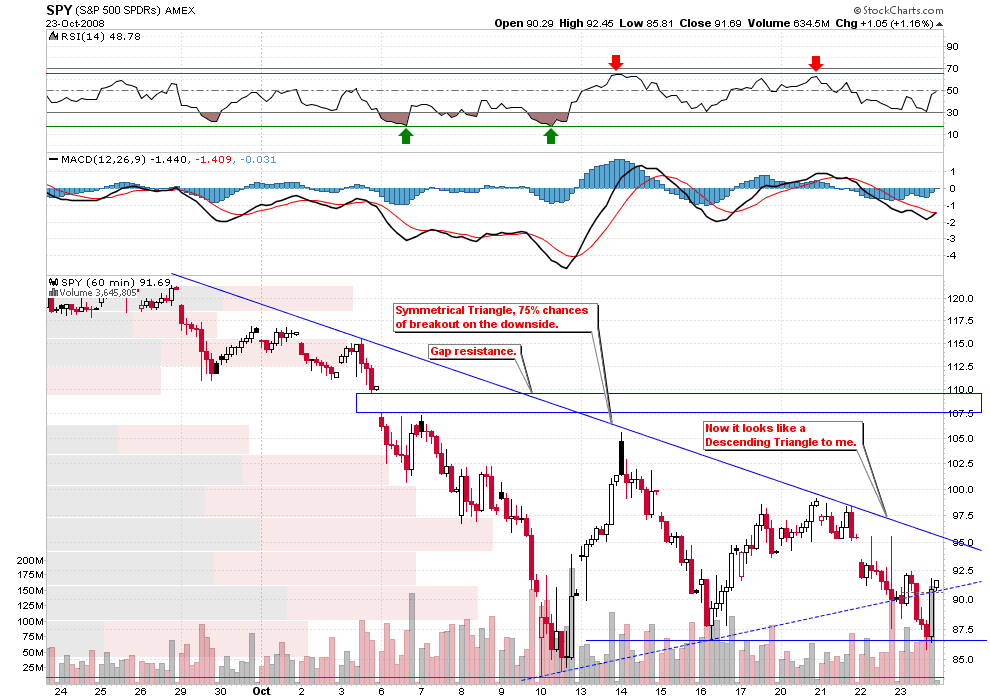
    S&P 500 SPDRs (SPY 60 min)

    The symmetrical triangle was broken today, but big money was defending and the support held. Now it looks like a descending triangle. In general, for a descending triangle the possibility of breakout at the downside is higher. Especially the market has tested the support three times, if the support is tested for the fourth time, very likely the descending triangle will not hold.
    Click to enlarge

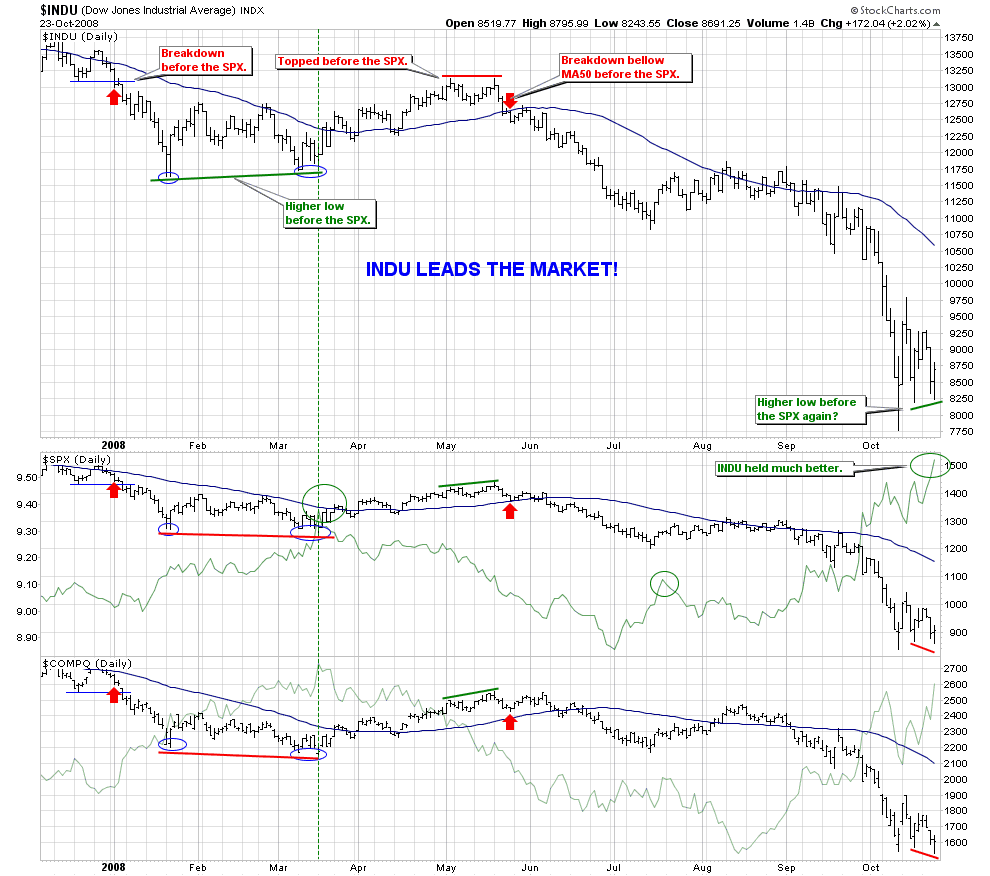
    INDU leads the Market

    What the phenomena of INDU leading the market is that INDU is always ahead of other indices to be topped or bottomed. Usually INDU breaks out first, or forms a higher low while other indices are still lower low. This phenomena can be verified in the following chart, and it works well so far. Now look at the chart, while SPX and COMPQ have broken the last Thursday low and formed lower low, INDU is still a higher low, isn't it? This is a good news.
    Click to enlarge

Related Posts :
  1. 10/23/2008 - Upgrade & Downgrade (Update 1)
  2. Bunge's Profit Fall - Fertilizer & Agriculture crash boom bang!
  3. 10/22/2008 Market Rekap - Global Panic Selling Continues
Sources :
  1. AOL Money & Finance: Asian stocks sink; Sony drops on earnings revision, October 24, 2008 04:09 pm
  2. AOL Money & Finance: Stocks end mixed as investors search for bargains, October 23, 2008 17:50 EDT
  3. Cobra's Market View: 10/23/2008 Market Recap: 3 steps to confirm trend reversal, October 23, 2008 09:33 pm
Please Note!
This is generally never true. Before buying or selling any stock you should do your own research and reach your own conclusion. See my Disclaimer on the bottom for more information.

You are welcome to republish this article, or any portion thereof.
Please, cite the actual/original source. I would be grateful if you could link back.



Stumble Upon Toolbar Add to Technorati Favorites Bookmark and Share

Denmark unexpectedly raised the benchmark lending rate by 50 bp to boost Krone

The Danish National Bank designed by Arne Jacobsen
Photo courtesy of Flickr

From Bloomberg:
    Nationalbanken lifted the rate to 5.5 percent from 5 percent, the Copenhagen-based bank said today in a statement.

    "In a climate in which the krone is under pressure, they need to react by raising rates," said Niels Roenholt, an economist at Jyske Bank A/S in Silkeborg, Denmark. "But it's worrying in that it puts the Danish economy, not least mortgage holders, under even more pressure."

    Nationalbanken's sole mandate is to keep the krone pegged to the single currency in a 2.25 percent band on either side of 7.46038 per euro. In the past seven days, the krone has weakened 0.1 percent and on Oct. 13 fell as much as 0.7 percent. The rate increase means forecasts for economic growth will have to be revised down, Roenholt said. The economy will shrink 0.2 percent this year and 1.4 percent in 2009, Deutsche Bank AG says.

    Today's move is the fourth time since February 2006 that the bank has changed rates independently of the European Central Bank. The bank last raised the rate on Oct. 7 by 0.4 of a percentage point to 5 percent.

    The move was part of a "continued intervention to support the Danish krone," the bank said in a statement.

    Denmark is one of five members of the Exchange Rate Mechanism 2 and defends the tightest spread to the euro. The bank doesn't hold scheduled meetings and changes rates in response to currency swings that threaten its target.
Related Posts :
  1. China cuts its housing lending rates and taxes
  2. Sweden guarantees $200 billion in bank loans, Oil Heads Toward $50, India Lowers Key Rate for the First Time Since 2004
  3. 10/22/2008 Market opened by fears (Update 2): Hungary raises the benchmark rate by 3% points to boost its currency
Source :
Please Note!
This is generally never true. Before buying or selling any stock you should do your own research and reach your own conclusion. See my Disclaimer on the bottom for more information.

You are welcome to republish this article, or any portion thereof.
Please, cite the actual/original source. I would be grateful if you could link back.


Stumble Upon Toolbar Add to Technorati Favorites Bookmark and Share

US Credit Crunch Hits South Korea

A rag-and-bone merchant pulls his cart in Seoul, South Korea. Large emerging nations have come under pressure in the global financial crisis as foreign investors withdraw their money (Lee Jae-Won/Reuters)

The US Economic troubles without borders since it has been spreading across the country, from Argentina, Canada, Iceland, Britain, Hungary, Ukraine, Pakistan, India and South Korea. Emerging markets around the globe have come under simultaneous pressure from the financial tsunami that started in the United States mortgage market.

South Korea is a major industrial power, whose $960 billion economy was the 13th-largest in the world last year and it differs from South Korea to Iceland in its immunity from global economic impacts. Economists have been hoping that demand from South Korea and Asian neighbors like China and India could replace some of the lost global demand from slowdowns in the United States and Europe. The biggest concern is that the global credit crisis could cripple South Korea’s banks, which rely more heavily on overseas borrowing than China’s or Japan’s.

South Korea's economy is vulnerable to Western market panic and destabilization because it is more transparent and open to foreign capital than those of neighboring Japan and China, who have so far survived the credit crisis unscathed. South Korea’s vulnerability is an indication that the global financial crisis has reached a new level.

As global credit markets have dried up, South Korean banks have scrambled to find dollars to repay maturing foreign-currency loans. Woori Bank, one of South Korea’s largest lenders, suddenly found itself unable to borrow dollars after last month’s collapse of Lehman.

Worse, foreign banks refused to roll over many existing loans, forcing Woori to repay them as they came due, also in dollars.

With the bank using as much as $280 million of precious foreign currency a week, Woori has stayed liquid by dollars loans from the government, which has pumped tens of billions into banks. the government responded by pledging more than $100 billion in loan guarantees and an infusion of $30 billion in American dollars to prop up the Korean banking system. The government said the additional liquidity should help Korean banks repay or roll over the banks’ $80 billion in foreign currency loans that will come due by June 2009.

International Banks would not lend to South Korea's Banks because of their own liquidity problems. According to the Bank of Korea, foreign investors have been leaving South Korea since subprime problems first hit last year. In the first six months of this year, net foreign direct investment in South Korea turned negative for the first time since 1980, when such figures started being kept, as foreign investors withdrew a net $886 million.

The real problem is that developing economies do not have the same access to emergency sources of foreign currency funding that the United States and a few developed countries have, and are thus left unfairly to the mercies of global financial markets.

Related Posts :
  1. Four Currency Crises: Hungary, Iceland, Pakistan, and Argentina
  2. Argentina crisis could have global impact
  3. Iceland receives $6 bln rescue package
  4. Nouriel Roubini: How to prevent contagion effects of the financial crisis in Hungary
  5. Will Hungary be the next Iceland?
Sources :
Please Note!
This is generally never true. Before buying or selling any stock you should do your own research and reach your own conclusion. See my Disclaimer on the bottom for more information.

You are welcome to republish this article, or any portion thereof.
Please, cite the actual/original source. I would be grateful if you could link back.


Stumble Upon Toolbar Add to Technorati Favorites Bookmark and Share

AIG Exceeds Loan

From The New York Times:
    The American International Group (AIG) has used $90.3 billion of a government credit line since it was bailed out last month, an amount that exceeds the size of the original loan meant to save the company.

    A.I.G. may need more than the $122.8 billion now available, its chief executive, Edward M. Liddy, said late Wednesday. A.I.G.’s latest balance was disclosed on Thursday and is up from $82.9 billion a week ago.
Related Posts :
  1. Greenspan: Incredible Testimony!
  2. Nouriel Roubini:"Panic" May Force Market Shutdown
Source :
Please Note!
This is generally never true. Before buying or selling any stock you should do your own research and reach your own conclusion. See my Disclaimer on the bottom for more information.

You are welcome to republish this article, or any portion thereof.
Please, cite the actual/original source. I would be grateful if you could link back.


Stumble Upon Toolbar Add to Technorati Favorites Bookmark and Share