Translate this page from English into :

Monday, July 28, 2008

Paul Tudor Jones Commented on Oil Bubble

Paul Tudor Jones is one of many hedge fund legends who recently did a number of short interviews on July 16, in Alpha Magazine; his comments on the energy markets were noteworthy:
    Is the price of oil high for fundamental reasons, or are hedge fund managers and Wall Street driving it up?

    It’s a very bullish supply-and-demand situation, and the peak oil theory is probably correct. But the run-up in prices is now bringing in an enormous amount of speculative, nontraditional capital such as pension funds and university endowments — principally through index products.

    Commodities have been the worst-performing asset class behind stocks, bonds and real estate for the past 200 years, but Wall Street doesn’t highlight that long history when selling commodity index instruments today. Instead, it shows a chart of the bull market of the past 12 years to rationalize why some pensioner should be long cattle futures in the derivatives markets as part of a basket.

    I am sure they were using similar logic about tulips three centuries ago. Oil is a huge mania, and it’s going to end badly. We’ve seen it play out hundreds of times over the centuries, and this is no different. It’s just the nature of a rip-roaring bull market. Fundamentals might be good for the first third or first 50 or 60 percent of a move, but the last third of a great bull market is typically a blow-off, whereas the mania runs wild and prices go parabolic.
While the rest of Wall Street counted its losses on Black Monday, 1987 market crash, Mr. Jones, at age 32, had predicted market will crash and returned 200 percent for his investors that year and drew a payday of an estimated $100 million for the year, an almost unheard-of sum at the time.

Bloomberg on June 3, wrote that Billionaire investor George Soros said the record oil prices weighing on the economy are the result of a "bubble" caused by speculation from index funds and a tight balance between supply and demand.


"The bubble is superimposed on an upward trend in oil prices that has a strong foundation in reality,'' Soros said in testimony before the Senate Committee on Commerce, Science and Transportation. "The rise in oil prices aggravates the prospects for a recession."

According to Forbes on July 16, Soros finally shorted oil at $137 a barrel and put on a long position in gold; he expects to see gold hold its ground even if oil continues to decline. In fact, the gold bug clique believes in a consistent 10-to-1 ratio for gold and oil. It holds that either gold will rise to 10 times a barrel of oil ($1,350 an ounce) or oil will fall to $96 a barrel–one-tenth the present market price of gold. Croesus was told Tuesday that statistics spanning many decades support, on average, this 10-to-1 ratio.


Related Posts :
  1. Other Short Ideas are Petrochina(PTR) and Whirlpool Corporation(WHR)
  2. Hedge Your Funds in Gold Stocks
Please Note!
This is generally never true. Before buying or selling any stock you should do your own research and reach your own conclusion. See my Disclaimer on the bottom for more information.

You are welcome to republish this article, or any portion thereof.
Please, cite the actual/original source. I would be grateful if you could link back.



Stumble Upon Toolbar Add to Technorati Favorites Bookmark and Share

Saturday, July 26, 2008

Gold’s Tight Supply, Soaring Demand Could Keep ETFs Looking Sharp

July 23, 2008 at 10:00 am by Tom Lydon

Source: http://www.etftrends.com

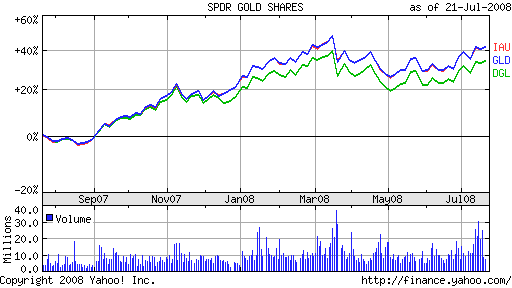
Gold bullion holdings in the world’s largest gold exchange traded fund (ETF), SPDR Gold Shares (GLD), reported a net inflow of five tons for the second quarter, making for a total of 948 tons.

The price of gold averaged $896.29 an ounce in the quarter, reports Frank Tang for Reuters, $30 below its average price in the first quarter. As the dollar strengthens, gold loses its luster and it’s seen as less of a safe haven than it is in more turbulent times.

Spot gold hit a record $1,030.80 an ounce on March 17. Yesterday, the price was $964.60.

BGF World Mining Fund Manager Evy Hambro reports for Telegraph that as uncertainty in the markets remains, gold will retain its characteristics as a hedge. The long-term outlook remains favorable, while both jewelry and investment demand should remain strong while gold mine production falls or keeps the status quo.

Hambro says that estimates are that global gold mining production will fall by 10%-15% over the next five years, in part because of a lack of success in exploration. Gold’s attractiveness as a hedge coupled with geopolitical tensions should keep the supply and demand fundamentals favorable.

  • iShares COMEX Gold Trust (IAU), up 15.5% year-to-date
  • SPDR Gold Shares (GLD), up 15.5% year-to-date
  • PowerShares DB Gold (DGL), up 13.6% year-to-date


Related Posts :
  1. Hedge Your Funds in Gold Stocks
  2. Gold May Rise to $5,000 on Inflation, Schroder Says
Please Note!
This is generally never true. Before buying or selling any stock you should do your own research and reach your own conclusion. See my Disclaimer on the bottom for more information.

You are welcome to republish this article, or any portion thereof.
Please, cite the actual/original source. I would be grateful if you could link back.


Stumble Upon Toolbar Add to Technorati Favorites Bookmark and Share

Dennis Gartman Predicts Corn Ethanol Producers Bankruptcy

FN Arena News on July 23, wrote:
    US based market trader Dennis Gartman highlighted this week a report from US FoodIndustryNews.com. It noted that VeraSun Energy, one of the country's largest ethanol producers, had delayed the opening of three new ethanol plants because of "volatility in the market". Citigroup has recently predicted that up to three-quarters of US ethanol plants would have to shut down as profits were turning to losses on the price of corn.

    Gartman also notes that a dozen or more ethanol and other bio-diesel plants have declared bankruptcy in recent months not just because of input prices, but because they can't find financing. The ramifications of the credit crunch have seeped beyond the financial sector into all corners of industry, and have not left the alternative fuel market unscathed. Moreover, the cost of building a new bio-fuel plant has skyrocketed along with everything else. Mr Jerry Taylor of the Cato Institute noted:

    "I think the ethanol industry as a whole will have to re-examine its entire financial model and determine how it can make money. Many of these [ethanol] plants never met the objectives that they were designed and built to achieve."

    It is actually a lot cheaper to make ethanol from sugar cane. Sugar, unlike corn, has not been on a one-way price trajectory. However the sugar market in the US is tightly controlled, and the government puts a US54c per gallon tariff on imported ethanol. Brazil is the world's major sugar source, and its ethanol industry has also been booming. And as corn ethanol has become ridiculously expensive, it has actually become a cheaper alternative for US oil refiners to pay the tariff and use Brazilian sugar ethanol instead.
While Darin Newsom, analyst with DTN in Omaha, on July 24, noted that the seemingly relentless drive in commodities - crude oil and corn have doubled in the past year - was built largely on robust demand for raw materials, especially in fast-growing economies in China and the Middle East.

A weakening U.S. greenback fed that demand by making dollar-denominated commodities cheaper to overseas buyers.

But with record energy prices and soaring costs for other commodities, "a lot of that demand has died out," Newsom said.

Rick Schwarck, CEO of Absolute Energy LLC, on January 8, said that the price of corn and soybeans is closely linked with the price of crude oil. “If oil goes down to $100 a barrel, ethanol goes down and plants shutter. More corn is released back into the market place and prices go down,” Schwarck says. “If it goes to $200 a barrel, plants that have gone off line would come back, demand [for corn] would go up, and the price of corn would go up.”

The Organization for Competitive Markets (OCM) on July 22, said that Monsanto's market power is driving up seed prices and devastating farmers and their communities. "Monsanto's market power has been quietly accruing over several years and has now begun materially impacting price," said Keith Mudd, OCM's board president. "The lack of competition and innovation in the marketplace has reduced farmers' choices and enabled Monsanto to raise prices unencumbered."

Even the list price on seed corn will topple the $300 per bag barrier starting this fall, up about $95 to $100 per bag, or 35 percent on average, according to Monsanto(MON) officials who met with DTN and Progressive Farmer editors this week. For 2009, 76 percent of the company's corn sales will be triple stack, 'so we think we can get the pricing right to show farmers the benefits,' John Jansen, Monsanto's corn traits lead. 'We can pass the red-faced test from the Panhandle of Texas to McLean County, Ill.'

"If and when the ethanol boom subsides, Monsanto will not lower its prices, farmers will be forced into bankruptcy, and the lack of an effective remedy for antitrust in crop seed will be a substantial cause," Said Fred Stokes, executive director, OCM.

Related Posts :

World Food Shortage and the Ethanol Bubble

Please Note!
This is generally never true. Before buying or selling any stock you should do your own research and reach your own conclusion. See my Disclaimer on the bottom for more information.

You are welcome to republish this article, or any portion thereof.
Please, cite the actual/original source. I would be grateful if you could link back.


Stumble Upon Toolbar Add to Technorati Favorites Bookmark and Share

Friday, July 25, 2008

Bank Collapse Update: $400 Billion of Writeoffs So Far, $600 Billion to Go (WM, WB, JPM, FNM, FRE)

Henry Blodget|Jul 25, 08 12:51 PM

ClusterStock.com

Picture 59.png

America's financial institutions insist they have enough capital. More and more analysts violently disagree.

For example, NYU professor Nouriel Roubini (who predicted this whole debacle), PIMCO bond guru Bill Gross, and Invesco strategist Diane Garnick all think that banks will have to write off $1 trillion of losses before the credit crash is through (and Diane and Nouriel think this is a floor).

What happens if these analysts are right and bank managers are wrong? The banks will have to take about another $600 billion of writeoffs on top of the $350+ billion they've already booked. What happens if that happens? Most of the banks will need to raise more capital, not all of them will be able to do so, and many will go bust. Even the ones that are able to raise capital, meanwhile, will dilute the hell out of current shareholders.

No wonder, then, that the stocks of Fannie Mae (FNM), Freddie Mac (FRE), Wachovia (WB), Wamu (WM), et al, have once again started marching toward zero.

Below, Nouriel Roubini and Diane Garnick discuss their apocalyptic views with me and Aaron Task on Yahoo TechTicker--views that are rapidly becoming consensus.


Related Posts :
  1. Lehman (LEH) May Sell Neuberger In Emergency Cash Raising Move
  2. WaMu Has $3.3 Billion Quarterly Loss on Rising Delinquencies
  3. Regional Banks Collapse Snow Ball Seems to Continue Rolling Downhill
  4. IndyMac Bancorp (IMB) Filling for Chapter 11 Bankruptcy
Please Note!
This is generally never true. Before buying or selling any stock you should do your own research and reach your own conclusion. See my Disclaimer on the bottom for more information.

You are welcome to republish this article, or any portion thereof.
Please, cite the actual/original source. I would be grateful if you could link back.


Stumble Upon Toolbar Add to Technorati Favorites Bookmark and Share

Lehman (LEH) May Sell Neuberger In Emergency Cash Raising Move


Bloomberg today, wrote:
    Lehman Brothers Holdings Inc(LEH). may sell at least part of its Neuberger Berman asset management unit to raise as much as $8 billion, CNBC reported, citing people it didn't name. A sale of the unit may make it difficult for Lehman, the smallest of the major Wall Street investment banks, to compete as an independent company, CNBC said. Last month, Lehman reported a $2.8 billion second-quarter loss, its first since the company went public in 1994.

Lehman Brothers Holdings Inc. acquired Neuberger Herman Inc, on July 28 2003, for about $2.63 billion. Under the terms of the agreement, Lehman Brothers will pay about $41.48 per share, consisting of $9.49 in cash and 0.496 shares of Lehman common stock.

Heidi N. Moore from Blog The Wallstreet Journal, on July 9, wrote:
    In fact, the asset-management business is Lehman’s biggest safety mechanism against the brutal markets. Consider that the asset-management business is valued at about two and a half times as much as Lehman’s investment banking business, according to one analyst’s estimates. Lehman Brothers asset management alone is worth $8 billion if it is valued the same as its peers using a multiple of 20.1 times the share price to trailing-earnings since 2000, wrote David Trone of Fox-Pitt Kelton Cochran Caronia Walker on June 13. That $8 billion is pretty considerable when you consider that all of Lehman had a market value of about $13 billion when the report was written ($11.5 billion as of Tuesday). It means the core Lehman businesses–investment banking, fixed-income and equity–was valued at only about $3 billion. Combined. (The remaining $2 billion in Trone’s valuation of Lehman comes from the high-net-worth brokerage business–the guys who sell Neuberger Berman’s funds, among others.)

    Without its asset-management business, Lehman could be scooped up for the price of a larger bank’s pocket change. So by selling Neuberger, Lehman would be signaling it wants to give up its independence and take a bargain-basement price for the rest of the firm.

    Other reasons that Lehman should keep its asset-management business? Take a look at the reasons it paid $2.6 billion for Neuberger Berman in the first place, back in 2003. At the time Lehman was looking for more stability in its earnings, which were highly dependent on the capital markets. Lehman also wanted to give its small group of high-net-worth brokers–400 at the time–a way to sell in-house funds, instead of just mutual funds founded and managed by other firms. If Lehman’s high-net-worth clients bought Lehman funds, Lehman could capture more fees.

    By many measures, Lehman’s acquisition of Neuberger fulfilled those expectations and more. Lehman, which had barely any assets under management before Neuberger, added $67 billion of assets under management through the 2003 deal. Now the Neuberger portion of Lehman Brothers Asset Management can claim about double that. Lehman Brothers Asset Management remains focused on high-net-worth individuals, which represent one of the few growing areas in the world of running money. Lehman has been adding to Neuberger through acquisitions: it acquired leveraged-loan manager Lightpoint in 2007 and is in the process of acquiring $2 billion New York money manager David J. Greene. There still is room for growth, as the brokerage house has long had its eye on overseas expansion in asset management. And, as recently as two years ago, Lehman bankers drove clients to Neuberger Berman to the tune of another $3.5 billion of assets under management, executives said at the time.
According to ClusterStock.com, Credit analysts suggest that because the unit is so profitable and is such a reliable source of income that offloading it might negatively affect Lehman's credit ratings.

Yesterday, July 24, Reuters wrote:
    Lehman, the smallest of the major Wall Street investment banks, has raised about $12 billion of capital this year to strengthen its balance sheet, sold off assets, and shaken up top management.

    The analyst said Lehman's current illiquid asset inventory of $83 billion includes residential mortgages of $24.9 billion, commercial mortgages of $29.4 billion, real-estate held for sale of $10.4 billion, non-investment grade acquisition finance facilities of $11.5 billion, and non-mortgage asset-backed securities of $6.5 billion.

    However, Lehman is able to borrow at the U.S. Federal Reserve's so-called discount window. This had not been the case in March when smaller Wall Street banking rival Bear Stearns Cos collapsed, eventually agreeing to a takeover by JPMorgan Chase & Co (JPM.N: Quote, Profile, Research).

    "Aggressive Fed moves and adequate capital cushion should help the firm weather near-term headwinds stemming from balance sheet overhang," Pinschmidt said.

Finally, I copy a part of The Financial Ninja Blog's Opinion, it may be also his conclusion:
    This is the same Lehman Brothers (LEH) that absolutely swore that they didn’t need to raise any additional capital as recently as a couple of weeks ago…

    Anyways… Selling Neuberger Berman means the following:

    1. Lehman really does need to raise capital, and lots of it.
    2. Lehman actually tried to quietly raise capital, and failed.
    3. Lehman is now left with no other option but to sell assets.
    4. Lehman will have to sell the ‘good stuff’ and keep the ‘bad stuff’.
    5. The end result will be a smaller, weaker Lehman.
    6. Therefore Lehman can’t survive as an independent entity.

    This should help put an end to the carefully orchestrated short covering rally in financials in general… Time to Go Ultra-Short, Again.

Related Posts :
  1. Lehman and Merrill Lynch Default Risk Charts
  2. Lehman Lying, Its Crush, and David Einhorn’s Winning
  3. Lehman: Death Spiral?
  4. Total Write-offs Stemming from the Credit Crisis may Total $1.3 Trillion
  5. Banks and Brokers at Greatest Risk of Default
  6. Why John Paulson Is Still Bearish On Financials [Housing Tracker]
Please Note!
This is generally never true. Before buying or selling any stock you should do your own research and reach your own conclusion. See my Disclaimer on the bottom for more information.

You are welcome to republish this article, or any portion thereof.
Please, cite the actual/original source. I would be grateful if you could link back.


Stumble Upon Toolbar Add to Technorati Favorites Bookmark and Share

Thursday, July 24, 2008

Agrium(AGU) is Temporary Oversold

Today market was panic because of negative news from the housing report and Ford Earning Release. Ford Earning Release is very important for investors as one of indicator whether US Economy is already in recession or not. Because it reflects current US industrial performance. When investors panic, they will dump everything assets they hold to save their money. As consequently, shares that have a good fundamental such as Agrium will also be sold off, it's like what occurred to many shares today, including Agrium.

Let's look at the chart below, Agu is currently oversold and I expect it will rebound in one or two days ahead. Beside Agu is currently supported by long upward trend as figured by the green line, Agu is also in a descending channel as figured by the double brown lines. I expected Agu will touch around $90 and further the rest depends on current market sentiment. It seems market will continue going lower as analysts said and Agu will follow the descending channel trend after rebound to around $90-$95.

If you are a long trader, maybe it's too late to buy Agu at this time. As Dennis Gartman said, "In Bull Markets One Can Only Be Long or Neutral, and in bear markets, one can only be short or neutral" (Dennis Gartman's Not-so-simple Rules of Trading).


While Agu's short Interest Ratio value was increasing sharply. It can be a measure of investors pessimism.

Source: Schaeffer's Investment Research, Inc.

Related Posts :
  1. The Rest of the World is Weakening Rapidly
  2. Buy Agrium (AGU) on The Dip


Please Note!

This is generally never true. Before buying or selling any asset you should do your own research and reach your own conclusion. See my Disclaimer on the bottom for more information.

You are welcome to republish this article, or any portion thereof.
Please, cite the actual/original source. I would be grateful if you could link back.


Stumble Upon Toolbar Add to Technorati Favorites Bookmark and Share